
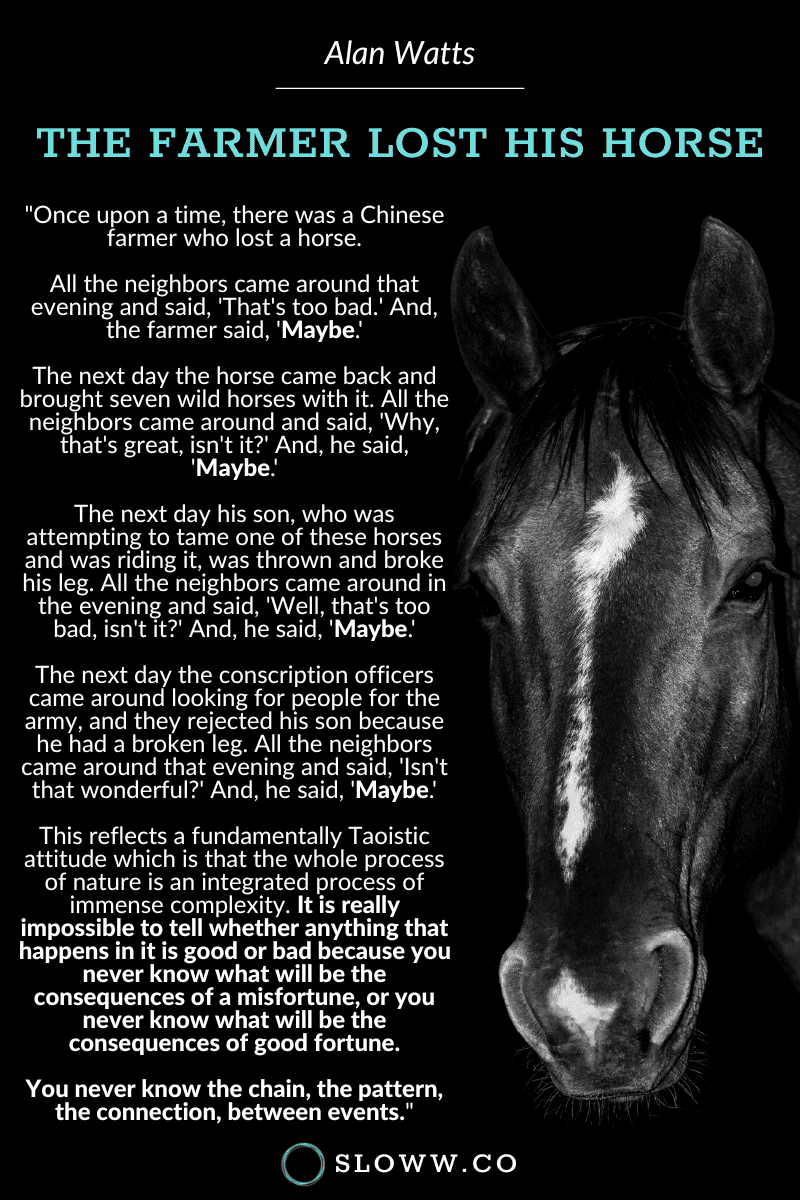
In a quiet village nestled among rolling hills, lived an old farmer with his only son. Their life was simple, marked by the rhythm of the seasons and the labor of their farm. One morning, their only horse, a creature of immense strength and value, ran away. When his neighbors came to offer condolences, they said, “What terrible luck! Your only horse is gone!” The farmer simply replied, “Maybe.”
The next day, as if summoned by the farmer’s calm acceptance, the horse returned. And not only that, it brought back a magnificent wild horse from the mountains, joining its own. The neighbors were overjoyed. “What good fortune! Now you have two horses!” they exclaimed. The farmer, with a gentle smile, responded, “Maybe.”
A week later, the farmer’s son, while trying to train the newly acquired wild horse, fell and broke his leg. The villagers gathered again, their faces etched with sympathy. “This is a terrible misfortune!” they cried. “Your son is injured, and he won’t be able to help on the farm.” The farmer, ever serene, simply said, “Maybe.”
Weeks turned into months. The son, confined to his home, spent his time reading and studying. Meanwhile, a great war broke out, and the emperor’s men came to the village, conscripting every able-bodied young man for the army. Many boys were sent to the front lines, never to be seen again. But the farmer’s son, with his broken leg, was spared. The villagers, witnessing this, came to the farmer and said, “You were right! It was good that your son was injured. We now see the blessing in his broken leg!” The farmer, looking out at the fields, simply replied, “Maybe.”
This timeless Zen story, often referred to as “The Farmer, His Horse, and the Wisdom of Maybe,” is more than just a folktale. It’s a profound lesson in perspective, teaching us to observe life’s events without immediate judgment. The farmer’s consistent “maybe” reflects a deep understanding that we rarely grasp the full implications of any single event. What appears to be good fortune can lead to unforeseen challenges, and what seems like a disaster might, in time, reveal itself as a hidden blessing.
The Farmer’s “Maybe”: Embracing Uncertainty
The farmer’s repeated utterance of “maybe” is the crux of this story’s enduring wisdom. It’s not a statement of indifference, but rather one of profound acceptance and understanding of the unpredictable nature of life. In a world that often demands immediate categorization of events as “good” or “bad,” the farmer offers a counter-narrative.
- Resisting Premature Judgment: The farmer refrains from labeling the horse’s escape as solely bad luck or the son’s injury as solely a misfortune. He understands that consequences unfold over time, and initial appearances can be deceiving. This is a valuable lesson for us all, especially when navigating the complexities of pet ownership. For instance, a dog’s destructive behavior might seem like a pure nuisance, but it could stem from underlying anxiety or boredom that, once understood and addressed, can lead to a stronger bond and a well-adjusted pet.
- Cultivating Equanimity: The farmer’s calm demeanor in the face of apparent adversity is a testament to his inner peace. He doesn’t allow external circumstances to dictate his emotional state. This equanimity allows for clearer thinking and more rational responses, rather than reactions fueled by panic or despair. When faced with a pet’s health issue, for example, a calm approach, seeking professional veterinary advice, is far more productive than succumbing to overwhelming fear.
- Recognizing Interconnectedness: The story subtly highlights how events are interconnected. The horse running away led to the acquisition of a second horse. The training of that horse led to the son’s injury. The injury, in turn, saved the son from war. This ripple effect demonstrates that outcomes are rarely isolated incidents; they are part of a larger, intricate web of cause and effect. This interconnectedness is also evident in a dog’s life. A change in diet might improve their coat, which in turn could boost their overall energy, leading to more playful interactions with the family.
Applying the “Maybe” Philosophy to Our Lives (and Our Dogs!)
The “Zen Story Farmer Horse” narrative offers a powerful framework for approaching life’s ups and downs, and this wisdom extends beautifully to our relationships with our canine companions.
Navigating the “Bad Luck” Moments with Pets
Every pet owner experiences moments that feel like pure misfortune. Your dog tears up the sofa, has an accident on the new rug, or barks incessantly at the mail carrier. In these moments, it’s easy to fall into a cycle of frustration and punishment. However, channeling the farmer’s “maybe” can shift our perspective.
- Destructive Chewing: Instead of seeing a ruined sofa as “bad luck,” consider it a “maybe.” Maybe your dog is bored. Maybe they have teething discomfort. Maybe they need more exercise. This perspective encourages problem-solving—providing appropriate chew toys, increasing playtime, or engaging in puzzle feeders—rather than just reacting to the damage.
- House-Soiling Accidents: A mess on the floor can be disheartening. But the “maybe” approach prompts us to ask: Maybe the dog isn’t feeling well. Maybe their signal to go outside was missed. Maybe there’s a new stressor in their environment. This leads to a more compassionate and effective response, such as a vet check-up or reinforcing potty training.
- Excessive Barking: The constant barking can be maddening. But maybe the dog is alerting you to something. Maybe they are seeking attention. Maybe they are anxious about a particular stimulus. Understanding these “maybes” can lead to training solutions that address the root cause, rather than simply trying to suppress the noise.
Embracing the “Good Fortune” with Gratitude (and Awareness)
Similarly, when positive events occur with our pets, the “maybe” reminds us to temper our immediate elation with a touch of awareness. A new puppy joins the family, a dog masters a difficult trick, or a senior dog enjoys a day of remarkable health. These are joyous occasions, but the “maybe” encourages us to remain grounded.
- A New Puppy: The arrival of a puppy is incredibly exciting. However, the “maybe” prompts us to remember the significant commitment involved—the training, the vet visits, the potential for chewed slippers. This isn’t to dampen joy, but to foster preparedness and realistic expectations.
- Training Successes: When your dog finally performs a complex command, it’s a moment of triumph. The “maybe” reminds us that consistent reinforcement and understanding of the dog’s learning process were key. It encourages us to continue this positive approach, rather than assuming the dog has suddenly become a perfect obedience machine.
- Unexpected Health: Seeing an elderly dog have a burst of youthful energy can be heartwarming. The “maybe” encourages us to cherish these moments while also being mindful of their age and potential health vulnerabilities, ensuring they are comfortable and well-cared for.
The Enduring Power of Acceptance
The story of the farmer, his horse, and his son is a parable that transcends time and culture. Its central message—that life is a series of unfolding events, many of which are beyond our immediate control or comprehension—resonates deeply. The farmer’s “maybe” is not an excuse for inaction, but a call for mindful observation, patient acceptance, and a release from the burden of needing to understand everything immediately.
In our modern, fast-paced world, where we are constantly bombarded with information and encouraged to seek immediate answers, the farmer’s simple yet profound wisdom offers a much-needed antidote. It teaches us to pause, to observe, and to trust in the unfolding of life, even when the path ahead is unclear. When it comes to our beloved dogs, applying this philosophy can lead to a more peaceful, understanding, and ultimately, a more rewarding relationship. We learn to appreciate the journey, with all its unexpected twists and turns, finding a quiet strength in the simple, powerful wisdom of “maybe.”
Frequently Asked Questions About Zen Stories and Pet Philosophy
Q1: What is the main moral of the “Farmer and His Horse” story?
A1: The main moral is to avoid making quick judgments about events, as what appears to be good fortune can lead to bad, and vice versa. It emphasizes acceptance of uncertainty and the interconnectedness of life’s events.
Q2: How can the farmer’s “maybe” philosophy help with training a difficult dog?
A2: Instead of getting frustrated by a dog’s slow progress or perceived stubbornness, the “maybe” approach encourages patience. It prompts us to consider maybe the training method isn’t right for this individual dog, maybe they are stressed, or maybe they need more positive reinforcement, leading to a more adaptive and compassionate training strategy.
Q3: Does the “zen story farmer horse” imply we should be passive about problems?
A3: Not at all. The “maybe” is about refraining from judgment and despair, not about inaction. The farmer still worked his farm and cared for his animals. The philosophy encourages thoughtful action based on observation rather than panicked reaction to initial appearances.
Q4: Can this story apply to other pets besides dogs?
A4: Absolutely. The core message of accepting life’s uncertainties and avoiding snap judgments is universal. Whether it’s a cat’s aloofness, a rabbit’s sudden skittishness, or a bird’s change in behavior, the “maybe” approach encourages observation and understanding rather than immediate negative labeling.
Q5: Where does the “zen story farmer horse” originate from?
A5: This parable is widely attributed to ancient Chinese philosophy, often associated with Taoist principles, emphasizing living in harmony with the natural flow of life and accepting change without resistance.
Q6: How can embracing “maybe” reduce stress for pet owners?
A6: By releasing the need to control every outcome and judging every event as strictly good or bad, pet owners can significantly reduce their stress. It allows for greater acceptance of imperfections in their pets and the training process, fostering a more relaxed and enjoyable bond.
Q7: What is the significance of the horse in the story?
A7: The horse is a valuable asset, representing worldly wealth and practical utility. Its disappearance and reappearance serve as catalysts for the unfolding of events, illustrating how changes in our “assets” (whether material, physical, or emotional) can have unforeseen ripple effects.
In conclusion, the tale of the farmer, his horse, and the wisdom of “maybe” offers a profound perspective on navigating life’s unpredictable currents. By embracing uncertainty and refraining from hasty judgments, we can foster a more balanced, resilient, and compassionate approach to all aspects of our lives, including our cherished relationships with our dogs. The farmer’s simple “maybe” is a powerful reminder that understanding often comes with time, patience, and an open heart.
