
Working with young horses is an exhilarating part of a rider’s journey, but it can also present challenges, particularly when it comes to finding engaging exercises. Riders without access to more experienced horses may feel limited to basic trot and canter work. However, there are numerous playful approaches to training young equines. This article explores five fun and effective flatwork exercises suitable for young horses, designed to build a solid foundation.
The FEI’s training scale serves as an excellent guide for riders, not just judges. It helps in establishing and ordering training priorities. For young horses, focusing on the initial three steps of the scale is crucial for building fundamental basics: Rhythm, Suppleness, and Connection.
- Rhythm: This involves ensuring the horse maintains consistent and correct limb timing within each gait. A horse with good impulsion should move forward with controllable direction in all three gaits.
- Suppleness and Relaxation: The rider should aim for a horse that is relaxed and moves freely, both in the mouth and throughout the body.
- Connection: This stage is achieved when the horse is “on the bit,” with a soft mouth that accepts contact. The neck should be well-oriented, and the horse should be able to engage in lateral work.
The following exercises are designed to help young horses progress through these foundational stages.
The Bow Tie 🎀
A refreshing alternative to traditional figures, the Bow Tie exercise is ideal for young horses learning to master directional changes. Begin with poles set wide apart, gradually narrowing the distance as the horse becomes more comfortable. This exercise can be performed at both a walk and a trot.
Objective: Encourage the horse to maintain its gait, rhythm, and cadence through directional changes, performing symmetrical loops with increasing relaxation and balance. As your horse progresses, you can vary the size of the loops and the amplitude of the horse’s movement to enhance the exercise’s completeness.
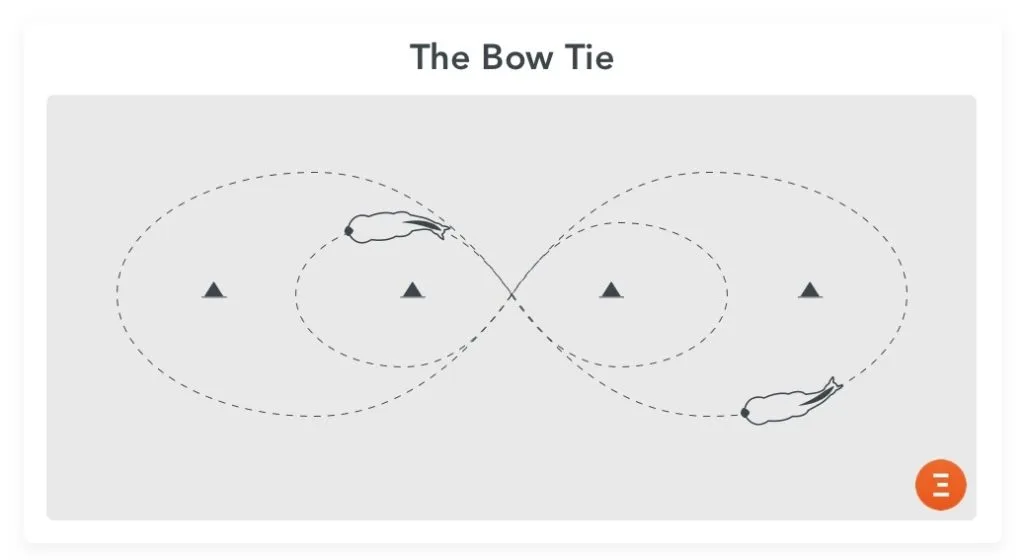 The Bow Tie, an fun exercise for young horses
The Bus Stop 🚌
This exercise is excellent for practicing gait transitions. Set up four “transition zones” on the arena track, marked by poles or cones, typically placed near the corners. The goal is to execute transitions between gaits (halt, walk, trot, canter) within each designated zone. Initially, you might circle between transitions to regain a steady cadence.
Objective: Successfully perform four transitions per lap with a calm and relaxed horse. As the horse improves, eliminate the circles, bring the transitions closer together, and introduce variations. You can also incorporate extensions between transitions for added challenge.
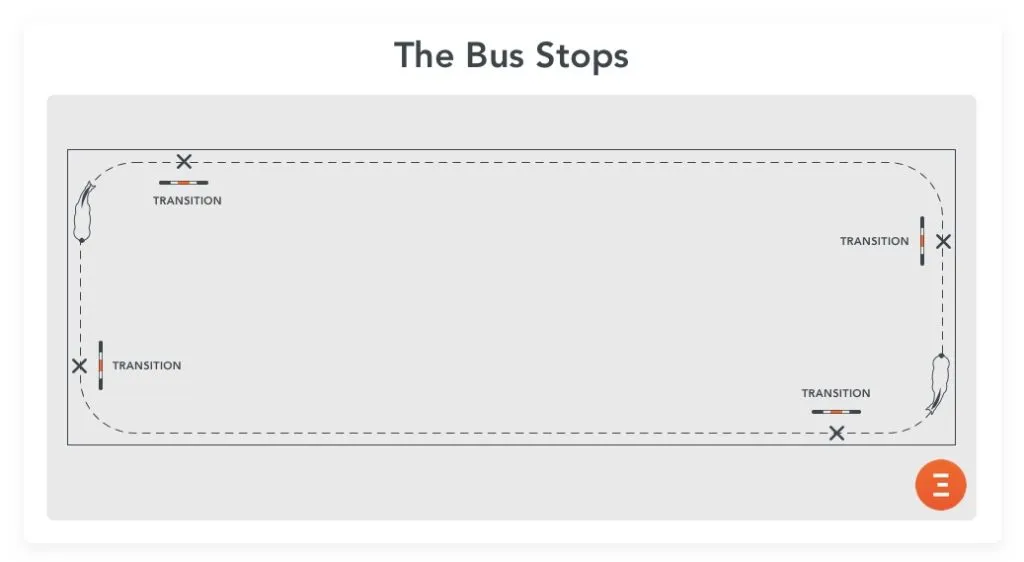 The Bus Stops, an fun exercise for young horses
💡 More to read: For a deeper understanding of equine well-being, explore The Purpose of Equine Osteopathy.
The Garland
The Garland exercise effectively combines directional work with transitions, making it suitable once transitions are well-established. Set up a series of gates on the track using poles or cones. At each gate, perform a gait transition, immediately followed by a circle of varying diameter (10m, 12m, 15m, or 20m).
Objective: Execute increasingly precise transitions followed by well-defined circles of anticipated diameters. The horse should remain relaxed, supple, maintain soft and even contact, and be balanced throughout the circles. Progress by moving the exercise to the centerline and alternating circles to the right and left.
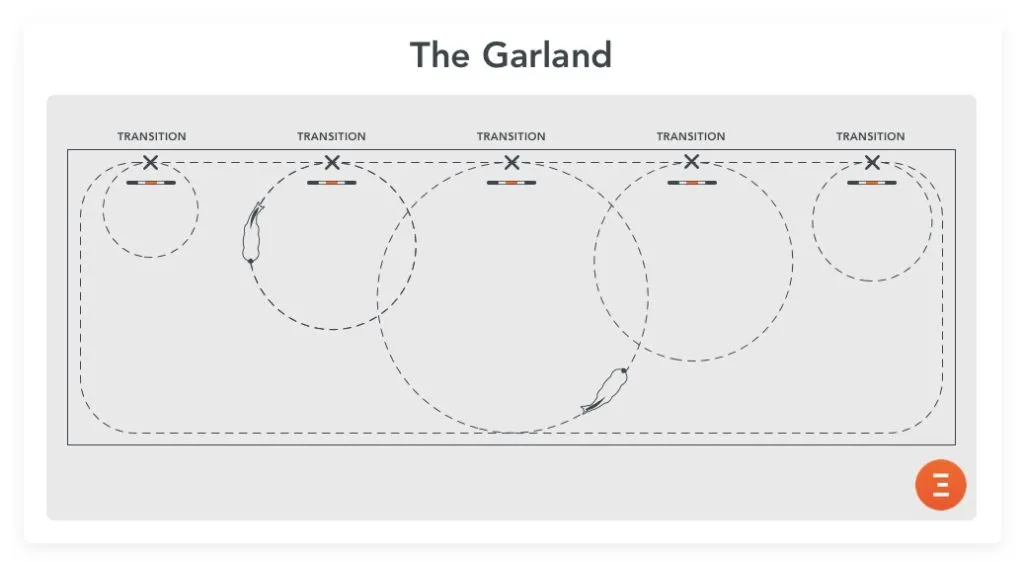 The Garland, an fun exercise for young horses
The Figure Eight With Ground Poles
This exercise provides a gentle introduction to ground poles. Incorporating them into a figure eight allows for easy control of cadence during the circular parts. Start with one or two poles and gradually increase the number as the horse gains confidence. Begin at a trot, progressing to more poles as the horse becomes comfortable.
Objective: Achieve a smooth passage over the ground poles without significant changes in cadence or posture. The horse should remain relaxed with a soft contact and a natural, yet supple, frame. To advance, progressively add more poles, adjust spacing, and even slightly raise them for a comprehensive conditioning exercise.
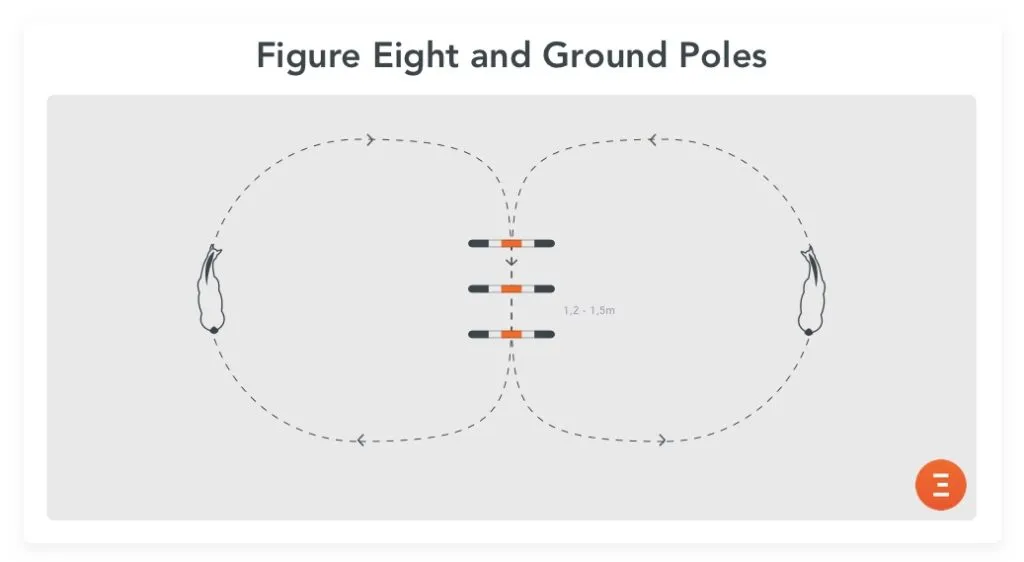 Figure 8 and ground poles, an fun exercise for young horses
Linking Lines Together
This exercise, while simple in concept, can be more challenging for young horses at a canter and should only be attempted once the initial stages of the training scale are well-acquired. Arrange three sets of poles in a “Y” formation. Begin on the base lane, then move to one of the side lanes, complete a 180-degree turn, and return to the base lane. Repeat on the other side. Start at a trot, and as proficiency grows, transition to cantering on the approach and then transitioning to trot for the curve.
Objective: Develop a horse that can confidently link two lanes in a curved line at both trot and canter without rushing. Mastering the canter-to-trot transition is key, ensuring the horse remains calm and finishes the exercise in a relaxed manner. This exercise is also beneficial for approaching counter-canter curves once the horse has developed better balance.
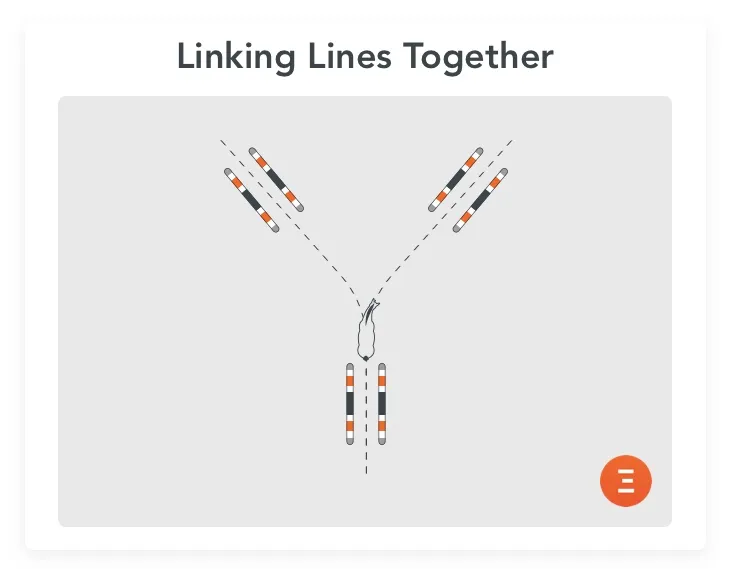 Linking lines together, an fun exercise for young horses
The foundational work with young horses is paramount for their future equestrian careers. It’s essential to embrace each training stage, rather than rushing through basic exercises due to rider boredom.
📲 For a wealth of additional exercises and training resources, explore the Equisense mobile app, featuring over 300 free exercises.
Camille Saute
Biomechanics and Biomedical Engineer
Co-founder of Equisense
