
Of all the legendary objects that populate our myths and histories, few capture the imagination quite like the wooden horse. These iconic figures are more than just carved timber; they are vessels of cunning strategy, symbols of childhood innocence, and carriers of profound narrative weight. The most famous of all Wooden Horse Stories is, of course, the tale of Troy, but the legacy of these silent, sturdy creatures extends far beyond the ancient battlefield into literature, folklore, and the very heart of our homes. This deep dive into legendary tales reminds us of other great narratives, much like the classic horses story, which also captivate our imagination. We will journey through the epic sagas and quiet nursery tales that have cemented the wooden horse as an enduring cultural icon.
The Ultimate Tale: The Story of the Trojan Horse
When one thinks of wooden horse stories, the mind immediately travels to the windswept plains of Anatolia and the besieged city of Troy. This ancient tale of warfare, deception, and divine intervention stands as the cornerstone of the genre, a masterclass in psychological warfare that has been retold for millennia.
The Legend’s Origins in Epic Poetry
The story isn’t fully detailed in Homer’s Iliad, which focuses on the final weeks of the ten-year Trojan War. Instead, the most complete account comes from the Roman poet Virgil in his epic, the Aeneid. The tale is recounted by Aeneas, a Trojan hero who escaped the city’s fall. Homer’s Odyssey also references the event, with characters recalling the ingenious stratagem that finally brought the mighty city to its knees. These texts form the literary foundation of the most dramatic siege in Western literature.
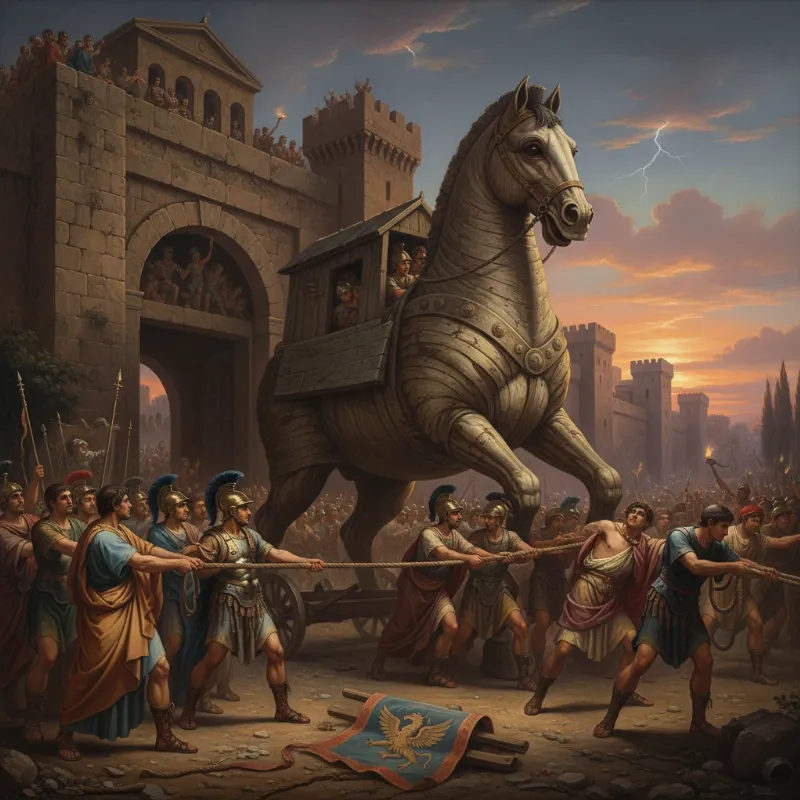 An artistic depiction of the Trojan Horse being brought into the city of Troy, a classic example of wooden horse stories.
A Cunning Plan: Odysseus’s Masterstroke
After a decade of fruitless war, the Greeks were at a stalemate. The walls of Troy were impenetrable. It was then that the clever Greek hero Odysseus conceived of a brilliant and devious plan. The Greeks would pretend to sail away in defeat, leaving behind a magnificent offering for the gods: a colossal wooden horse.
The Trojans awoke to find the Greek camp deserted and this strange, massive statue on the beach. While they debated its meaning, a Greek spy named Sinon was “captured” and brought before the Trojan king, Priam. Sinon spun a tale of Greek infighting and claimed the horse was an offering to the goddess Athena, built to an immense size specifically so the Trojans could not bring it into their city. If they did, he claimed, the city would become invincible. Despite the dire warnings of the priest Laocoön, who famously declared, “I fear the Greeks, even when bearing gifts,” the Trojans were convinced. They tore down a section of their own impassable walls and wheeled the giant horse inside, sealing their fate. That night, as the city celebrated its apparent victory, Odysseus and his elite soldiers crept out from the horse’s hollow belly, opened the city gates for the returned Greek army, and unleashed a night of utter destruction. This strategy has become the most famous of all wooden horse stories, a timeless lesson in looking beyond appearances.
Was the Trojan Horse Real?
For centuries, scholars and historians have debated whether the Trojan Horse was a real historical artifact or a purely metaphorical device. There is no definitive archaeological evidence of a giant wooden horse. However, the city of Troy itself was discovered in the 19th century, proving that the setting for Homer’s epic was a real place. The question of is the story of the trojan horse real continues to fascinate historians and archaeologists alike. Many experts suggest the “horse” may have been a metaphor for something else entirely.
According to Dr. Armand D’Angour, a classical scholar at Oxford University, “The most plausible theory is that the Trojan Horse was actually a battering ram. Ancient Assyrian siege engines were often draped in damp horse hides to protect them from flaming arrows and were sometimes named after animals.”
This theory suggests that the myth evolved from the reality of a powerful siege weapon that breached Troy’s famous walls, transforming over time into the more fantastical story we know today.
More Than a Myth: Other Famous Wooden Horse Stories
While the Trojan Horse dominates the landscape, it is not the only tale where a wooden horse plays a pivotal role. Across literature and film, these figures reappear, often carrying complex themes of ambition, magic, and the boundary between the inanimate and the living.
The Rocking-Horse Winner: A Tale of Luck and Tragedy
D.H. Lawrence’s 1926 short story, “The Rocking-Horse Winner,” presents a much darker take on the wooden horse. In this haunting tale, a young boy named Paul becomes obsessed with his rocking horse, riding it furiously in the belief that it can predict the winners of actual horse races. He sees it as a way to win the love of his money-obsessed mother. The horse, a simple nursery toy, becomes a conduit for a terrifying, supernatural gift. Paul’s frantic rides do yield the winning names, but the effort drains his life force, culminating in a tragic end. Here, the wooden horse is not a symbol of victory or childhood joy, but a vehicle for destructive obsession. This poignant narrative is a powerful example of a rocking horse short story that explores much darker themes.
From Puppet to Person: The Magic of Wooden Toys
The theme of wooden creations coming to life is a staple of children’s literature, most famously in Carlo Collodi’s The Adventures of Pinocchio. While not a horse, the story of the wooden puppet who dreams of becoming a real boy shares a common ancestry. It taps into the universal childhood fantasy of toys having a secret life of their own. This idea explores the love and imagination a child pours into an inanimate object, giving it a soul. This concept is mirrored in many modern stories, influencing even beloved characters like Bullseye, the trusty steed in the Toy Story films, a character that feels as alive as any other. The idea of a toy horse being a loyal friend is a recurring theme, not unlike the familiar horse off of toy story.
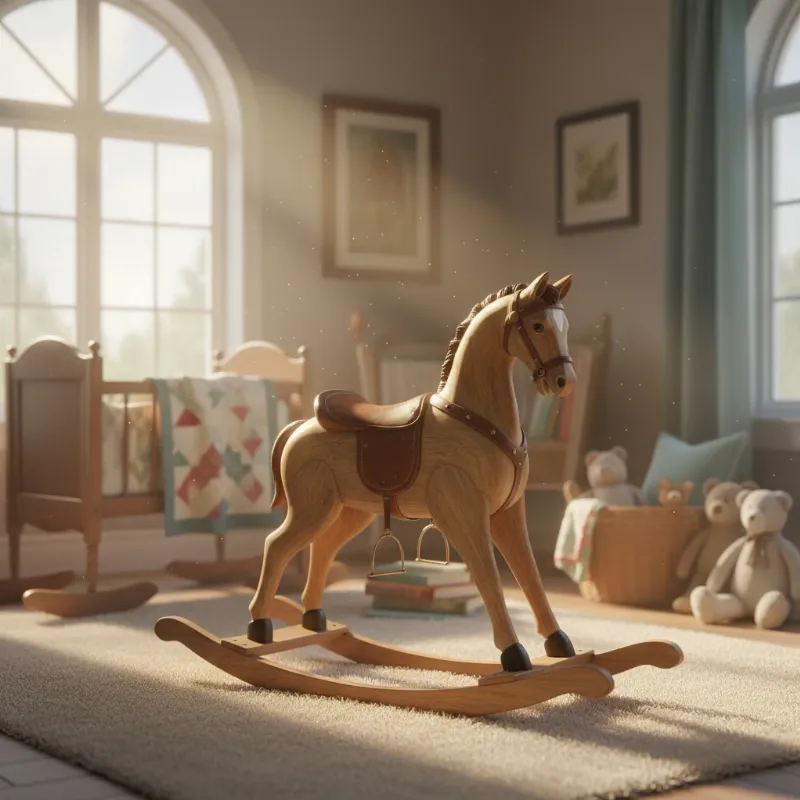 A classic wooden rocking horse in a sunlit nursery, symbolizing timeless wooden horse stories and childhood innocence.
The Enduring Charm of the Wooden Horse Toy
Beyond epic battles and tragic tales, the wooden horse holds a special place as a beloved toy. From simple pull-along horses to elaborate, hand-carved rocking horses, these toys have been a staple of nurseries for centuries. Their appeal lies in their simplicity and the boundless imagination they inspire.
A wooden horse doesn’t have flashing lights or programmed sounds; it requires a child to provide the movement, the story, and the voice. It’s a blank canvas for adventure. A rocking horse in a bedroom can become a noble steed charging into battle, a trusty companion exploring the Wild West, or a Pegasus soaring through the clouds. This timeless quality is why, even in an age of digital entertainment, the wooden horse endures as a symbol of pure, unadulterated play. It connects generations, a toy that a grandparent remembers fondly and a grandchild can enjoy just as much today. To understand its place in our shared narrative, it helps to explore the story of trojan horse and see how myth shapes even our simplest toys.
What Do Wooden Horses Symbolize?
The symbolism of the wooden horse is rich and multifaceted, changing dramatically depending on the context of the story.
- Deception and Hidden Danger: Thanks to the Trojan War, the primary symbolism is that of a “Trojan horse”—a gift that carries a hidden threat. In modern language, the term refers to malicious software disguised as a legitimate file.
- Childhood and Innocence: The rocking horse represents the opposite. It symbolizes the safety, imagination, and simplicity of childhood. It is a source of comfort and a catalyst for countless adventures within the four walls of a playroom.
- Potential and Magic: In stories like “The Rocking-Horse Winner,” the wooden horse symbolizes untapped potential and the mysterious forces that lie just beyond our understanding. It becomes a bridge between the mundane and the magical.
- Endurance and Timelessness: As a physical object, often passed down through families, the wooden horse symbolizes craftsmanship, durability, and the enduring power of classic toys and stories that never go out of style.
Frequently Asked Questions about Wooden Horse Stories
What is the most famous wooden horse story?
The most famous story is undoubtedly that of the Trojan Horse. This tale from Greek mythology describes how the Greeks captured the city of Troy by hiding soldiers inside a giant wooden horse, which the Trojans brought into their city as a supposed victory trophy.
Who came up with the idea for the Trojan Horse?
In the traditional narrative, the cunning Greek hero Odysseus is credited with conceiving the plan for the Trojan Horse. His intelligence and strategic mind were key to breaking the ten-year stalemate of the Trojan War.
Is there a moral to the story of the Trojan Horse?
Yes, the story carries several morals that have resonated through the ages. The most famous is to “beware of Greeks bearing gifts,” which serves as a timeless warning against accepting things from an enemy that appear too good to be true. It also highlights the power of ingenuity over brute force.
Why are rocking horses so popular in stories and as toys?
Rocking horses are popular because they symbolize childhood, innocence, and the power of imagination. As a toy, they provide rhythmic, soothing motion while allowing a child to feel a sense of freedom and adventure, making them a powerful and enduring motif in literature and real life.
Are there any other significant wooden horse stories in mythology?
While the Trojan Horse is the most prominent in Western mythology, horse figures are significant across many cultures. In Norse mythology, Odin’s eight-legged steed, Sleipnir, was not wooden, but the idea of a mythical horse with extraordinary properties is a common theme. Many folk tales feature enchanted wooden toys, continuing the tradition of inanimate objects playing magical roles.
The Unending Gallop of a Timeless Tale
From the blood-soaked beaches of Troy to the quiet, sunlit corner of a child’s bedroom, wooden horse stories continue to captivate us. They serve as a powerful reminder that the most compelling narratives are often contained within simple, symbolic objects. Whether as a vessel of devastating deception or a catalyst for imaginative play, the wooden horse gallops through our collective consciousness, a silent testament to the enduring power of a good story. Its legacy is one of duality—of war and peace, of cunning and innocence, of a history that informs the very toys we give our children.
