
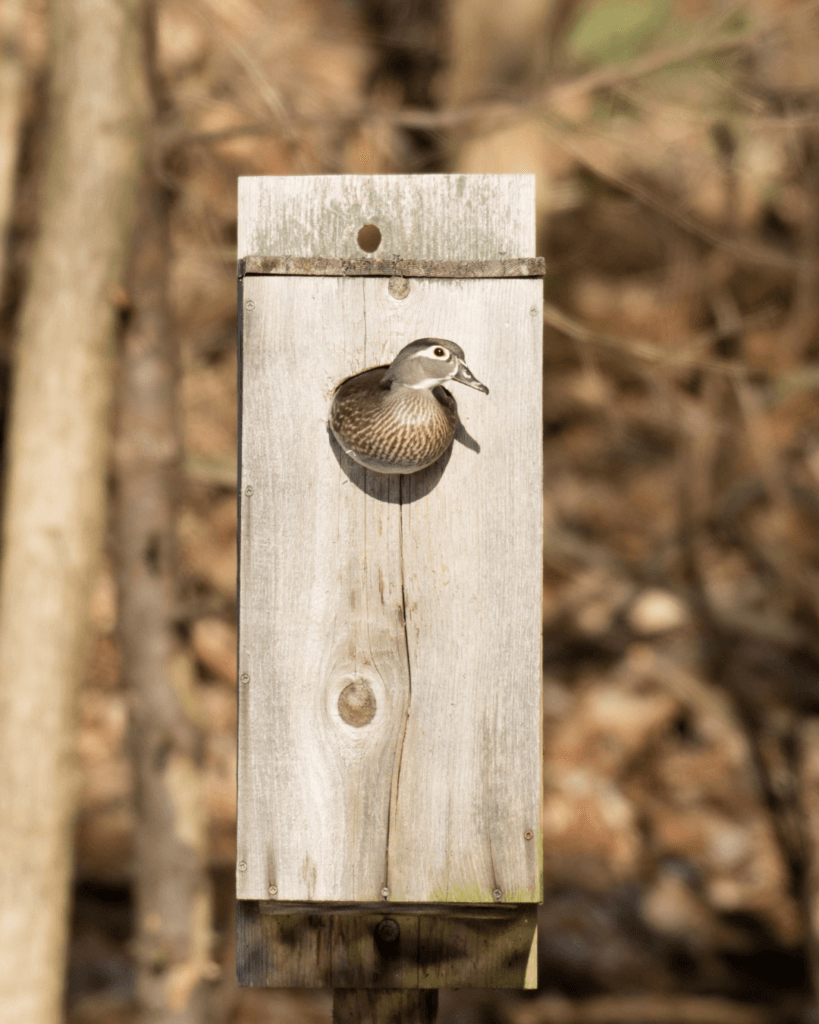
Wood Ducks are fascinating waterfowl that inhabit a variety of wetland environments. These visually striking birds thrive in bottomland forests, swamps, freshwater marshes, and beaver ponds, frequently being observed along streams of all sizes. Their ideal habitat often features a balance of open water and dense vegetative cover, which they utilize for both hiding and foraging. This cover can include fallen trees, shrubs, and emergent plants, creating a rich ecosystem for these ducks.
Diet and Foraging Habits
The diet of the Wood Duck is diverse, consisting of seeds, fruits, insects, and other arthropods. While aquatic foods are a staple, they are adaptable and will forage on dry land for acorns, nuts, and grains when necessary. Plant materials constitute the majority of their diet, often exceeding 80%. Their menu includes items like acorns, soybeans, various smartweeds, water primrose, panic grass, duckweed, millet, waterlilies, blackberries, and wild cherries. Complementing this plant-based diet, they also consume a variety of invertebrates such as flies, beetles, caterpillars, isopods, and snails. Wood Ducks are known to feed by dabbling on the water’s surface or engaging in short, shallow dives to access food sources.
Nesting Preferences and Behaviors
Wood Ducks are cavity nesters, meaning they rely on pre-existing holes in trees or artificial nest boxes for their nests. Breeding pairs diligently search for suitable cavities, with the male often observing as the female inspects potential sites. They typically favor trees with a diameter of at least one foot, and often two feet, with cavities located anywhere from 2 to 60 feet above the ground, with higher sites seeming to be preferred. These natural cavities often form where a branch has broken off, leading to the rot of the tree’s heartwood. While they can utilize woodpecker cavities, Wood Ducks are unable to excavate their own nesting sites. The nest tree is usually situated close to or directly over water, although they have been known to use cavities up to 1.2 miles away from water sources.
The nest opening itself can be as small as 4 inches across, which may offer protection from predators, though they are also known to use much larger openings. The depth of the cavities varies, averaging around 2 feet, but can extend up to 15 feet in rotten trees, which is not an issue as the young possess clawed feet enabling them to climb out. Artificial nest boxes have proven to be highly successful for Wood Ducks, though care must be taken with plastic designs as they can overheat in intense sunlight. Once a suitable nest site is chosen, the female diligently lines it with down feathers plucked from her own breast.
A female Wood Duck typically lays between 6 to 16 eggs, which are glossy and range in color from creamy white to tan. The incubation period lasts from 28 to 37 days. Once hatched, the chicks are alert and covered in down. They are remarkably self-sufficient, leaving the nest by jumping out of the entrance hole just a day after hatching. Wood Ducks generally raise one to two broods per year, with the nestling period lasting between 56 to 70 days.
A fascinating aspect of Wood Duck behavior is “intraspecific brood parasitism,” commonly known as egg-dumping. This occurs when females deposit eggs into the nests of other Wood Ducks, leaving them to be raised by another female. This behavior may be exacerbated by the widespread availability of artificial nest boxes. In some regions, egg-dumping is observed in over half of all nests, with individual clutches sometimes containing up to 29 eggs due to this phenomenon.
Conservation Status and Efforts
The Wood Duck population has shown positive trends, with numbers increasing between 1966 and 2019 according to the North American Breeding Bird Survey. Their global breeding population is estimated at 4.6 million, and they are considered a species of low conservation concern. This recovery is particularly noteworthy given the dramatic declines experienced due to hunting in the late 19th century. Despite their current robust numbers, Wood Ducks are second only to Mallards in the number of ducks hunted annually.
As cavity nesters, their reliance on dead trees, which are often in short supply, presents a potential challenge. To support their populations, providing predator-resistant nest boxes near ponds has been shown to have a positive impact on their growth.
References
- Hepp, Gary R. and Frank C. Bellrose. (2013). Wood Duck (Aix sponsa), version 2.0. In The Birds of North America (P. G. Rodewald, editor). Cornell Lab of Ornithology, Ithaca, New York, USA.
- Lutmerding, J. A. and A. S. Love. (2020). Longevity records of North American birds. Version 2020. Patuxent Wildlife Research Center, Bird Banding Laboratory 2020.
- Partners in Flight. (2020). Avian Conservation Assessment Database, version 2020.
- Sauer, J. R., D. K. Niven, J. E. Hines, D. J. Ziolkowski Jr., K. L. Pardieck, J. E. Fallon, and W. A. Link (2019). The North American Breeding Bird Survey, Results and Analysis 1966–2019. Version 2.07.2019. USGS Patuxent Wildlife Research Center, Laurel, MD, USA.
- Sibley, D. A. (2014). The Sibley Guide to Birds, second edition. Alfred A. Knopf, New York, NY, USA.
Learn more at Birds of the World.
