
Black and white cats, often referred to as bicolored or piebald cats, are a common and beloved sight in households worldwide. While black is the most prevalent feline coat color, the striking contrast of black and white fur patterns can offer fascinating insights into a cat’s genetic makeup. These captivating patterns are not exclusive to any single breed and can be found in numerous cat breeds as well as in domestic mixed breeds.
The genetic influence behind these distinct patterns is rooted in the inheritance of the “white spotting gene.” This gene, being incompletely dominant, leads to a variety of expressions depending on the combination of dominant and recessive alleles a cat inherits from its parents. Experts have developed grading systems, such as the white spotting scale and the Cat Fanciers Association’s 1-10 scale, to help classify the extent and distribution of white fur, ranging from minimal low-grade spotting to high-grade patterns where white fur covers a significant portion of the body. It’s important to note that while these scales provide a framework, the precise presentation of bicolor patterns can vary.
Many popular cat breeds, including the Turkish Van, British Shorthair, American Shorthair, Manx, and Turkish Angora, feature bicolor coat patterns within their breed standards. Whether found in a purebred or a mixed breed, these black and white cats offer a unique charm.
Common Black and White Cat Coat Patterns
While predicting the exact coat pattern of an unborn kitten is impossible due to the interplay of various genes, several common black and white patterns have been identified. These classifications help in appreciating the diversity within bicolor cats.
Locket Pattern
Considered a low-grade pattern on the white spotting scale, cats with a locket pattern display a small, isolated patch of white fur. This distinct marking, often found on the chest, can appear as a spot, patch, or a thin streak, resembling a locket necklace. Occasionally, a small white marking on the stomach may also qualify a cat for this classification.
Tuxedo Pattern
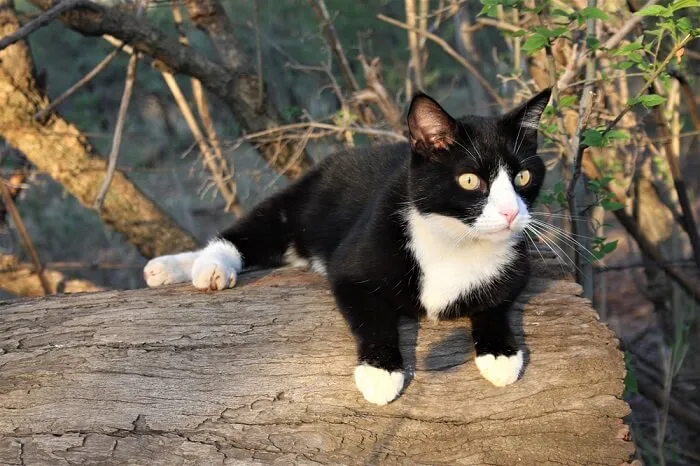 Tuxedo catBettina Calder / Shutterstock.com
The tuxedo pattern is perhaps the most iconic and sought-after black and white coat pattern. These cats appear as if they are dressed in formal wear, with white fur adorning their chest, belly, and paws, sometimes extending to the face. It’s worth noting that the tuxedo pattern isn’t exclusive to black and white cats; it can also be seen in gray and white, or even tabby cats, showcasing its versatility in feline fashion. When identifying a tuxedo cat, the key characteristic is the distinct division of colors resembling formal attire.
True Bicolor Pattern
Often used as an umbrella term, “bicolor” in its truest sense refers to a cat with an equal distribution of white fur and another primary color, typically black. These cats fall into the medium-grade category of the white spotting scale. The contrasting colors are usually present in distinct patches, spread evenly across the cat’s body, creating a balanced and striking appearance.
Harlequin Pattern
The harlequin pattern is characterized by a white coat generously speckled with smaller, randomly distributed spots and patches of color. Sometimes likened to a cow cat or even a Dalmatian, these cats lack the uniform stripes of a tabby or the distinct sections of a tuxedo cat. The irregular distribution of color patches across the predominantly white coat gives them a unique, spotted appearance.
Mask and Mantle Pattern
This pattern creates the illusion that the cat is adorned for a masquerade ball. A “mask” refers to dark or colored fur surrounding the eyes, ears, and forehead, while white fur typically extends from the nose down the chin, neck, and chest. Some cats also exhibit a “mantle,” which resembles a colored cape draped over their shoulders and torso. A cat can display either a mask, a mantle, or both, contributing to their distinctive look.
Cap and Saddle Pattern
Similar to the mask and mantle, the cap and saddle patterns involve distinct patches of color. A “cap” is a patch of colored fur situated above the eyes, whereas a “saddle” is a smaller patch of color located on the back, reminiscent of a saddle. These patterns are less extensive than a full mantle and create specific, localized color distributions on the cat’s head and body.
Exploring Other Black and White Coat Variations
Beyond these common patterns, the world of feline genetics allows for rarer and more unique black and white coat variations. The van coat pattern, predominantly seen in Turkish Van cats or those with Turkish Van lineage, is characterized by a mostly white body with small, isolated patches of color on the head and a fully colored tail. Another unique variation is the “skunk” pattern, identified by a white stripe running down the cat’s spine.
Interestingly, certain health conditions can also influence coat patterns. Vitiligo, for instance, is a condition that causes a loss of pigmentation, often resulting in white patches appearing on the feet and face of affected cats. These variations highlight the complex and fascinating world of cat coat genetics.
