
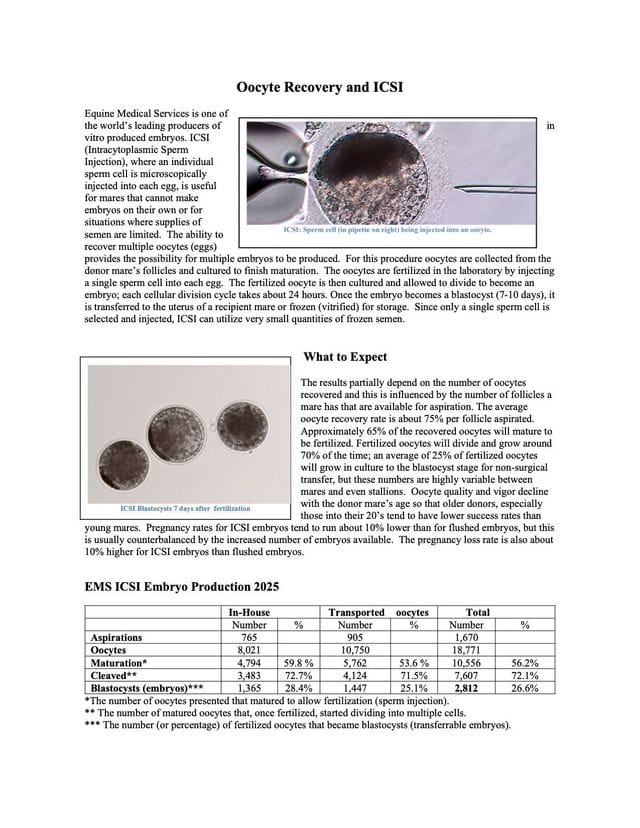
Intracytoplasmic sperm injection (ICSI) has revolutionized equine reproduction, offering a powerful tool for extending the reproductive life of both mares and stallions and preserving valuable genetics. Developed over 20 years ago at Colorado State University, this assisted reproductive technique has since enabled the birth of thousands of foals, providing a last hope for breeders aiming to produce offspring from horses whose genetics are destined for championship status. For many, ICSI isn’t just a procedure; it’s a “life giver,” ensuring that exceptional bloodlines can continue to thrive.
AQHA Rules and ICSI Registration Eligibility
The American Quarter Horse Association (AQHA) has established specific rules to ensure fairness and maintain the integrity of the registry as reproductive technologies evolve. Owners considering ICSI must familiarize themselves with these regulations to ensure any resulting foals are eligible for registration. Key rules, such as AQHA REG112, address the registration of horses conceived through embryo/oocyte transfer.
Before an ICSI attempt, the AQHA must be notified in writing, accompanied by a $200 fee. Mares can be enrolled in the embryo program either for life or on an annual basis. A critical requirement for registration is parentage verification through DNA testing. Furthermore, AQHA REG111.6 stipulates that semen from stallions foaled in 2015 or later cannot be used more than two years after the stallion’s death or gelding. Similarly, for mares born in 2015 or later, stored embryos and oocytes are usable only up to two years after the mare’s death, as outlined in REG112.9.
How ICSI Benefits Mares
While initially seen as a solution for older or infertile stallions, ICSI also offers significant advantages for broodmares, potentially extending their breeding careers. The mare is central to the ICSI process, as the procedure requires harvesting a viable oocyte (an immature egg cell) from her. Older mares may present a challenge due to a lower yield of oocytes.
The oocyte aspiration process can be performed whether the mare is in season or not. A needle is guided either through the mare’s flank or via ultrasound through the anterior vagina to reach the ovary. This procedure requires only a single sperm from the stallion. While veterinarians commonly opt for the ultrasound-guided method, aspiration carries minimal risks, including potential hemorrhage or secondary complications. Dr. Glenn Blodgett of the Four Sixes Ranch advises against using ICSI on reproductively healthy mares that can conceive normally, citing concerns about potential scarring from multiple ovarian perforations.
Dr. Rob Foss of Equine Medical Services emphasizes the importance of informing clients about these risks and employing proper techniques. Mares undergoing aspiration are typically restrained in stocks and given tranquilizers, relaxants, pain relievers, and antibiotics. The procedure is performed under sterile conditions, and mares are monitored post-procedure. Dr. Foss also cautions against using ICSI on very young mares unless it is the only viable option due to specific stallion requirements, making the decision a balance of cost, potential foal value, and the mare’s reproductive health. Studies indicate that routine follicular aspiration generally has no discernible negative effect on future fertility, though infection or inadvertent puncture of the oviduct could impact fertility. Mare infertility remains the primary reason for ICSI procedures in Dr. Foss’s practice, as these mares require laboratory assistance to produce desired foals.
The ICSI Procedure Detailed
While universities like Texas A&M and Colorado State offer comprehensive ICSI services, private labs such as EquiEmbryo in Fort Worth, Texas, specialize in the sperm injection itself. EquiEmbryo provides a range of services, including embryo freezing, manipulation, warming, biopsies for genetic testing, and stallion in vitro fertility testing.
Dr. Young Ho Choi at EquiEmbryo handles oocytes based on their maturity. Mature oocytes, aspirated from preovulatory follicles, are less common. Most oocytes received are immature and require incubation for 24 to 36 hours to mature, indicated by the formation of a polar body. If maturation doesn’t occur, the oocyte degenerates. Typically, about 60% of aspirated oocytes per follicle can develop into a transferable embryo (blastocyst stage).
The ICSI process involves multiple steps, including medical preparations, oocyte maturation, the ICSI injection, and embryo culture, demanding highly skilled execution and concentration over an 11-day period. While predicting success can be challenging, with techniques improving, success rates have increased. Dr. Choi typically achieves about three embryos from every 10 injected oocytes. Oocyte quality, influenced by the mare’s age and overall health, plays a crucial role in embryo production.
The cost of an ICSI pregnancy can range from $5,000 to $10,000, with laboratory expertise and quality control being significant factors, more so than the equipment itself. Advances in the procedure now allow for culturing embryos to the blastocyst stage for non-surgical transfer, an improvement over earlier surgical transfers of younger embryos. Embryo freezing is also gaining traction, offering a way to store surplus embryos for future use, though a slight decrease in pregnancy rates is expected compared to fresh embryo transfers.
How ICSI Benefits Stallions
ICSI is particularly beneficial for stallions, especially as age affects their fertility. Collecting and freezing semen allows owners to continue marketing their stallions even after they become infertile. The Four Sixes ranch notably utilized ICSI for breeding with legendary Quarter Horse stallions Streakin Six and Special Effort.
Special Effort, who died in 2006, was a highly successful racehorse and sire. Streakin Six was also a multiple stakes winner. Neither stallion falls under the 2015 restriction for postmortem breeding. Dr. Blodgett reported success using ICSI for Streakin Six with limited semen and for Special Effort after traditional frozen semen breeding attempts were unsuccessful. Dr. Rick Beck achieved pregnancies using ICSI with Special Effort. This ability to breed with limited or suboptimal semen is a significant advantage.
Stallion owner Brian Ellsworth shared his experience using ICSI when his stallion died, leaving very few straws of low-quality semen. After conventional methods failed, he turned to ICSI as a last resort. He viewed it as a calculated risk, given the mare’s history of producing champion foals with that specific stallion. His first ICSI foal was born in 2018, and he continued the process in subsequent years. He stresses that ICSI is not for every situation but is a viable option when conventional methods fail, the genetic cross is promising, and the owner is prepared for the financial risk.
ICSI: An Option Among Many
Veterinarians emphasize that ICSI should be considered one option among many in a breeder’s toolkit and not undertaken lightly. As with any invasive procedure, rare complications can occur. However, for breeders facing mare infertility or seeking to preserve exceptional stallion genetics, ICSI offers a valuable solution, enabling the continuation of genetic lines with tremendous potential. It provides a crucial option for older mares unable to conceive naturally or mares with abnormalities, ensuring that valuable genetic contributions are not lost.
QStallions.com: AQHA’s Online Stallion Directory
QStallions.com serves as a trusted resource for both mare and stallion owners. It offers comprehensive and current information for marketing and researching American Quarter Horse stallions online, consolidating the data mare owners need in one accessible platform.
