
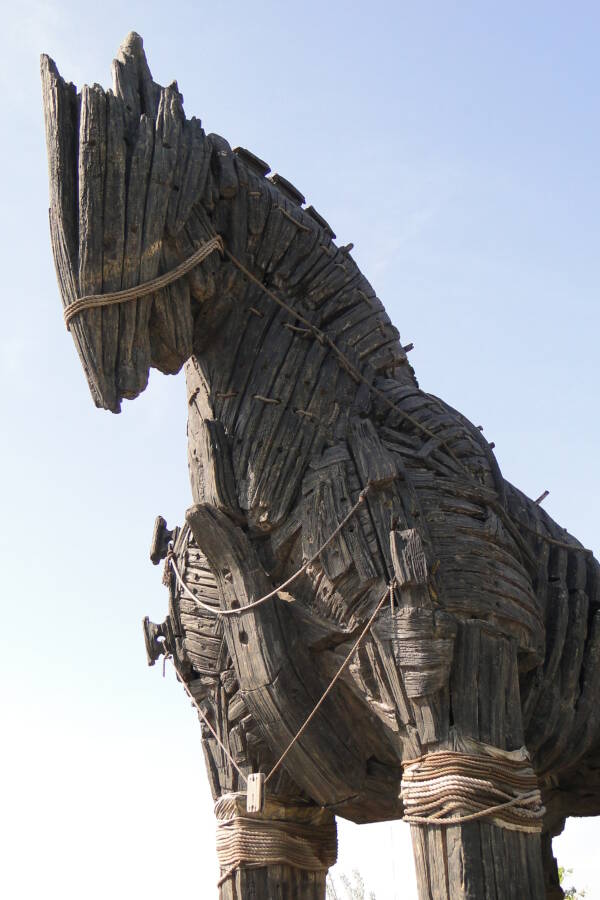
The epic tale of the Trojan Horse, a monumental wooden steed concealing Greek warriors, has captivated imaginations for centuries. It’s a story central to the fall of Troy, a pivotal moment in ancient Greek mythology. But as with many ancient legends, the question arises: Was The Trojan Horse A True Story, or just a clever fabrication of poets and storytellers? Delving into historical accounts, archaeological evidence, and literary interpretations, we aim to separate fact from fiction in this enduring narrative.
The Foundation of the Legend: Homer’s Iliad
While the Trojan War itself is a subject of historical debate, the most influential account of the war and its dramatic conclusion comes from Homer’s epic poem, the Iliad. However, it’s crucial to note that the Iliad primarily focuses on a specific period of the war, notably the wrath of Achilles, and does not detail the final stratagem of the Trojan Horse.
The tale of the horse and the cunning ruse that led to Troy’s downfall is primarily found in later works, most notably Virgil’s Aeneid and various other Greek texts that elaborated on Homer’s narrative. These accounts describe how the Greeks, after a decade of fruitless siege, devised a plan. They pretended to sail away, leaving behind a giant wooden horse as an offering to the gods. The unsuspecting Trojans, believing the war was over and the horse a gift, brought it inside their impenetrable walls. That night, Greek soldiers hidden within the horse emerged, opened the city gates for their returning army, and Troy was conquered.
Echoes in History and Archaeology
The historical existence of Troy and the Trojan War has been supported by archaeological discoveries. The ancient city of Troy, identified with the ruins at Hisarlik in modern-day Turkey, has been excavated extensively, revealing multiple layers of settlement spanning thousands of years. These findings confirm that a significant Bronze Age city did exist at the location and that it was indeed destroyed, likely through conflict, around the time the Trojan War is believed to have occurred (around the 12th or 13th century BCE).
However, the archaeological evidence does not provide any direct proof of a giant wooden horse. The city’s destruction layers indicate warfare, but the specific details of the Greek stratagem, including the horse, remain within the realm of legend. It’s possible that the story of the Trojan Horse is a symbolic representation of a real event or a combination of different stratagems used during the long siege.
The “Horse” as a Metaphor or Symbol
Many scholars believe the Trojan Horse might be a metaphor or a symbolic representation rather than a literal depiction. Several theories attempt to explain its origin:
- A battering ram: Some suggest the “horse” could have been a type of siege engine, possibly a wooden battering ram covered in hides to protect it from fire, which the Trojans may have mistaken for a religious offering. The Greek word for horse, “hippos,” shares roots with words for siege engines.
- An earthquake: Another theory posits that the destruction of Troy might have been caused by a powerful earthquake, and the “horse” could be a metaphor for the earth-shattering event that brought down the city walls.
- A ship: In some interpretations, the “horse” could have symbolized a specific type of ship or a fleet that carried the Greek soldiers, and the story evolved into a more dramatic narrative.
It’s also worth noting that the horse was a significant symbol in Mycenaean Greek culture, appearing in their art and mythology. This cultural resonance may have influenced the story’s development.
The Role of Virgil and Later Narratives
Virgil’s Aeneid, written centuries after Homer, significantly popularized the Trojan Horse narrative. Virgil’s depiction of the horse is dramatic and vivid, cementing its place in Western literature. The Aeneid intertwines the fall of Troy with the founding of Rome, with Aeneas, a Trojan survivor, escaping the burning city and eventually journeying to Italy. This epic poem, commissioned by Emperor Augustus, served not only as a foundational myth for Rome but also as a powerful literary device that ensured the Trojan Horse story would be retold and reinterpreted for millennia.
Later Greek writers, such as Dictys Cretensis and Dares Phrygius, also provided accounts of the Trojan War that included variations of the horse story, further embedding it into the collective consciousness. These later narratives often added more details and sensationalism, contributing to the legend’s enduring appeal.
Conclusion: A Legend Enduring
While concrete historical or archaeological evidence for a literal giant wooden horse remains elusive, the story of the Trojan Horse is undeniably rooted in the historical reality of the Trojan War and the existence of the city of Troy. The enduring power of the legend lies not just in its dramatic narrative but also in its thematic exploration of cunning, deception, and the consequences of pride.
Was the Trojan Horse a true story? In a literal sense, probably not. But as a powerful myth that has shaped our understanding of ancient history, warfare, and storytelling, its truth resonates deeply. The tale serves as a potent reminder of how human ingenuity, even when employed through deception, can lead to the downfall of even the most formidable defenses. The legacy of the Trojan Horse continues to inspire, reminding us that sometimes, the most enduring truths are found not in literal facts, but in the stories we tell.
Frequently Asked Questions
Q1: Did the Trojan War actually happen?
While the specifics of Homer’s epics are debated, archaeological evidence at Hisarlik, Turkey, confirms the existence of a Bronze Age city that matches the likely location of Troy and shows signs of destruction by warfare.
Q2: Where is the story of the Trojan Horse first told?
The most detailed accounts of the Trojan Horse appear in Virgil’s Aeneid and other later Greek texts, as Homer’s Iliad does not describe the stratagem itself.
Q3: What are some alternative theories about the Trojan Horse?
Scholars suggest the “horse” might represent a battering ram, an earthquake, a type of ship, or even a symbolic representation of Mycenaean culture, rather than a literal wooden structure.
Q4: How did the Greeks use the Trojan Horse to win the war?
The Greeks pretended to abandon their siege, leaving behind a large wooden horse. The Trojans brought it inside their city walls, unaware that Greek soldiers were hidden inside. These soldiers emerged at night, opened the city gates, allowing the Greek army to enter and conquer Troy.
Q5: Is there any archaeological evidence of the Trojan Horse?
No direct archaeological evidence of a literal Trojan Horse has been found. Archaeological findings at Troy confirm warfare and destruction, but the horse remains part of the legendary narrative.
