
For millennia, the tale of the Trojan Horse has stood as the ultimate symbol of cunning and deception. It’s a story of a decade-long war, a city thought impenetrable, and a clever trick that brought it all crashing down. But as the dust of ages settled, a persistent question remained: Was The Trojan Horse A Real Story? We picture Greek soldiers spilling from the belly of a giant wooden beast, but is this dramatic image a historical fact or a masterful piece of fiction? This enduring question invites us to explore whether is the story of the trojan horse real or simply a masterpiece of ancient storytelling.
The legend is one of the most famous in history. After a ten-year siege of the city of Troy, the Achaean (Greek) army appeared to give up. They sailed away, leaving behind a colossal wooden horse as a supposed offering to the goddess Athena for a safe voyage home. Despite the warnings of the priest Laocoön and the prophetess Cassandra, the triumphant Trojans pulled the massive statue into their city to celebrate their victory. That night, as the city slept in a drunken stupor, a hidden door in the horse opened. A group of elite Greek warriors, led by Odysseus, crept out, slaughtered the sentries, and opened the city gates for their returned army. Troy was sacked, burned, and its people were either killed or enslaved, all thanks to a single, audacious ruse.
The Legend as Told by the Poets
Before we dissect the history, it’s crucial to understand where the story comes from. Many people mistakenly believe the tale of the Trojan Horse is the climax of Homer’s epic poem, the Iliad. However, the Iliad actually ends with the funeral of the Trojan hero Hector, well before the city’s fall.
The story of the horse is found elsewhere in ancient literature. Homer alludes to it briefly in the Odyssey, when Helen of Troy reminisces about the warriors hidden inside the wooden structure. The most detailed and famous account comes from the Roman poet Virgil in his epic, the Aeneid, written centuries after Homer. Virgil tells the story from the Trojan perspective, narrating the tragic tale of how the city was deceived. The story also appeared in other, now-lost poems of the “Epic Cycle,” which filled in the gaps of the Trojan War saga. This literary origin is the first clue: the story was crafted by poets, not historians, whose primary goal was to create compelling drama, not a factual record.
 An illustrative depiction of the legendary Trojan Horse being brought into the city of Troy, exploring the question of was the trojan horse a real story.
The Search for Troy: A City Lost and Found
For centuries, Troy itself was considered as mythical as the horse. Scholars believed it was a fantasy city, a backdrop for Homer’s grand tales. That all changed in the 1870s with the arrival of Heinrich Schliemann, a German businessman and pioneering archaeologist. Obsessed with Homer’s epics since childhood, Schliemann was convinced that Troy was a real place and he was determined to find it.
Following geographical clues from the Iliad, he began excavating a large mound called Hisarlik in modern-day Turkey. What he uncovered was astounding: not one city, but layers upon layers of different settlements built on top of each other over thousands of years. Schliemann enthusiastically, and somewhat destructively, dug down through these layers.
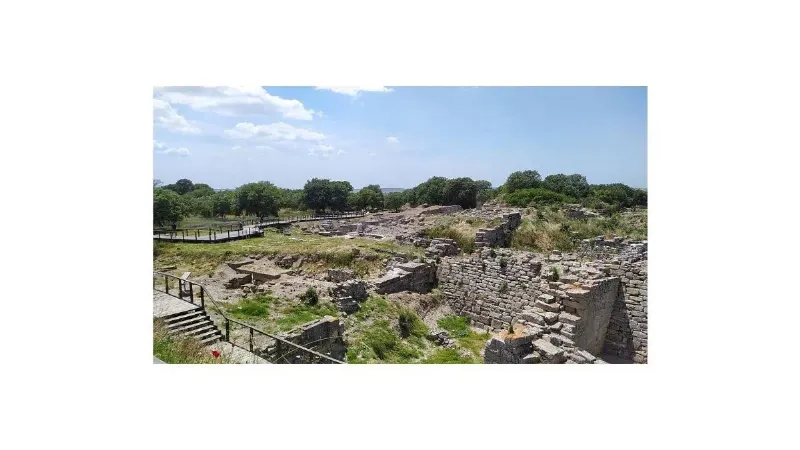
While his methods were crude by modern standards and he may have misidentified some of his findings, Schliemann proved the most important thing: the city of Troy was real. Later, more scientific excavations identified the layer known as Troy VIIa as the most likely candidate for the city of the Trojan War. Archaeological evidence shows this version of the city was destroyed in a violent fire around 1200 BCE, a timeframe that aligns perfectly with the traditional date of the war. The quest to uncover the trojan horse true story now had a real-world location.
Analyzing the Evidence: Fact or Fiction?
With a real city and evidence of a real war, the next logical step was to look for proof of the horse. This is where the line between history and myth becomes sharply defined.
The Archaeological Case
The hard truth is that archaeologists have found no physical evidence of the Trojan Horse. This is not entirely surprising. A giant structure made of wood would not have survived for over 3,000 years. However, there are also no inscriptions, no Trojan records, and no definitive depictions from the era that confirm the story as a historical event. The ruins of Troy show that it was a formidable fortress with massive defensive walls, which certainly would have required a clever plan to breach. But the evidence points to a city destroyed by fire and conquest in a conventional siege, not by a wooden gift.
The Military Plausibility Argument
Beyond the lack of physical proof, many historians and military analysts question the logistics of the story itself.
- Immense Scale: Building a wooden horse large enough to hide a few dozen soldiers would have been a monumental engineering task, requiring significant time and resources, all supposedly done in secret.
- Movement: Moving such a massive object across the plains and through the city gates—which might have had to be partially dismantled—presents a major logistical challenge.
- Obvious Deception: The idea that the Trojans, after a ten-year war against the cunning Greeks, would blindly accept such a strange and enormous gift seems incredibly naive. The second-century writer Pausanias even described the Trojans’ actions as foolish, suggesting the story strained credulity even in ancient times.
This debate over military strategy is central to understanding if was the trojan horse story real. As a literal military tactic, it seems highly improbable.
Alternative Theories: What Could the ‘Horse’ Represent?
If the Trojan Horse wasn’t a literal horse, does that mean the story is pure invention? Not necessarily. Many scholars believe the legend is a poetic metaphor for a real event, a memory of the war’s end that became more fantastical over centuries of retelling. Here are the most compelling theories.
A Metaphor for a Siege Engine
This is perhaps the most widely accepted theory among historians. In the ancient world, siege engines were common military tools used to break down city walls. These were often large, wooden structures, sometimes covered with dampened animal hides to protect them from flaming arrows. It is highly plausible that the Greeks built a battering ram or a wheeled siege tower to breach Troy’s famous walls.
According to Dr. Armand D’Angour, a classicist at Oxford University, the Trojan Horse is likely “an imaginative fable, perhaps inspired by the way ancient siege-engines were clothed with damp horse-hides to stop them being set alight.”
The name “horse” could have been a nickname for the machine, or a poetic description that was later taken literally. The story of soldiers emerging from its “belly” could be a dramatic retelling of warriors pouring through the breach created by the engine. This theory elegantly explains how the city fell without relying on the Trojans’ unbelievable gullibility.
A Symbol of an Earthquake
Another intriguing theory connects the horse to the Greek god Poseidon. In addition to being the god of the sea, Poseidon was also known as the “Earth-Shaker” and, crucially, was the god of horses. The walls of Troy VI, an earlier layer of the city, show evidence of destruction by an earthquake. It’s possible that a timely earthquake damaged Troy’s defenses, allowing the Greeks to finally enter. Such a natural disaster, seen as an act of Poseidon, could have been mythologized over time as a “horse” sent by the god to aid the Greeks.
A Deceptive Ship
A third theory suggests the horse was a metaphor for a ship. Homer sometimes poetically refers to ships as “horses of the sea.” The story could be a distorted memory of a final, deceptive offering. The Greeks may have left behind a ship filled with valuable “tribute” to feign their departure, with soldiers hidden in the hull. The Trojans, eager for spoils after a long war, might have brought the ship or its contents into the city, inadvertently carrying their doom along with it.
So, Was the Trojan Horse Story Real?
The final verdict is nuanced. If you ask, “Did the Greeks build a giant, hollow wooden horse and hide inside it to capture Troy?” the answer is almost certainly no. The Trojan Horse as described in Virgil’s epic is a myth, a brilliant piece of storytelling from a literary tradition that valued drama and symbolism over historical accuracy.
However, if you ask whether the story contains a kernel of truth, the answer is likely yes. The Trojan War was probably a real historical event. The city of Troy was a real place that was besieged and destroyed. And its fall was likely accomplished through some form of stratagem or advanced technology that was later immortalized in the unforgettable image of the horse. The most likely reality behind the myth is a powerful siege engine that finally broke through Troy’s defenses.
Ultimately, the answer to is the trojan horse a real story is complex, blending historical kernels with epic storytelling. The enduring power of the legend lies not in its historical accuracy, but in its timeless themes of deception, ingenuity, and the catastrophic consequences of letting one’s guard down.
Frequently Asked Questions (FAQ)
1. Where does the story of the Trojan Horse come from?
The story is not in Homer’s Iliad. It is mentioned briefly in his Odyssey and described in great detail in the Roman poet Virgil’s epic, the Aeneid. It was also part of other lost poems from the ancient “Epic Cycle.”
2. Is the city of Troy real?
Yes. The archaeological site of Hisarlik in modern-day Turkey is widely accepted as the historical location of Troy. Excavations have revealed multiple layers of a fortified city dating back to the Bronze Age.
3. Did the Trojan War actually happen?
Most historians believe the Trojan War was a real conflict, likely fought over trade routes and resources in the Aegean around 1200 BCE. The epic poems are considered dramatic embellishments of this real historical event.
4. Is there any proof of the Trojan Horse?
No. There is no archaeological evidence, such as remains of the structure or contemporary inscriptions, to prove the Trojan Horse existed as described in the myth.
5. What could the Trojan Horse have been in reality?
The most popular scholarly theory is that the “horse” was a metaphor for a wooden siege engine, like a battering ram, used to breach Troy’s walls. Other theories suggest it could represent an earthquake or a ship used in a deceptive ploy. The exploration of was the story of the trojan horse real often leads back to these more plausible scenarios.
