
The raw, visceral imagery of the 1970 film A Man Called Horse has been seared into the minds of audiences for decades. Its depiction of a British aristocrat captured and absorbed into a Sioux tribe is so intense and detailed that it leaves many viewers with a pressing question: Was A Man Called Horse A True Story? The film’s commitment to showing the brutal realities of survival and the complex social rituals of the Lakota Sioux feels startlingly real, blurring the line between historical account and cinematic fiction. The answer, however, is not a simple yes or no; it lies in a fascinating blend of literary creation, historical research, and Hollywood dramatization.
This journey to uncover the truth takes us from the pages of a mid-century magazine to the controversial heart of one of the most iconic Westerns ever made. While the narrative of Lord John Morgan is not the biography of a real person, its origins are rooted in a deep respect for the history of the American West, even as its on-screen adaptation sparked debates about authenticity and representation that continue to this day. Understanding this story is about more than just a single man; it’s about how we tell stories of different cultures and the line between honoring history and exploiting it. The journey of an outsider finding a new life in a foreign culture is a timeless theme, much like a classic [horse love story](https://dogcarestory.com/horse-love-story/) where connection transcends initial boundaries.
The Literary Roots: Dorothy M. Johnson’s Fictional Tale
Before Richard Harris ever graced the screen, the story of an Englishman named Horse began on paper. The narrative was born from the mind of Dorothy M. Johnson, a celebrated author of Western fiction, and was first published as a short story in Collier’s magazine in 1950. It later appeared in her acclaimed 1968 collection, Indian Country. Johnson was not a casual writer of cowboy tales; she was a meticulous researcher who dedicated herself to understanding the history and cultures of the Native American peoples she wrote about.
Her short story introduces a young Boston aristocrat who, seeking adventure, finds himself captured by the Crow tribe (a detail notably changed to Sioux for the film). He is initially treated as a captive, given the demeaning name “Horse” because he is treated like a beast of burden. However, over time, he begins to see the humanity and complex social structure of his captors. He sheds his own cultural arrogance and, through acts of bravery and a willingness to understand, earns the respect of the tribe, eventually becoming a warrior and marrying into their society.
Johnson’s story was never presented as a biography. It was a work of historical fiction designed to explore themes of cultural assimilation, pride, and the meaning of “civilization.” Her goal was to use a fictional character as a vehicle to present a more nuanced and respectful portrayal of Native American life than was common at the time. The story’s power comes from its character arc—the transformation of a man stripped of his identity who ultimately finds a more profound sense of self by embracing a completely alien way of life. It’s a powerful narrative, and like [my wonder horse short story](https://dogcarestory.com/my-wonder-horse-short-story/), it focuses on the transformative journey of an individual.
From Page to Screen: Hollywood’s Vision and The Authenticity Debate
In 1970, director Elliot Silverstein adapted Johnson’s story into a feature film, and it was here that the question of truthfulness became more pronounced. The film was groundbreaking in its effort to present a Native American culture from an internal perspective. Over eighty percent of the dialogue is in the Lakota Sioux language, a bold and almost unprecedented choice for a mainstream Western. The production team hired advisors and cast Native American actors in many roles to heighten the sense of realism. This dedication to certain details is a primary reason why audiences often believe they are watching a true story unfold.
However, the film also took significant liberties, sensationalizing elements of the story for dramatic effect. The most famous and controversial of these is the grueling “Sun Vow” or Sun Dance ceremony. In the film, Lord John Morgan undergoes this excruciating ritual—being pierced through the chest with hooks and suspended from the roof of a lodge—to prove his worthiness and become a member of the tribe. While the Sun Dance is a real and deeply sacred ceremony for many Plains tribes, the film’s depiction is widely considered by historians and cultural experts to be a grotesque and inaccurate dramatization.
Many critics, including respected Sioux historian Clyde Dollar who was an advisor on the film, noted a long list of historical inaccuracies and anachronisms. The film’s portrayal of the ritual was seen as a violation, exposing a sacred practice to the world in a way that was both fictionalized and exploitative. This highlights the central paradox of the movie: its quest for authenticity was selective, prioritizing shocking visuals over genuine cultural accuracy.
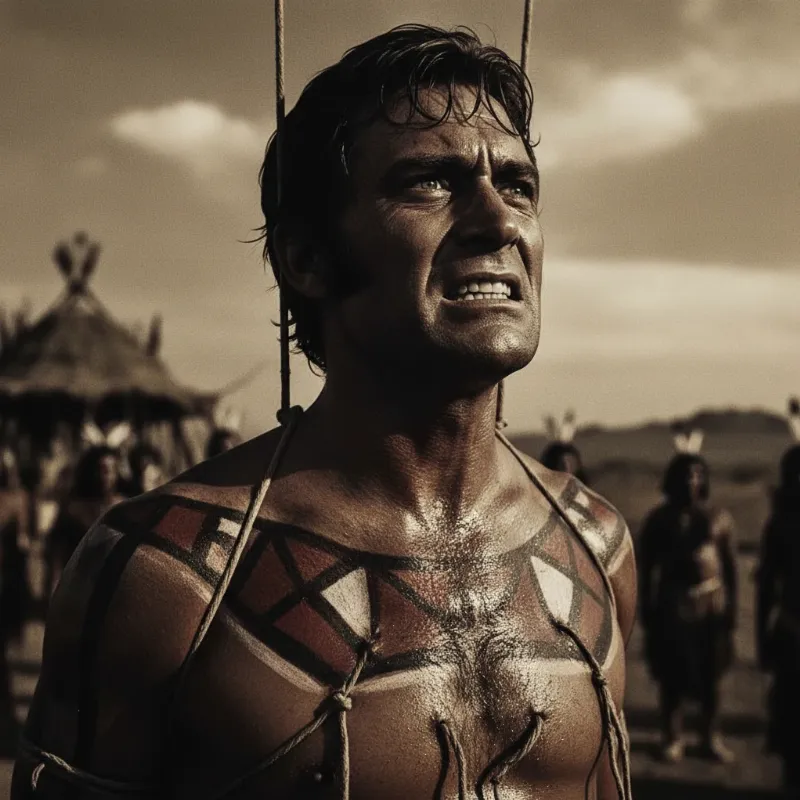 A cinematic still from the 1970 film A Man Called Horse, showing the protagonist during the intense Sun Dance ceremony, a focal point of the movie's authenticity debate.
Was There a Real John Morgan?
Simply put, there was no real-life English lord named John Morgan who was captured by the Sioux in the 1820s and became known as Horse. He is a purely fictional character created by Dorothy M. Johnson.
However, the concept of a white person being captured by or choosing to live among Native American tribes is not fictional at all. Throughout the 18th and 19th centuries, there were numerous documented cases of “white Indians.” These were individuals who, through capture or by choice, assimilated into various tribes. Some, like John Tanner, were captured as children and fully adopted the culture, living as Native Americans for decades and struggling to readjust when they returned to white society.
It is likely that Johnson drew inspiration from this broader historical phenomenon rather than a single individual’s life. She used the archetype of the assimilated captive to craft her narrative. The story’s strength lies not in being a true account but in its exploration of a plausible, if not specific, historical reality. It channels the spirit of these real-life stories to ask what it means to belong to a culture. It’s a common question explored in storytelling, from Westerns to [derby horse stories](https://dogcarestory.com/derby-horse-stories/) that chronicle an individual’s struggle and triumph.
The Legacy of Controversy: White Savior or Cultural Landmark?
Decades after its release, A Man Called Horse remains a subject of debate. On one hand, it is praised for being a precursor to films like Dances with Wolves, shifting the perspective of the Western genre to view Native Americans as protagonists rather than savage antagonists. The use of the Sioux language and its focus on their culture was a significant step forward from the simplistic portrayals common in earlier films. Richard Harris himself underwent a profound personal transformation during the role, developing a lifelong respect for Native American history.
On the other hand, the film is heavily criticized through a modern lens for promoting the “white savior” trope. The story still centers on a white man who not only masters the Sioux way of life but ultimately becomes their leader and teaches them how to fight their enemies more effectively. Indigenous activists and scholars, like the acclaimed author Vine Deloria Jr., have pointed out that the narrative still suggests that a white man is inherently better, even within a Native American context. Activist Buffy Sainte-Marie famously called it “the whitest of movies” because the story’s ultimate focus remains on the white protagonist’s experience, using the Native culture as an exotic backdrop for his personal journey. This critical perspective forces us to constantly ask [is the movie a man called horse a true story](https://dogcarestory.com/is-the-movie-a-man-called-horse-a-true-story/) not just in a literal sense, but in its cultural and spiritual representation.
Frequently Asked Questions (FAQ)
Is ‘A Man Called Horse’ based on a real person?
No, the character of Lord John Morgan is fictional. The story was written by author Dorothy M. Johnson and is not a biography. It is inspired by the general historical phenomenon of white individuals who lived among Native American tribes in the 19th century.
How accurate is the depiction of the Sioux in the film?
The film’s accuracy is mixed and highly debated. While it was praised for using the Lakota language and attempting to portray daily life, it contains numerous historical and cultural inaccuracies. Key advisors, including Sioux historians, noted many errors in customs, attire, and events.
Is the Sun Dance ceremony in the movie real?
The Sun Dance is a real and sacred ceremony, but the film’s depiction is a heavily dramatized and fictionalized version. Critics and cultural experts state that the on-screen ritual does not accurately represent the true spiritual practice and was sensationalized for cinematic effect.
What tribe is featured in the story?
In Dorothy M. Johnson’s original short story, the protagonist is captured by the Crow people. The 1970 film adaptation changed the tribe to the Lakota Sioux.
Why is the film considered controversial?
The controversy stems from two main points. First, its claims of authenticity are undermined by significant historical and cultural inaccuracies, particularly regarding the sacred Sun Dance. Second, it is often cited as a prime example of the “white savior” narrative, where a white character enters a non-white culture and ultimately becomes its hero and leader.
Conclusion: A Powerful Fiction Rooted in History
So, was a Man Called Horse a true story? The definitive answer is no. The character of John Morgan and his specific journey are the products of fiction. However, the story’s enduring power comes from its foundation in historical reality and its earnest, if flawed, attempt to portray a world rarely seen by outsiders. It is a work of fiction that feels true because it is built upon the well-researched framework of life on the Great Plains and the very real historical accounts of cultural encounters.
A Man Called Horse is best understood not as a historical document, but as a cultural artifact of its time. It represents a turning point in the Western genre, initiating a move toward more complex portrayals of Native American life, while also serving as a cautionary tale about the pitfalls of cultural appropriation and the “white savior” narrative. The story is a powerful fiction, one that continues to provoke important conversations about history, Hollywood, and how we tell the stories of others.
