
When you encounter cats living outdoors, distinguishing between strays and ferals can be challenging. Both are considered “community cats,” an umbrella term for unowned domestic cats living outside. However, their history with humans and resulting behaviors differ significantly, impacting how we can best help them. Understanding these differences is crucial for cat advocates, shelter workers, veterinarians, and anyone sharing their neighborhood with these animals. This knowledge can inform the most appropriate course of action.
What is Socialization in Cats?
Socialization refers to a cat’s acclimation to and comfort with human interaction, including touch, presence, sights, sounds, and smells. This process is heavily influenced by a cat’s early life experiences. Kittens naturally become socialized through positive interactions like being held, spoken to, and played with from a young age. Without this crucial early exposure, kittens may grow up wary of humans and unsuited for indoor living. A kitten’s well-rounded development depends on early socialization with people and other animals.
The Core Distinction: Stray vs. Feral Cats
While both stray and feral cats are domestic cats (Felis catus), their history of human contact shapes their behavior.
Pet or indoor cats are fully socialized to people. Stray cats have also experienced socialization with humans at some point in their lives. Feral cats, on the other hand, are unsocialized to humans. They are bonded to their feline family members and colonies but do not seek or appreciate human companionship.
Stray Cats: Once Loved, Now Lost
A stray cat is one who previously lived indoors and was socialized to people but has since lost or left their home, or was abandoned, resulting in a lack of regular human contact. Over time, a stray can become more feral if their human interaction diminishes. While a stray might still tolerate some human touch, prolonged absence of positive interaction can lead to reduced socialization. With the right circumstances and care, a stray cat can be successfully re-acclimated to indoor living, though they may initially be frightened and wary.
Feral Cats: Wild at Heart
Feral cats are unsocialized outdoor cats. They may have had minimal to no physical contact with humans, or their contact has dwindled to the point where they are no longer accustomed to it. Most feral cats are fearful of people and are unlikely to ever adapt to living indoors or become comfortable as pets. However, kittens born to feral cats can be socialized at an early age and potentially adopted into homes. Alley Cat Allies generally advises against attempting to socialize feral kittens over four months old, as it is time-consuming and success is not guaranteed. Kittens born to feral cats can be socialized and are prime candidates for adoption.
Why This Distinction Matters
Recognizing the varying degrees of socialization in cats is key to providing them with the best care and protection. The Cat Socialization Continuum: A Guide to Interactions Between Cats and Humans offers a comprehensive look at these nuances.
Stray cats can often readjust to living with people and may be excellent candidates for adoption into indoor homes, provided individuals have the time and resources to foster and adopt them.
Differentiating between strays and ferals can be difficult, especially when they are trapped or distressed. Scared stray cats often need time to relax and reveal their true level of socialization. Scared stray cats often need time to relax and show their level of socialization.
Adult feral cats, being unsocialized, cannot be adopted into indoor homes. Consequently, they face a high risk of euthanasia if picked up by animal control or brought to shelters. Therefore, allowing them to continue living outdoors in their established colonies is often in their best interest.
Trap-Neuter-Return (TNR) is a life-saving program for feral cats and benefits all community cats, regardless of their socialization level. TNR involves humanely trapping cats, scanning for microchips, spaying or neutering them, vaccinating them, and eartipping (a universal sign of a neutered and vaccinated community cat). Stray cats that are thriving and not identified as lost via microchip can either be returned to their outdoor homes or fostered for adoption.
Identifying Cats Outdoors
Observing cats in their natural outdoor environment can provide clues to their socialization level. Keep in mind that cats exist on a spectrum, and some may not fit neatly into either category.
Socialization to Humans
- Stray: May approach people, houses, porches, or cars.
- Feral: Will typically avoid people and seek hiding places.
Socialization to Other Cats
- Stray: Often lives alone and is not part of a group.
- Feral: May be part of a colony and live with other cats.
Body Language
[- Stray: May exhibit house-cat behaviors like walking with an upright tail (a sign of friendliness) and making eye contact.
- Feral: Tends to move low to the ground, crawl, or crouch, and may use their tail to protect their body. They are unlikely to make direct eye contact.
Vocalization
- Stray: May meow, be vocal, or respond when spoken to.
- Feral: Generally silent, not meowing, begging, or purring.
Activity Schedule
- Stray: More likely to be visible during daylight hours.
- Feral: More often nocturnal, though they may occasionally be seen during the day.
Physical Appearance
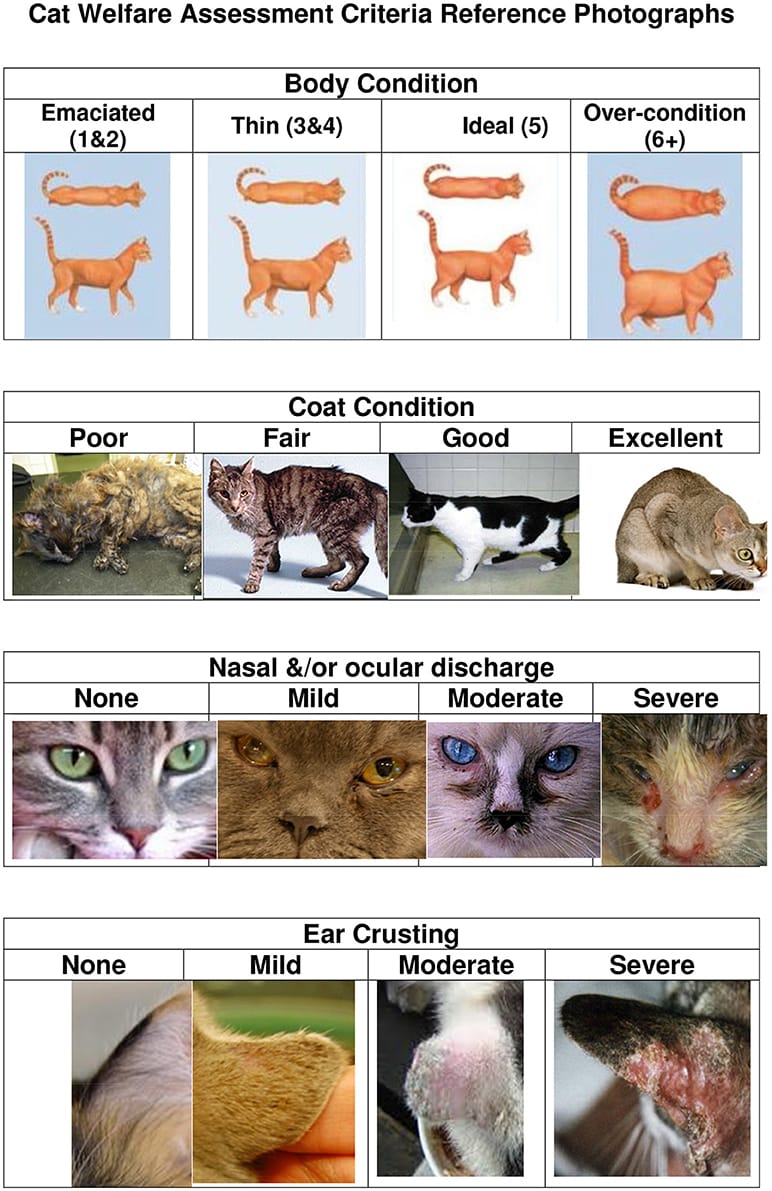
- Stray: May appear dirty or disheveled and will not have an eartip.
- Feral: Often have a clean, well-kept coat. Intact males may show physical characteristics like a larger head, thicker neck, muscular build, and scars from fighting, alongside potential signs of hormonal influence like a spiky coat, “stud tail,” or hair loss at the base of the tail. Feral cats who have undergone TNR will likely have an eartip.
Pregnancy and Kittens
- Feral: A female cat who is pregnant or nursing is more likely to be feral, as fewer feral cats are neutered compared to pet cats.
It is important to remember that a cat’s behavior isn’t always clear-cut, especially when they recognize a caregiver. Behaviors like an upright tail or resting on a caregiver’s porch, while indicating familiarity, are usually limited to that specific interaction and do not mean the cat is suited for indoor living.
Distinguishing Trapped Cats
When cats are trapped or in a stressful new environment like a shelter, even friendly strays can appear feral, avoiding people out of fear. Here’s how to differentiate them when confined:
Touch Barrier
- Stray: May eventually tolerate or even solicit touch, or at least tolerate touch with an object.
- Feral: Cannot be touched, even by a familiar caregiver.
Cage Behavior
[- Stray: May approach the front of the cage and eventually show friendly behaviors like rubbing against it.
- Feral: Will likely retreat to the farthest back of the cage. If startled, they may shake, rattle the cage, or try to climb, risking injury.
Level of Relaxation
- Stray: May relax and show less tension over time.
- Feral: Will likely remain tense and unsocialized.
Responsiveness to Stimuli
- Stray: May investigate toys or food placed near the cage and respond to familiar household sounds like can openers.
- Feral: Will likely ignore people, toys, and possibly even food, showing no interest in household sounds.
Fear and Anxiety
[- Stray: Might hiss or growl to express anxiety.
- Feral: If threatened or cornered, will exhibit aggression, including flattened ears and dilated pupils.
Next Steps for Community Cats
Gathering all necessary information is crucial for making informed decisions about a cat’s welfare. Once you have assessed a cat’s level of socialization, the next vital step is ensuring they are neutered. Following this, your evaluation will guide you in acting in the cat’s best interest. This might involve returning a feral cat to their outdoor home, or fostering and adopting out a stray cat.
Alley Cat Allies, founded in 1990, is dedicated to transforming communities to protect and improve the lives of all cats. With millions of supporters, they strive for a world where cats are valued and every community implements humane and effective programs and policies for their protection. Through advocacy, humane care, education, and policy work, Alley Cat Allies empowers individuals and groups globally to create better communities for cats using nonlethal, evidence-based approaches.
References:
- Alley Cat Allies. (n.d.). Cat Socialization Continuum Guide. Retrieved from https://www.alleycat.org/resources/cat-socialization-continuum-guide/
- Alley Cat Allies. (n.d.). Get Informed: Discover the Truth About Feral Cats. Retrieved from https://www.alleycat.org/resources/get-informed-discover-the-truth-about-feral-cats/
- Alley Cat Allies. (n.d.). Kitten Socialization: How To. Retrieved from https://www.alleycat.org/community-cat-care/kitten-socialization-how-to/
- Alley Cat Allies. (n.d.). Socializing Feral Kittens. Retrieved from https://www.alleycat.org/resources/socializing-feral-kittens/
- Alley Cat Allies. (n.d.). Soothe a Stray. Retrieved from https://www.alleycat.org/community-cat-care/soothe-a-stray/
- Alley Cat Allies. (n.d.). Stray and Feral Body Language. Retrieved from https://www.alleycat.org/wp-content/uploads/2015/04/Stray_Feral_Body_Language_Image.png
- Alley Cat Allies. (n.d.). Stray and Feral Cats Caged. Retrieved from https://www.alleycat.org/wp-content/uploads/2015/04/Stray_Feral_Cats_Caged.png
- Alley Cat Allies. (n.d.). Stray and Feral Cats Fear and Anxiety. Retrieved from https://www.alleycat.org/wp-content/uploads/2015/04/Stray_Feral_Fear_Anxiety.png
