
Have you ever heard a story that feels as ancient as the earth itself, whispered on the wind across vast desert plains? The Turquoise Horse Story is one such tale, a powerful and deeply sacred narrative woven into the cultural fabric of the Diné (Navajo) people of North America. It’s more than just a myth; it’s a profound exploration of creation, spirituality, and the unbreakable bond between humans, nature, and the divine. This isn’t just a story about an animal of a peculiar color; it’s a legend that carries the weight of the sky, the wisdom of the earth, and the spirit of a people.
This journey into the heart of the Turquoise Horse Story will unveil its origins, its rich symbolism, and the timeless lessons it holds. Prepare to saddle up for a ride into a world where sacred stones and noble beasts gallop together through the landscape of legend.
The Origins: A Gift from the Holy People
The Turquoise Horse Story begins not in a dusty corral, but in the celestial realm of the Diné Holy People. According to ancient creation myths, the horse was not a creature of earthly evolution alone but a divine gift intended to aid humankind. The story tells of a time when the world was still being formed, and the great Sun God, Jóhonaa’éí, rode across the sky each day on a magnificent steed.
To house his celestial mounts, the Sun God kept four great herds at the four cardinal directions of his home.
- East: A herd of horses made from shimmering white shell, representing the dawn.
- South: A herd of brilliant turquoise horses, symbolizing the warmth and life of midday.
- West: A herd of gleaming abalone-shell horses, reflecting the colors of the sunset.
- North: A herd of spotted or black jet horses, embodying the mystery of the night sky.
These were not merely animals but spiritual beings, each carrying the essence of their respective direction and time of day. The Turquoise Horse, with its vibrant blue-green hue, was particularly significant, embodying the beauty, vitality, and preciousness of the southern sky at its zenith.
The Quest of Turquoise Boy
The narrative often centers around a heroic figure, sometimes known as Turquoise Boy, who embarks on a quest. Sent by the Holy People or driven by a need to help his people, he journeys to the home of the Sun God. There, with the guidance of a mystical figure named Mirage Man, he is shown the four celestial herds. The sight of the turquoise horses, radiant and powerful, leaves an indelible mark. This quest is a rite of passage, a journey to acquire the sacred knowledge and tools—fetishes made of bead, pollen, and horse saliva—needed to bring these divine creatures into the physical world for the Diné people, providing them with a means of travel, prosperity, and spiritual connection.
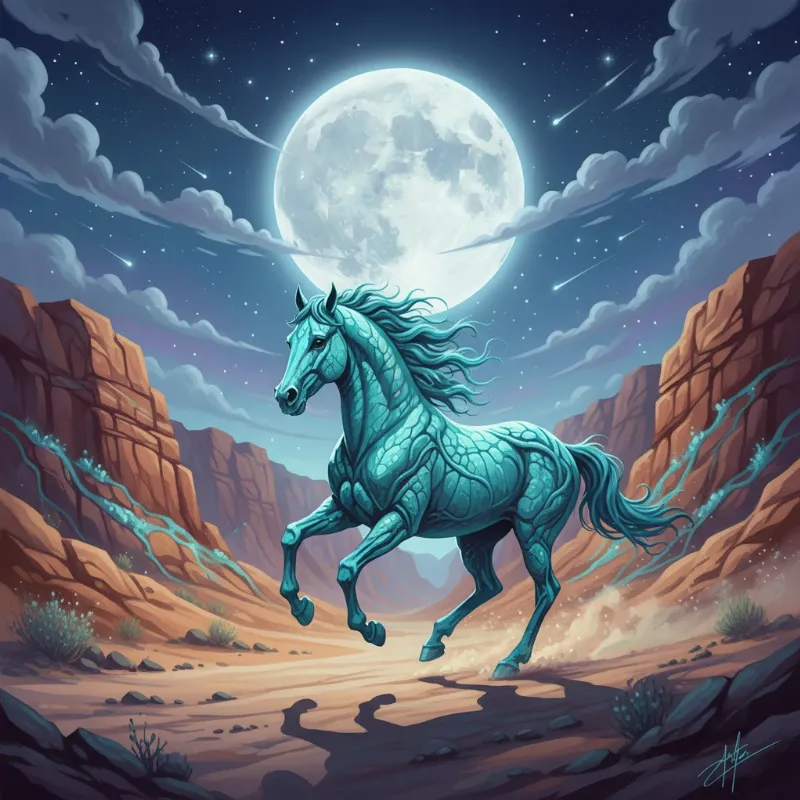 An artistic rendering of the Turquoise Horse Story, with a spirit horse made of polished turquoise galloping across a starry desert sky.
The Dual Symbolism: Stone and Steed
To truly understand the Turquoise Horse Story, one must appreciate the immense significance of both the turquoise stone and the horse in Native American culture, particularly for the Diné. The legend is a perfect fusion of two powerful symbols.
The Sacred Power of Turquoise
For centuries, turquoise has been more than just a beautiful gemstone; it is considered a piece of the sky that fell to earth. It is a stone of life, protection, and healing.
- A Connection to the Divine: Its blue color connects it to the sky, to water, and to breath—all essential elements of life. It is seen as a conduit for spiritual energy and a way to communicate with the spirits.
- A Stone of Protection: Warriors and riders would affix turquoise to their horses’ bridles and to their own arrows. It was believed to be a powerful talisman that could warn of impending danger by changing color, protecting both the rider and their mount from harm and falls.
- A Symbol of Wealth and Well-being: Possessing turquoise was a sign of prosperity, good health, and connection to the sacred world. It was used in ceremonies, as offerings, and to create beautiful, meaningful jewelry that told a story.
“When you look at a piece of turquoise, you’re not just seeing a mineral,” explains Dr. Anya Sharma, a cultural historian specializing in Indigenous American folklore. “You’re seeing a fragment of sky, a promise of rain, and a vessel of protective energy. In the Turquoise Horse Story, the horse is the stone—a living, breathing amulet of immense power.”
The Transformative Spirit of the Horse
The arrival of the horse profoundly transformed life for the tribes of the Great Plains and the Southwest. It revolutionized travel, hunting, and warfare, becoming an integral part of their economy, society, and spirit.
- A Brother in Spirit: The horse was not seen as a mere beast of burden but as a sacred partner, a relative, and a spiritual guide. This deep respect is reflected in the many songs, prayers, and stories dedicated to the Horse Nation.
- A Measure of Strength: A tribe’s or an individual’s wealth and strength were often measured by the quality and quantity of their horses. They were a symbol of honor, freedom, and mobility.
- An Extension of Self: A skilled rider and their horse moved as one. This symbiotic relationship became a powerful metaphor for harmony, trust, and the connection between the physical and spiritual worlds.
The Turquoise Horse Story thus represents the ultimate fusion: the protective, life-giving power of the sacred stone embodied in the noble, transformative spirit of the horse. It is a creature of immense beauty, power, and sacred duty.
Lessons from the Legend: What the Turquoise Horse Teaches
Like all great myths, the Turquoise Horse Story is rich with meaning and timeless wisdom. It offers profound lessons that resonate just as strongly today as they did centuries ago.
The Importance of Spiritual Quests
The journey of Turquoise Boy highlights the universal theme of the vision quest. It teaches that true wisdom and the greatest gifts are not easily obtained. They require courage, perseverance, and a willingness to venture into the unknown spiritual realms. It is through these trials that we discover our purpose and bring back boons to share with our community.
Harmony with the Natural World
The story is a beautiful reminder of a worldview where there is no separation between the material and the spiritual. The horses are of the sky and the earth. The directions have colors, and stones have life. The legend encourages a deep respect for nature, seeing the divine in the animals, the stones, and the landscape that surrounds us. It teaches that by honoring the natural world, we honor the creator and ourselves.
The Power of Storytelling Itself
The very existence of the Turquoise Horse Story, passed down through generations of oral tradition, is a lesson in the power of storytelling. For the Diné, stories are not just entertainment; they are medicine. They are how history is preserved, values are taught, and the sacred is kept alive. The legend serves as a cultural anchor, connecting the present generation to their ancestors and the cosmic order.
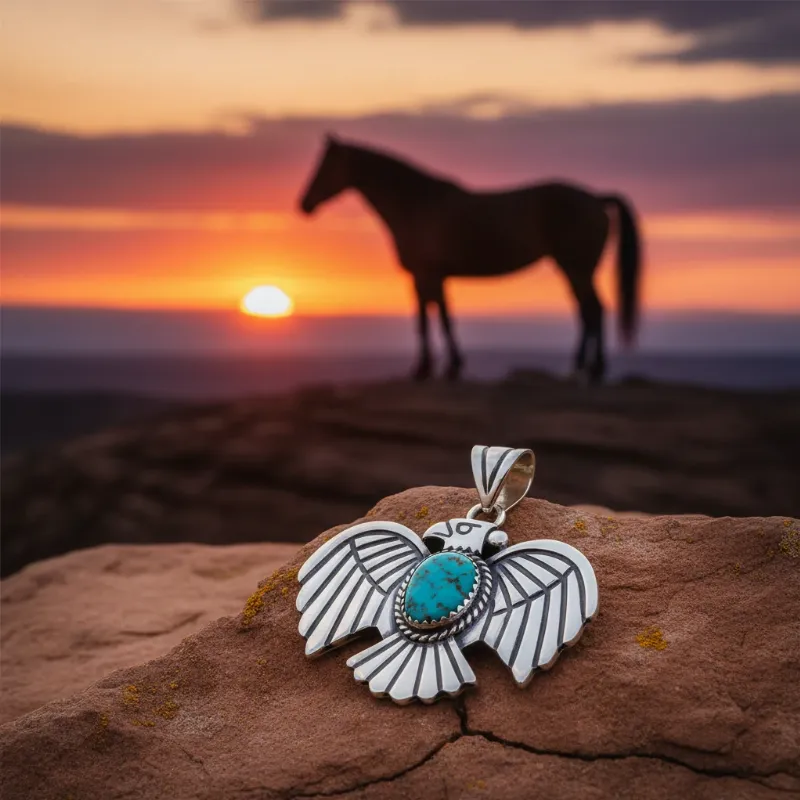 A symbolic image for the Turquoise Horse Story showing a piece of Navajo turquoise jewelry and a horse figure.
The Enduring Gallop of the Turquoise Horse
The Turquoise Horse Story is not a relic of a forgotten past. It continues to inspire and captivate. Its imagery is a recurring motif in Native American art, from traditional silversmithing and painting to contemporary literature. Author Gerald Hausman’s children’s book, The Turquoise Horse, introduces the legend to a new generation, telling the story of a young Navajo girl who connects with her heritage through a powerful dream of this sacred creature.
This enduring presence demonstrates the story’s timeless appeal. It speaks to a universal human longing for connection—to our history, to the natural world, and to the magic that lies just beyond the veil of the ordinary.
So, the next time you see a piece of turquoise jewelry or watch a horse run free across a field, take a moment. You might just feel the echo of an ancient tale, the thunder of celestial hooves, and the powerful, protective spirit of the Turquoise Horse, forever galloping through the heart of a sacred story.
Frequently Asked Questions (FAQ)
What is the Turquoise Horse Story?
The Turquoise Horse Story is a sacred narrative from the Diné (Navajo) people. It describes the origin of horses as a divine gift from the Holy People, specifically from the Sun God who kept herds of celestial horses in the four cardinal directions, with the southern herd being made of brilliant turquoise.
What does the turquoise horse symbolize?
The turquoise horse is a powerful symbol of life, protection, and vitality. It combines the sacred, protective qualities of the turquoise stone—representing the sky and water—with the transformative strength, freedom, and spiritual importance of the horse in Native American culture.
Is the turquoise horse a spirit animal?
Within the context of Diné spirituality, the turquoise horse can be seen as a powerful spirit being. It is one of the original, celestial horses given to the people and embodies the sacred energy of the south, making it a profound spiritual figure rather than just an animal.
Why are turquoise and horses important in Navajo culture?
Turquoise is a sacred stone used for protection, healing, and ceremony, believed to be a piece of the sky. The horse transformed Navajo life, becoming essential for travel, status, and survival, and is regarded as a sacred relative and a spiritual partner. The combination of the two in this story creates a symbol of ultimate sacred power.
Where can I learn more about this legend?
The story is a part of the vast body of Diné oral tradition. You can find versions of it in collections of Native American myths and legends, works by cultural historians, and in art and literature from Navajo creators. Reading books on Diné (Navajo) creation stories will provide the deepest context.
