
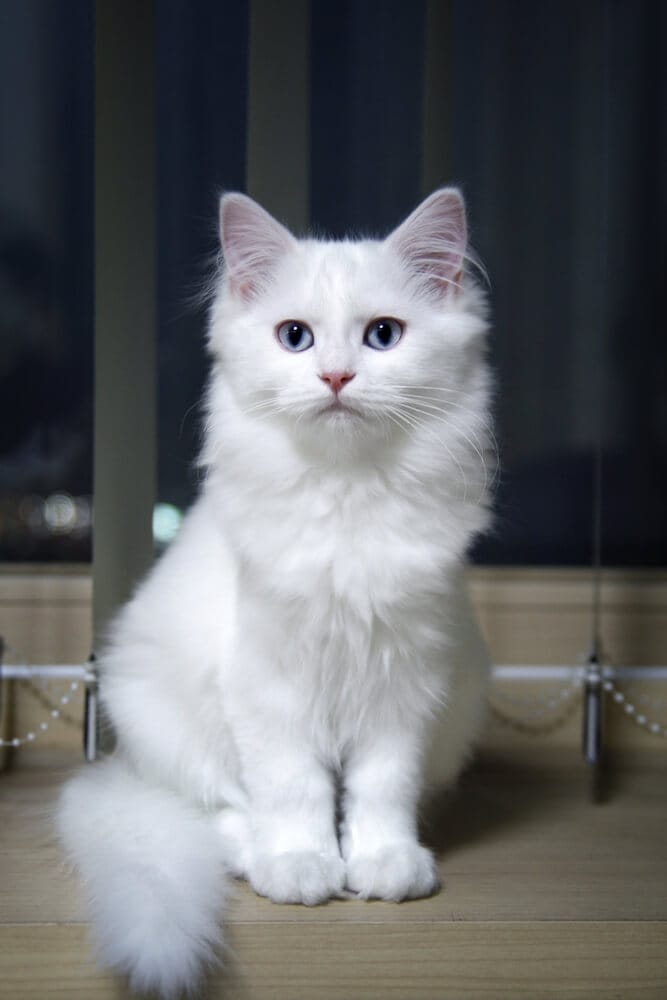
The Turkish Angora is a captivating breed, renowned for its graceful demeanor, elegant appearance, and a fine, silky coat that shimmers with movement. This breed is characterized by a balanced, lithe physique, medium size, and a lack of exaggerated features, embodying an ethereal, flowing motion. This guide delves into the breed’s standards, including head, body, coat, and color variations, providing a thorough understanding for enthusiasts and potential owners.
Breed Standard: A Detailed Look
The Turkish Angora’s ideal physical attributes are meticulously defined to ensure breed integrity and distinctiveness.
Head and Facial Features
The head is medium-sized, presenting a smooth wedge shape that is in proportion to the cat’s body and extremities. A flat profile is preferred, formed by two planes meeting slightly above the eyes, with no perceptible “break.” The muzzle is a continuation of these smooth lines, neither pronounced with whisker pads nor pinched. Large, wide-based ears, pointed and tufted, are set high on the head, positioned vertically and erect. The eyes are large and almond-shaped, with a slight upward slant, conveying an open expression. Eye color is diverse, including various shades of blue, green, green-gold, amber, and odd-eyed (one blue, one other color). While points are not allocated to eye color, deeper, richer tones are favored, with odd-eyed cats expected to have similar color depth in both eyes. The nose is medium in length and even in width when viewed from the front.
Body Structure and Physique
A slim, graceful, and relatively long neck complements the elegant head. The chin is firm and gently rounded, aligning perpendicularly with the nose in profile. The body is medium-sized, finely boned, and exhibits firm muscularity. Overall balance, grace, and fineness of bone are paramount, rather than sheer size. Females are typically smaller than males. The body is long and slender, with greater depth than width, and oval rather than round, avoiding a tubular appearance. Shoulders and hips are of equal width, with the rump positioned slightly higher than the shoulders.
Limbs and Tail
The legs are long, with the hind legs being longer than the front. Paws are small, round, and dainty, with tufts between the toes being a preferred feature. The tail is long and tapering, wide at the base and narrowing to a fine end, adorned with a full brush.
Coat Characteristics
The Turkish Angora possesses a single-coated, finely textured coat with a silk-like sheen. While the body coat length can vary, the tail and ruff are expected to be long and full. “Britches,” or longer fur on the hind legs, should be apparent.
Balance and Penalties
The breed standard emphasizes overall balance and a graceful, lithe appearance. Penalties are given for extremes such as an overtly oversized or coarse build, broad chest or hips, or a tendency towards miniaturization. Noticeable curvature in profile is also a fault. Kittens may have a growth bump on their forehead or the end of their nose without penalty. Disqualifications include a cobby body type, crossed eyes, an incorrect number of toes, a stop or break in profile, malocclusion, and any color or pattern indicating hybridization, such as chocolate, lilac, point patterns, or these combinations with white. A directional kink in the tail is also a disqualifying fault.
Turkish Angora Colors: A Spectrum of Beauty
All colors are considered of equal value in the Turkish Angora standard. While lockets and buttons are not penalized, sound color is preferred.
Solid Colors
- White: Pure white with no other coloring. Nose leather and paw pads should be pink.
- Black: Dense coal black, sound from root to tip, free from rust or smoke undercoat. Nose leather is black, and paw pads are black or brown.
- Blue: A lighter shade of blue is preferred, with a uniform tone from nose to tail. Soundness in color is prioritized over shade. Nose leather and paw pads are blue.
- Cream: A uniform shade of buff cream without markings, sound to the root. Lighter shades are preferred. Nose leather and paw pads are pink.
Tabby Patterns
The Turkish Angora standard recognizes several tabby patterns: Classic, Mackerel, Spotted, and Ticked. These patterns should be dense, clearly defined, and contrasting.
- Classic Tabby: Broad markings with an “M” on the forehead, swirls on the cheeks, and butterfly markings on the shoulders.
- Mackerel Tabby: Narrow, penciled markings with distinct necklaces and a narrow saddle.
- Spotted Tabby: Round, evenly distributed spots, with a dorsal stripe ideally composed of spots.
- Ticked Tabby: Ticked hair shafts create an overall impression without obvious body markings, but with distinct tabby striping on the head, neck, legs, and tail.
These tabby patterns can appear in various colors, including:
- Silver Tabby: Pale clear silver ground color with dense black markings.
- Red Tabby: Red ground color with deep rich red markings.
- Brown Tabby: Brilliant coppery brown ground color with dense black markings.
- Blue Tabby: Pale bluish ivory ground color with very deep blue markings.
- Cream Tabby: Very pale cream ground color with buff or cream markings.
- Red Silver Tabby: Off-white ground color with red markings.
- Cream Silver Tabby: Off-white ground color with cream markings.
- Blue-Silver Tabby: Pale bluish silver ground color with deep blue markings.
- Blue Silver Patched Tabby: Pale bluish silver ground color with sound blue markings and patches of cream tabby.
Bi-Color and Parti-Color Variations
- Tabby and White: Tabby patterns in accepted colors with white.
- Tortoiseshell: Black with patches of red or softly intermingled red.
- Calico: White with distinct patches of black and red, tabby markings allowed in red patches.
- Dilute Calico: White with distinct patches of blue and cream, tabby markings allowed in cream patches.
- Tortoiseshell and White: Black with red patches and white.
- Blue-Cream and White: Blue with cream patches and white.
- Blue-Cream: Blue with cream patches.
Smoke and Shaded Colors
These colors feature a white basecoat with the specified color deeply tipped or shading over it.
- Black Smoke: White basecoat tipped with black.
- Blue Smoke: White basecoat tipped with blue.
- Red Smoke: White basecoat tipped with red.
- Cream Smoke: White basecoat tipped with cream.
- Blue-Cream Smoke: White basecoat tipped with blue and cream.
- Tortoiseshell Smoke: White basecoat tipped with black, red, and shades of red.
- Shaded Silver: White basecoat with a mantle of black shading.
- Blue Shaded Silver: White basecoat with a mantle of blue shading.
- Red Shaded: White basecoat with a mantle of red shading.
- Cream Shaded: White basecoat with a mantle of cream shading.
- Tortoiseshell Shaded: White basecoat with a mantle of black and red shading.
- Blue-Cream Shaded: White basecoat with a mantle of blue and cream shading.
Special Color Classes
- Parti-Color and Bi-Color: Encompasses tortoiseshell, blue cream, tortoiseshell and white, blue-cream and white, calico, dilute calico, and other colors with white spotting.
- Smoke and White: Various smoke colors combined with white.
- Calico Smoke: White with black and red patches, where the colored patches have a white basecoat.
- Dilute Calico Smoke: White with blue and cream patches, where the colored patches have a white basecoat.
- Tortoiseshell Smoke and White: White basecoat tipped with black and red, with white.
- Blue-Cream Smoke and White: White basecoat tipped with blue and cream, with white.
- OTAC (Other Turkish Angora Colors): Any other color or pattern not excluded by the standard, such as those showing hybridization.
Understanding these detailed standards and color variations is crucial for appreciating the unique beauty and integrity of the Turkish Angora breed.
