
The Hollywood blockbuster “12 Strong” brought a stunning, almost unbelievable story to the big screen: modern U.S. Army Special Forces soldiers riding into battle on horseback against a formidable enemy. But behind the cinematic action lies the True Story Of The Horse Soldiers, a tale of courage, adaptation, and unconventional warfare that is even more remarkable than fiction. In the immediate, chaotic aftermath of September 11, 2001, a small team of Green Berets undertook a mission that would change the course of the war in Afghanistan and become a legendary chapter in U.S. military history.
This is the declassified account of Task Force Dagger and the men of Operational Detachment Alpha (ODA) 595. Their mission was to infiltrate the treacherous mountains of northern Afghanistan, link up with a local warlord, and wage a war against the Taliban and Al-Qaeda. They were America’s first response, a spearhead of retribution armed with 21st-century technology and… 19th-century transportation. The story of how they blended the two is a fascinating study in military ingenuity, one that has parallels in other historical accounts like the fury horse story where unconventional tactics proved decisive.
The Dawn of a New Warfare: A Post-9/11 Mission
Within weeks of the 9/11 attacks, the United States was poised to strike back. The objective was to dismantle Al-Qaeda and topple their Taliban hosts in Afghanistan. But a full-scale invasion was logistically impossible on such short notice. The solution was quintessentially Special Forces: insert small, elite teams to advise and assist local anti-Taliban forces, primarily the Northern Alliance.
This mission, codenamed Task Force Dagger, was unprecedented. The first team to go in was ODA 595. Their objective was to connect with General Abdul Rashid Dostum, a powerful and mercurial Uzbek warlord who had been fighting the Taliban for years. The team, consisting of just 12 Green Berets, was flown into the country by a clandestine MH-47 Chinook helicopter on October 19, 2001. They carried with them advanced communications gear, laser designators for airstrikes, and the hopes of a nation demanding justice. They had no idea they were about to become cavalrymen.
The Men of ODA 595: Who Were the Real Horse Soldiers?
The team depicted in “12 Strong” was based on the real-life Green Berets of ODA 595. While the movie changed their names, their roles were rooted in reality. The leader of the team was Captain Mark Nutsch, portrayed by Chris Hemsworth as “Mitch Nelson.” Nutsch was a quiet professional with deep experience in the region, though he had no prior combat command. His second-in-command was Chief Warrant Officer 5 Bob Pennington, a seasoned veteran of special operations, who was the inspiration for the character “Hal Spencer.”
These men were the epitome of the U.S. Army Special Forces. They were highly trained in unconventional warfare, foreign languages, and cultural sensitivity. Their job wasn’t just to fight, but to build rapport, train, and lead indigenous forces. They were warrior-diplomats, a role that would be tested to its absolute limit in the mountains of Afghanistan. The challenges they faced required a unique blend of strategic thinking and raw courage, a theme explored in the true story of horse soldiers that set a new precedent for modern warfare.
An Unlikely Alliance: Teaming Up with General Dostum
Landing in the dark, the team was met by representatives of General Dostum. Building a relationship with him was their first and most critical task. Dostum was a legendary figure, known for his battlefield prowess and shifting allegiances. ODA 595 had to earn his trust not with words, but with action.
The Green Berets needed Dostum’s manpower and knowledge of the terrain; Dostum needed their ability to call in devastating American airpower. This symbiotic relationship became the cornerstone of the campaign. As military historian Dr. Johnathan Pike states:
“The success of ODA 595 was a masterclass in force multiplication. You had twelve American soldiers leveraging a local army of thousands, coordinated with B-52s flying miles overhead. It was a fusion of the ancient and the ultra-modern, and the Taliban had no answer for it.”
This alliance was fragile and fraught with cultural misunderstandings. The Americans had to adapt to local customs, sharing meals and building personal bonds, all while coordinating a complex military operation.
From Humvees to Horses: Adapting to the Battlefield
The single most iconic element of their story is, of course, the horses. The terrain in northern Afghanistan was brutal and unforgiving, characterized by steep, narrow mountain passes where vehicles were useless. The Northern Alliance fought on horseback, the same way their ancestors had for centuries. If ODA 595 wanted to keep up and fight alongside them, they would have to do the same.
This presented a massive challenge. While a few members of the team had some recreational riding experience, none were expert horsemen. They were given small, resilient Afghan horses and rudimentary saddles made of wood and leather. They had to learn quickly, often while on the move towards enemy lines. The experience was physically punishing, but it was essential. Riding alongside Dostum’s men showed respect and solidified their alliance. It also gave them the mobility needed to traverse the battlefield and direct airpower effectively. The complete narrative of this incredible adaptation is central to the horse soldiers true story.
The image of a modern special operator, with body armor and a rifle, calling in a B-52 strike from the back of a horse became the defining symbol of the war’s opening chapter. It was a perfect metaphor for the mission itself: blending America’s technological might with the ancient traditions of Afghan warfare.
The Battle for Mazar-i-Sharif: A Decisive Victory
The ultimate goal of the joint U.S.-Northern Alliance force was to capture the strategic city of Mazar-i-Sharif. This Taliban stronghold was the key to northern Afghanistan. Taking it would be a major psychological and strategic blow to the enemy.
The battle involved a series of intense engagements where ODA 595 played a pivotal role. The team would identify Taliban positions—tanks, artillery, troop concentrations—and use their laser designators to guide in precision bombs from B-52s and other aircraft. They directed this airpower from exposed positions, often while under heavy fire. The climax of the campaign involved what many consider the last true cavalry charge of the 21st century, as Dostum’s fighters, with Green Berets among them, charged Taliban positions on horseback across the plains.
The combination was devastatingly effective. The Taliban’s Soviet-era armor was no match for GPS-guided munitions. Within weeks, the Taliban’s defensive lines collapsed. On November 10, 2001, Mazar-i-Sharif fell, a victory that stunned the world and signaled the beginning of the end for the Taliban regime. It was an outcome achieved by just twelve Americans on the ground, a powerful testament to their skill and bravery, further detailed in the 12 strong horse soldiers real story.
How Accurate Is the Movie “12 Strong”?
So, how does the Hollywood version stack up against the true story of the horse soldiers? Like most films “based on a true story,” “12 Strong” takes liberties for dramatic effect.
What the Movie Got Right:
- The Core Mission: The central premise is accurate. ODA 595 did embed with General Dostum, they did ride horses, and they were instrumental in calling in airstrikes to defeat the Taliban.
- The Key Figures: The characters are based on real people, and the film captures the essence of their roles and the team dynamic.
- The Unconventional Nature: The film successfully portrays the culture shock and the challenge of blending modern soldiers into an ancient style of warfare.
What Was Dramatized:
- Specific Battle Scenes: While the battles were intense, the movie condenses events and creates Hollywood-style firefights and a single, climactic “tanks vs. horses” charge that is a composite of several engagements.
- Personal Conflict: The film invents some internal tension within the team and a more adversarial initial relationship with Dostum to create dramatic arcs. In reality, the team was highly cohesive, and the partnership with Dostum, while challenging, was built on mutual respect.
- The “12” Number: While ODA 595 was a 12-man team, other special forces teams and CIA operatives were also in the country contributing to the wider effort. The movie focuses solely on one team for narrative clarity. This context is vital for anyone exploring the declassified true story of the horse soldiers.
Despite the dramatizations, the film is largely faithful to the spirit of the events and brought much-deserved recognition to a mission that was classified for years.
The Enduring Legacy of the Horse Soldiers
The mission of ODA 595 was a spectacular success. In just a few weeks, they achieved what many thought would take months or years with a massive ground force. Their victory at Mazar-i-Sharif triggered a domino effect, leading to the rapid collapse of the Taliban across the north and the eventual fall of Kabul.
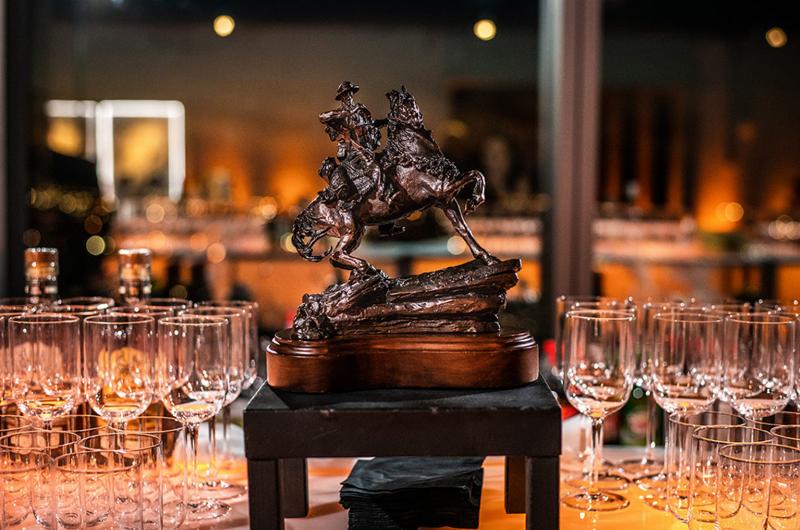 The legacy of the true story of the horse soldiers is commemorated by the America's Response Monument, showing a Green Beret on horseback.
Today, the legacy of these men is immortalized by the America’s Response Monument, a life-and-a-half scale bronze statue located at Liberty Park, overlooking the National September 11 Memorial & Museum in New York City. It depicts a Green Beret on horseback, a permanent tribute to the first soldiers who took the fight to the enemy after 9/11.
The true story of the horse soldiers is more than just a great war story. It is a powerful example of what small teams of highly skilled individuals can accomplish when they are empowered to adapt, innovate, and build partnerships in the most challenging environments imaginable. It proved that in the age of stealth bombers and satellite technology, courage, ingenuity, and the spirit of the American soldier—sometimes on the back of a horse—are still the most powerful weapons of all.
