
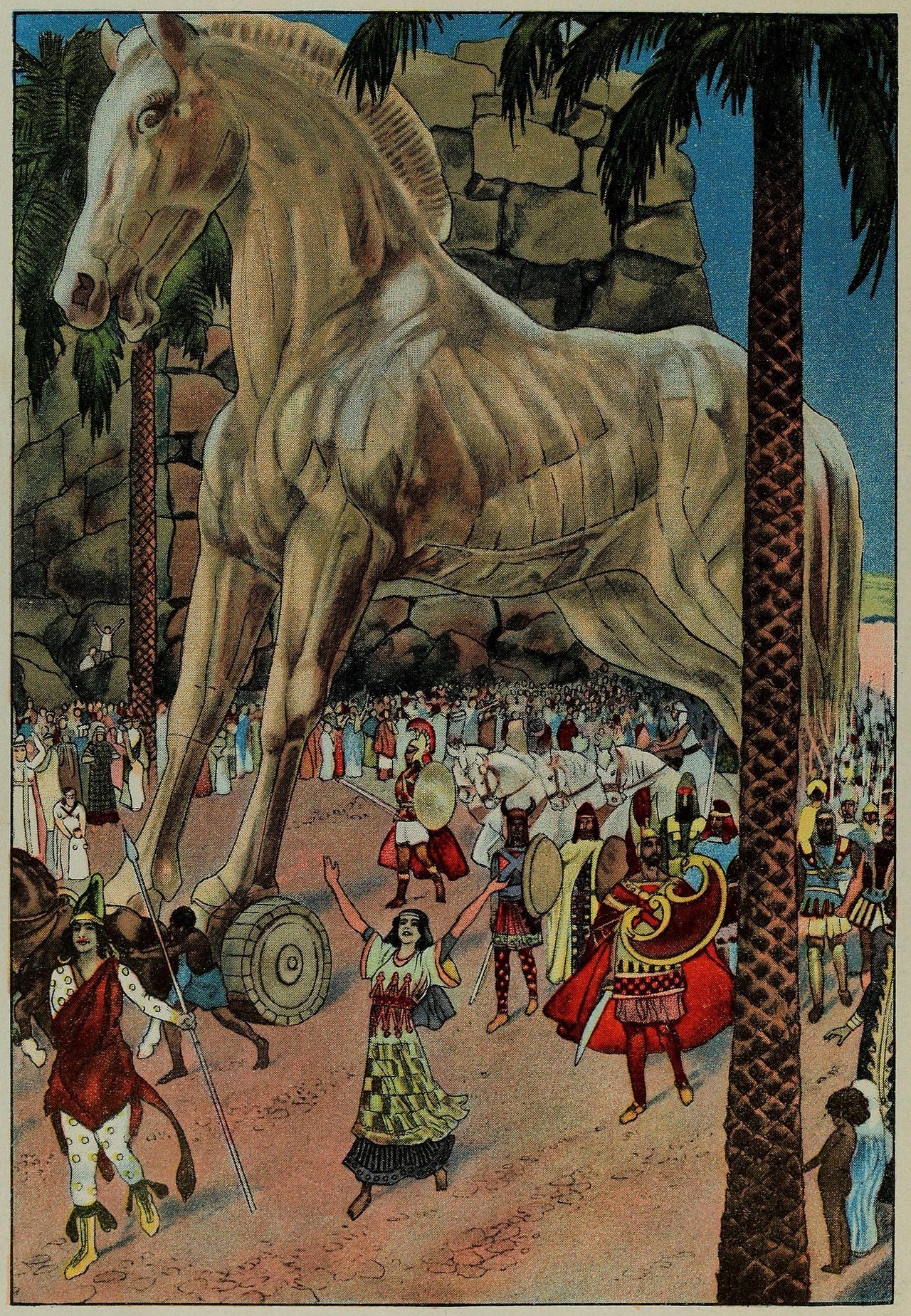
The image is one of the most powerful in all of Western literature: a colossal wooden horse standing before the impenetrable gates of Troy. For ten long years, the might of the Greek army had crashed against the city’s walls, a decade of bloodshed and stalemate. Then, one morning, the Trojans awoke to an eerie silence. The Greek fleet was gone, and in its place on the beach sat this strange, magnificent offering. The Trojan War Horse Story is a timeless tale of ingenuity, deception, and the catastrophic fall of a great city. It’s a narrative that has captivated audiences for millennia, blurring the lines between myth, history, and metaphor. But what is the real story behind this legendary stratagem?
This tale is more than just an ancient epic; it’s a foundational story that has shaped our understanding of warfare and human psychology. While the details of the conflict have been debated for centuries, the core narrative remains a powerful lesson in cunning and vulnerability. To truly appreciate its impact, one must delve into the full account of this masterful deception. For a complete narrative, exploring the trojan horse full story provides an in-depth look at the events leading to Troy’s downfall.
The Epic Deception: Unpacking the Legend
The story of the Trojan Horse is most famously told not in Homer’s Iliad, which concludes before the city’s fall, but in the Roman poet Virgil’s masterpiece, the Aeneid. It is here that the intricate details of the Greek plan are laid bare. After a grueling decade of war, the brilliant and cunning Greek king Odysseus of Ithaca proposed a radical new strategy: if they could not conquer Troy by force, they would do so by guile.
The Master Plan of Odysseus
The plan was audacious. The Greeks would construct a gigantic hollow horse from the wood of cornel trees, a wood considered sacred to the Trojans. The finest Greek warriors, including Odysseus himself, would hide inside its belly. The rest of the Greek army would burn their camps, board their ships, and sail away, but only as far as the nearby island of Tenedos, where they would wait for a signal.
One man, a Greek soldier named Sinon, was chosen for the perilous role of being left behind. His mission was to convince the Trojans that he had deserted the Greeks and that the horse was a sacred offering to the goddess Athena. This offering, he was to claim, was made deliberately immense to prevent the Trojans from taking it inside their city. According to Sinon’s fabricated tale, if the horse were to be brought within Troy’s walls, the city would become invincible, protected by Athena herself.
The Warning Ignored
When the Trojans discovered the horse, a fierce debate erupted. Some were suspicious, while others saw it as a divine trophy marking the end of the war. The Trojan priest Laocoön issued a dire warning, famously declaring, “Timeo Danaos et dona ferentes”—”I fear the Greeks, even when bearing gifts.” To prove his point, he hurled his spear into the horse’s flank, and the sound of clashing armor echoed from within, a detail unheard or ignored by the jubilant Trojans.
In a dramatic turn of events that seemed to be divine intervention, two giant sea serpents emerged from the ocean and devoured Laocoön and his two sons. The Trojans interpreted this horrific event as a sign of Athena’s wrath against Laocoön for desecrating her sacred gift. Their fate was sealed. Believing the horse was their key to divine favor, they tore down a section of their own supposedly impregnable walls to bring the colossal statue into their city.
That night, as the Trojans celebrated their perceived victory with feasting and wine, Sinon released the hidden Greek soldiers. They crept through the sleeping city, killed the sentries, and opened the gates for the rest of the Greek army, which had sailed back under the cover of darkness. The city was sacked, burned to the ground, and the Trojan War, at last, came to a brutal and decisive end.
Fact or Fiction: Is the Trojan War Horse Story Real?
For centuries, scholars and historians have debated a crucial question: did any of this actually happen? The story is a cornerstone of Greek mythology, but is there any historical or archaeological basis for it? The search for an answer has led researchers through ancient texts and the dusty ruins of modern-day Turkey, raising the central question, is the trojan horse a real story.
The Archaeological Evidence
In the 1870s, archaeologist Heinrich Schliemann excavated a hill called Hisarlik in Turkey, which is now widely accepted as the site of ancient Troy. His excavations revealed that the city was destroyed and rebuilt multiple times, with one layer, known as Troy VIIa, showing compelling evidence of a violent destruction consistent with the timeline of the Trojan War (around 1200 BCE). There were signs of fire, skeletons, and arrowheads found in the streets.
So, while there is strong evidence that a war at Troy likely occurred, archaeologists have found no physical proof of a giant wooden horse. This absence of evidence doesn’t disprove the story, but it has led most historians to believe the horse was not a literal structure as described by Virgil.
Metaphor and Military Reality
The prevailing theory is that the Trojan Horse was a metaphor for a type of military technology or a different kind of event entirely.
- A Sophisticated Siege Engine: The most popular historical interpretation is that the “horse” was actually a sophisticated siege engine, possibly a battering ram, covered with wet horse hides to protect it from flaming arrows. Ancient siege towers were often given animal names, and it’s plausible that a large, wooden structure used to breach the city walls was later mythologized into the form of a horse.
- An Earthquake: Another theory suggests that the horse was a metaphor for an earthquake that damaged the city walls, allowing the Greeks to enter. The god of the sea, Poseidon, was also the god of earthquakes and horses, creating a powerful symbolic link. It’s possible an earthquake breached the walls, and the Greeks, seeing this as a sign from Poseidon, stormed the city.
- A Ship as a Gift: Some scholars have proposed that the “horse” was a ship carrying a peace offering or tribute. The Trojans might have brought the ship into their harbor, not realizing soldiers were hidden inside.
“The Trojan Horse is a masterclass in psychological warfare,” states Dr. Alistair Vance, a classical historian and author. “Whether it was a literal wooden horse or a brilliant metaphor for a siege weapon that looked like one, its power lies in turning a symbol of peace and sanctity—an offering to a goddess—into the very instrument of destruction. The story endures not because of the wood and nails, but because it exposes a fundamental truth about human conflict: the most effective weapon is often the one you willingly invite inside your own defenses.”
The Enduring Legacy of the Trojan Horse
Regardless of its historical accuracy, the Trojan War horse story has had a profound and lasting impact on Western culture, art, and language. Its themes of deception, betrayal, and the fallibility of even the mightiest are universal and continue to resonate thousands of years later. The narrative has been adapted countless times, influencing everything from classical literature to modern cinema, a testament to its compelling war horse story line.
A Powerful Metaphor
The most significant legacy of the story is the phrase “Trojan horse” itself. It has become a universal metaphor for any trick or stratagem that causes a target to invite a foe into a securely protected bastion or place. It describes a form of subversion where a seemingly harmless gift or offering conceals a malicious intent.
This metaphor is most famously used in the world of computing. A “Trojan horse” or “Trojan” is a type of malware that misleads users of its true intent. The user is tricked into executing it, often by disguising it as legitimate software. Once activated, the Trojan can be used to steal data, install other malware, or take control of the user’s computer—a digital echo of the Greek soldiers hidden inside the wooden horse. The fundamental principle of this ancient military deception is perfectly preserved in modern cybersecurity.
Key Figures in the Saga
The enduring power of the story also comes from its unforgettable characters, each representing a timeless human archetype.
- Odysseus: The brilliant strategist. He represents the power of intellect over brute force, the idea that the sharpest mind is the most dangerous weapon. His plan required not only creativity but also a deep understanding of enemy psychology.
- Laocoön: The tragic voice of reason. He is the archetypal truth-teller who is ignored and punished for his insight. His fate serves as a chilling reminder of how societies can be swayed by wishful thinking and ignore uncomfortable truths.
- Cassandra: The cursed prophet. Like Laocoön, she also warned her people, but she was cursed by the god Apollo so that her prophecies would never be believed. She represents the agony of knowing the future but being powerless to change it.
- Sinon: The master deceiver. His character is a study in espionage and manipulation. His ability to sell a convincing lie under immense pressure was just as crucial to the Greek victory as the horse itself.
Together, these figures elevate the trojan horse war story from a simple military tale to a complex human drama about trust, belief, and the consequences of a single, fateful decision.
Frequently Asked Questions (FAQ)
Who built the Trojan Horse?
According to the myth, the Trojan Horse was designed by the cunning Greek hero Odysseus and built by a master carpenter named Epeius. The construction was guided by the goddess Athena.
What was the purpose of the Trojan Horse?
Its purpose was to deceive the Trojans into bringing a select group of elite Greek soldiers inside their impenetrable city walls. It was designed to look like a sacred offering to the goddess Athena to ensure the Trojans would take it in, believing it would bring them divine protection.
Did the Trojan War actually happen?
Most historians now believe that the Trojan War was a real historical conflict that took place around 1200 BCE. Archaeological evidence from the site of Hisarlik in Turkey shows that the city of Troy was destroyed in a manner consistent with the legends. However, the epic poems describing the war, like the Iliad, are considered mythological embellishments of real events.
What is a “Trojan horse” in modern terms?
In modern language, a “Trojan horse” is a metaphor for a person or thing intended to undermine or destroy from within. It most commonly refers to a type of computer malware that disguises itself as a legitimate program to trick users into installing it.
Where can you read the original Trojan War horse story?
The most detailed and famous account of the Trojan War horse story is found in Book 2 of the Aeneid, an epic poem written by the Roman poet Virgil in the 1st century BCE. The story is also referenced in Homer’s Odyssey.
Conclusion: A Legend for the Ages
The Trojan War horse story is a masterwork of mythological storytelling, a narrative that operates on multiple levels. It is a thrilling war story, a cautionary tale about pride and gullibility, and a profound exploration of human psychology. While the literal existence of a giant wooden horse remains a subject of debate, its symbolic power is undeniable. The horse stands as an eternal monument to the idea that the greatest walls cannot protect against a clever enough deception and that victory can be achieved through the mind as much as through the sword. It is a story that has been told and retold for three thousand years, and its lessons on strategy, vulnerability, and the nature of hidden threats remain as relevant today as they were in the Bronze Age.
