
The tale of the Trojan Horse is one of the most famous stories to emerge from ancient Greece, a dramatic account of ingenuity and deception that led to the fall of a great city. For centuries, we have been captivated by the image of a giant wooden horse, presented as a gift, secretly hiding Greek soldiers within its hollow belly. But is the Trojan Horse True Story an accurate historical event, or is it a masterful piece of fiction created by the poets of antiquity? This question has intrigued historians, archaeologists, and enthusiasts for generations, blurring the lines between myth and a tangible past.
The legend is a cornerstone of Western literature, a powerful symbol of cunning strategy where victory is achieved not by brute force, but by intellect and subterfuge. It tells of the decade-long Trojan War, a seemingly endless stalemate between the attacking Achaeans (Greeks) and the defenders of the city of Troy. Frustrated and unable to breach the city’s formidable walls, the clever Greek hero Odysseus conceived a brilliant plan. The Greeks would build an enormous wooden horse, offer it to the Trojans as a gift to the goddess Athena, and then pretend to sail away in defeat. Despite the warnings of the prophetess Cassandra and the priest Laocoön, the triumphant Trojans pulled the horse into their city to celebrate their victory. That night, as the city slept, Greek soldiers hidden inside emerged, opened the city gates for their returning army, and brought about the brutal and decisive sack of Troy. Many wonder, is the trojan horse story true, or is it simply a compelling narrative?
The Ancient Sources: Where Does the Story Come From?
To understand the authenticity of the Trojan Horse, we must first turn to the ancient texts where the story is told. Surprisingly, the most famous account of the Trojan War, Homer’s epic poem the Iliad, does not actually describe the Trojan Horse. The Iliad covers a period of just a few weeks in the tenth and final year of the war, ending with the funeral of the Trojan hero Hector. The epic focuses on the wrath of Achilles and the brutal realities of battle, but it concludes before the city’s fall.
The story of the horse itself is mentioned briefly in Homer’s other great epic, the Odyssey. While recounting his travels, Odysseus sees a bard sing of the Trojan Horse and weeps as he remembers the heroic deception. However, the most detailed and influential account comes from the Roman poet Virgil in his epic, the Aeneid, written centuries after Homer. Virgil provides the dramatic, blow-by-blow narrative that has become the definitive version of the story, complete with the skepticism of the Trojans and the tragic fate of those who warned against accepting the gift.
Other fragmented sources, known as the “Epic Cycle,” also referenced the story, but these texts have largely been lost to time. The fact that the story appears in multiple ancient sources suggests it was a widely known legend, but it doesn’t confirm its historical accuracy. These were epic poems, not historical chronicles, designed to entertain and inspire rather than to document events with factual precision.
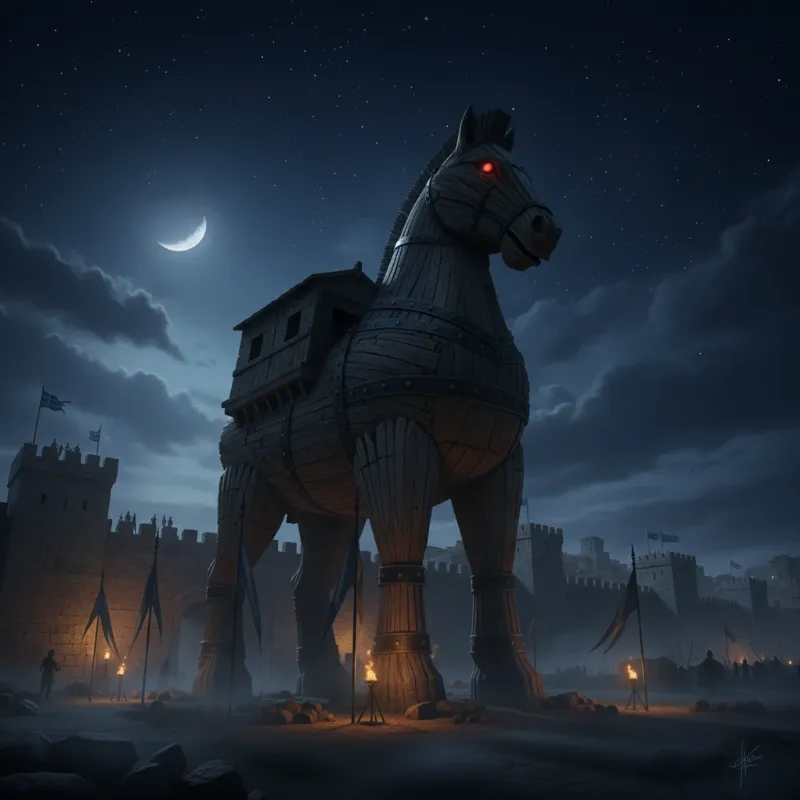 An artistic depiction of the giant wooden Trojan Horse sitting before the imposing gates of the ancient city of Troy at night, illustrating the trojan horse true story.
Archaeological Evidence: Digging for the Truth
If the Trojan Horse were real, one would expect to find some physical evidence at the site of ancient Troy. The search for this legendary city led archaeologists to Hisarlik, a hill in modern-day Turkey. Beginning in the 1870s with the controversial work of Heinrich Schliemann, excavations revealed not one, but multiple layers of ancient cities built on top of each other over millennia.
Archaeologists have identified a layer, typically known as Troy VIIa, which shows signs of a violent destruction consistent with a war, dated to around 1200 BCE—the approximate time frame for the Trojan War. Evidence of fire, arrowheads, and skeletal remains suggests a city that was besieged and sacked. This discovery provided a tantalizing link to Homer’s epic, suggesting that a real war did indeed take place. The debate over trojan horse story true or false often hinges on this archaeological context.
However, there is a conspicuous absence of any physical proof of a giant wooden horse. This is not surprising. A structure made of wood would not have survived for over 3,000 years. Furthermore, if the horse was as central to the city’s fall as the legend suggests, the victorious Greeks would likely have destroyed it along with the rest of Troy as a final act of conquest. The lack of direct evidence neither proves nor disproves the story, leaving it in the realm of speculation.
Was the Trojan Horse a Metaphor?
Given the lack of concrete evidence, many scholars and historians propose that the Trojan Horse was not a literal wooden animal but a poetic metaphor or a misinterpretation of a real historical event. This theory offers several compelling possibilities that bridge the gap between myth and reality.
One of the most popular interpretations is that the “horse” was actually a type of siege engine. Ancient armies, including the Assyrians, used large, wooden structures, sometimes covered with damp animal hides to protect against fire, to ram city gates or help soldiers scale walls. It is possible that such a machine, perhaps even named the “Horse” by its creators, was used to breach Troy’s defenses. Over time, storytellers could have embellished this fact, transforming a functional war machine into the fantastical wooden creature we know today. As Dr. Armand D’Angour, a classical scholar, suggests:
“It’s plausible that an ancient siege engine, perhaps one that resembled a horse or was named as such, became the seed for the legendary story. Epic poetry often magnifies the mundane into the magnificent.”
Another theory suggests the horse was a symbol for an earthquake. The region around Troy is seismically active, and the god of the sea, Poseidon, was also known as the “Earth-Shaker” and was strongly associated with horses. It’s conceivable that an earthquake damaged Troy’s walls, allowing the Greeks to finally enter. The “gift” of a horse could have been a symbolic representation of the god’s intervention on behalf of the Greeks. The question of was the trojan horse a true story might be answered not with a simple yes or no, but with an understanding of ancient symbolism.
The Verdict: A Story Too Good Not to Be Told
So, is the trojan horse true story a historical fact? The most honest answer is that we don’t know for certain, but it is highly unlikely to have happened as described in the epics. There is no definitive archaeological proof of its existence, and the literary sources are poetic, not historical. The consensus among modern historians is that the tale is a brilliant work of fiction, a powerful myth that encapsulates the themes of the Trojan War: the conflict between brute strength and cunning intelligence, the hubris of the victors, and the tragic fate of the vanquished.
Whether it was a metaphor for a siege engine, a natural disaster, or a clever military tactic involving disguise and infiltration, the core idea of deception leading to victory is timeless. The story’s power does not lie in its historical accuracy, but in its enduring message. It serves as a cautionary tale about being wary of gifts from enemies and the danger of letting pride cloud judgment.
The legend of the Trojan Horse has embedded itself so deeply in our culture that the term “Trojan horse” is now a common expression for any trick or strategy that causes a target to invite a foe into a protected space. From computer viruses to political infiltration, the legacy of Odysseus’s clever plan continues to resonate. The story survives not because it is a factual account, but because it is a masterful piece of storytelling that speaks to fundamental truths about human nature and warfare.
Frequently Asked Questions (FAQ)
What is the earliest mention of the Trojan Horse?
The earliest surviving literary mention of the Trojan Horse is in Homer’s Odyssey, which is believed to have been composed in the 8th century BCE. The story is referenced as a past event well-known to the characters.
Did the historian Herodotus believe the story was true?
Herodotus, often called the “Father of History,” does not discuss the Trojan Horse in detail, which some scholars find telling. He was known to be skeptical of the more fantastical elements of myths and may have considered the story too unbelievable to be treated as history.
Could the Greeks have built such a large wooden structure?
Yes, the ancient Greeks were skilled shipbuilders and carpenters. The technical ability to construct a large, hollow wooden structure was well within their capabilities. The primary questions are not about their ability, but about the tactical viability and historical reality of such a plan.
Who was inside the Trojan Horse?
According to most versions of the myth, an elite group of Greek warriors was hidden inside. The most prominent among them was Odysseus, the mastermind of the plan. Other heroes mentioned in various accounts include Menelaus, Diomedes, and Neoptolemus.
Why is the story still so famous today?
The story’s fame comes from its dramatic and clever plot, its central role in the fall of Troy, and its powerful symbolism. It represents the ultimate victory of cunning over strength and serves as a timeless warning about deception, which is why the trojan horse true story continues to fascinate us.
