
The tale of the Trojan Horse is one of the most famous stories to emerge from antiquity. A giant wooden horse, a cunning trick, and the fall of a great city—it’s a narrative packed with drama and ingenuity. But as we separate legend from history, a critical question arises: is the Trojan Horse Story True Or False? For centuries, this question has captivated historians, archaeologists, and storytellers alike. While the image of the horse is seared into our collective imagination, the evidence for its existence is far from straightforward. This article will delve into the literary origins, archaeological findings, and scholarly interpretations to uncover the truth behind this enduring myth.
The story itself is a masterpiece of military strategy. After a grueling ten-year siege of the city of Troy, the Greek army, seemingly defeated, sails away, leaving behind a massive wooden horse as a supposed offering to the goddess Athena. Despite warnings from prophets like Cassandra and Laocoön, the triumphant Trojans pull the colossal statue into their fortified city to celebrate their victory. That night, as the city sleeps in a drunken stupor, a hidden door in the horse opens, and a select group of Greek soldiers, led by Odysseus, emerge. They open the city gates for the returning Greek army, leading to the brutal sack and ultimate destruction of Troy. It’s a brilliant story, but did it actually happen? The journey to answer the trojan horse story true or false debate begins by examining its ancient sources. Understanding the origins of the tale provides context, much like exploring the trojan horse greek mythology story in greater detail.
The Literary Origins of the Legend
When people think of the Trojan War, they often think of Homer’s epic poem, the Iliad. However, one of the most surprising facts about the story is that the Trojan Horse is not mentioned in the Iliad at all. Homer’s epic focuses on the final year of the war, detailing the wrath of Achilles and the clashes between heroes like Hector and Achilles, but it ends before the city’s fall. The actual account of the wooden horse comes from other ancient texts, most notably Virgil’s Aeneid.
Virgil’s Aeneid: The Definitive Account
The most detailed and influential telling of the Trojan Horse story is found in the Aeneid, a Latin epic poem written by Virgil in the 1st century BCE. The story is told from the perspective of the Trojan hero Aeneas as he recounts the fall of his city. Virgil’s dramatic narrative gives us all the iconic elements: the construction of the horse, the Greek deception, the debate among the Trojans, and the tragic infiltration. However, it’s important to remember that Virgil was writing epic poetry, not a historical document. His goal was to create a foundational myth for Rome, linking its origins to the heroes of Troy. As such, his work was designed for dramatic effect rather than historical accuracy.
Other Ancient Mentions
While Virgil provides the most famous version, he wasn’t the first to mention the horse. The story is briefly referenced in Homer’s other epic, the Odyssey. In it, Odysseus is at the court of King Alcinous, and a bard sings of the hero’s exploits, including his strategy with the wooden horse that led to Troy’s downfall. Mentions of the story also appeared in other fragmented works of the Epic Cycle, a collection of ancient poems that narrated the entire saga of the Trojan War, though most of these have been lost to time. These earlier, more fleeting references suggest the story was part of a well-established oral tradition long before Virgil wrote it down in its most famous form.
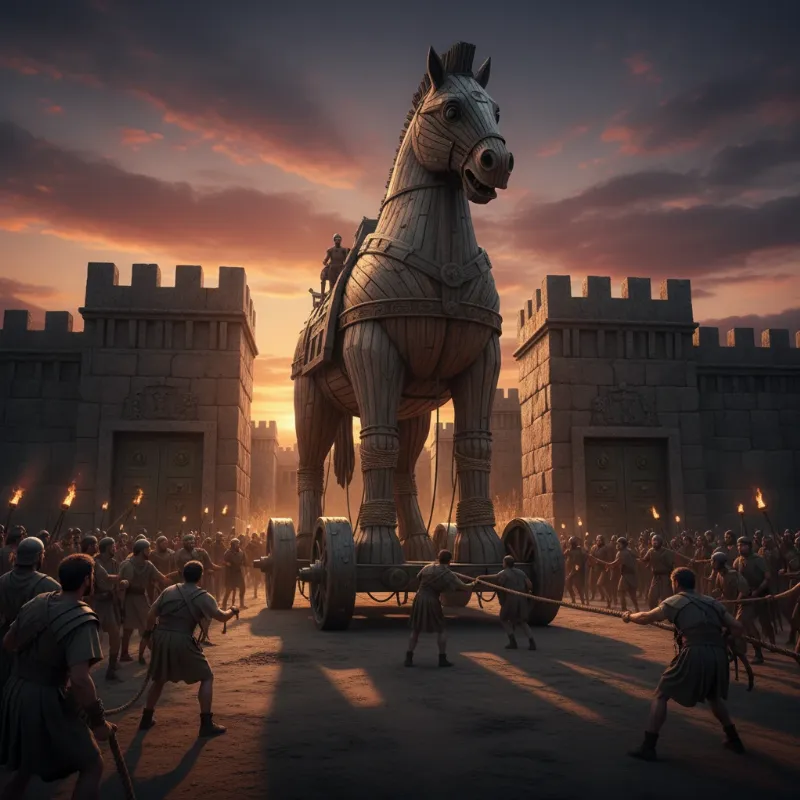 A detailed depiction of the giant wooden Trojan Horse being pulled into the ancient city of Troy, addressing the question of whether the trojan horse story is true or false.
Archaeological Evidence: Digging for Truth at Troy
For a long time, the city of Troy itself was considered a myth. That changed in the 1870s when archaeologist Heinrich Schliemann began excavations at a site called Hisarlik in modern-day Turkey. His findings revolutionized our understanding of the Bronze Age and provided a physical location for the legendary city. But did he find any evidence of a giant wooden horse?
The short answer is no. Archaeologists have found no physical proof that the Trojan Horse ever existed. The very nature of the object—a structure made of wood—means it would be highly unlikely to survive for over 3,000 years. However, the excavations at Hisarlik have revealed something else that is crucial to the trojan horse story true or false debate: evidence of a real war.
The Layers of Troy
The site of Hisarlik is not a single city but a mound composed of at least nine different cities built on top of one another over millennia. The layer designated Troy VIIa is the most likely candidate for the city of Homeric legend. Archaeological evidence from this layer, dating to the late Bronze Age (around 1200 BCE), shows clear signs of a violent end. There is evidence of widespread fire, skeletal remains found in the streets, and arrowheads embedded in the walls, all of which point to a city that was besieged, conquered, and destroyed by an enemy force. This discovery suggests that a historical Trojan War, or at least a major conflict, likely did occur. The question of whether this conflict was real is central to understanding the legend, similar to how one might ask if the trojan horse story true.
Was the Trojan Horse a Metaphor?
Given the lack of direct physical evidence, most modern historians and archaeologists believe the Trojan Horse was not a literal creation. Instead, they propose it was a metaphor or a poetic embellishment representing something else entirely. This interpretation allows for a historical basis for the war while explaining the fantastical element of the story.
A Siege Engine
One of the most popular and plausible theories is that the “horse” was actually a type of siege engine. In ancient warfare, armies often used large wooden structures, sometimes covered in damp horse hides to protect them from fiery arrows, to ram city gates or allow soldiers to scale walls. Dr. Sarah Miller, a historical strategist, explains:
“A battering ram or a wheeled siege tower fits the general description of the Trojan Horse. It would have been a large wooden structure that brought soldiers to the gates and breached the city’s defenses. It’s very possible that an oral tradition over centuries transformed a functional piece of military hardware into the more mythical and memorable image of a horse.”
This theory is compelling because it grounds the story in real-world military tactics of the era. A siege tower, perhaps one nicknamed “The Horse” by the Greeks, could easily have been exaggerated into the legendary creature over generations of storytelling.
An Earthquake
Another fascinating theory suggests the horse was a symbol for an earthquake. The god of the sea, Poseidon, was also the god of horses and earthquakes. The region around Troy is seismically active. It’s possible that an earthquake damaged the walls of Troy, allowing the Greeks to finally enter the city. In this scenario, the “Trojan Horse” was a symbolic representation of Poseidon’s power, an event that the poets later personified as a literal wooden horse given as an offering to the gods. The destruction came from a “horse” sent by the gods, just not in the way the story is usually told.
A Ship as a Trick
A third interpretation, proposed by some naval historians, is that the “horse” was a ship. The trick might have involved a ship bearing a peace offering or tribute, which was allowed into the harbor. This ship could have carried hidden soldiers who then opened the gates for the main force. The word for a Phoenician boat at the time, “hippos,” also means horse. It’s conceivable that a translation error or poetic license over time confused a ship for a literal horse. This aligns with the deceptive nature of the story, even if the vehicle of that deception was different.
The Verdict: Myth Rooted in Reality
So, is the trojan horse story true or false? The overwhelming consensus among historians is that the story of the giant wooden horse is a myth. There is no archaeological evidence to support the existence of such a structure, and its first detailed account appears in a work of epic poetry written nearly a thousand years after the supposed event. The story’s fantastical elements and its absence from the primary war epic, the Iliad, further point to its status as a literary invention.
However, dismissing the story entirely would be a mistake. The legend is likely an allegorical or metaphorical telling of a real historical event. The Trojan War, or a series of conflicts in the late Bronze Age, almost certainly happened. The city of Troy was real, and it was violently destroyed. The Trojan Horse is best understood as a brilliant piece of storytelling, a powerful symbol of cunning and deception that evolved to explain the fall of this mighty city. It encapsulates the idea that cleverness can triumph over brute force. Just as we question if the is the trojan horse story in the bible, we must separate foundational stories from historical records.
The Trojan Horse story has endured for millennia not because it is a factual report, but because it is a timeless tale of ingenuity and hubris. It serves as a powerful cautionary tale about the dangers of accepting gifts from enemies and celebrating victory too soon. While the wooden beast itself likely never stood before the gates of Troy, the war it ended was very real, and the legend it created has become a permanent fixture in the history of human conflict and creativity, forever blurring the line between fact and fiction.
Frequently Asked Questions (FAQ)
Did the Trojan War really happen?
Most historians believe that the Trojan War was a real historical conflict, though likely smaller and less dramatic than depicted in the epic poems. Archaeological evidence at the site of Troy (Hisarlik) shows the city was destroyed by violence around 1200 BCE, which aligns with the traditional timeline of the war.
Who wrote the story of the Trojan Horse?
The most famous and detailed account of the Trojan Horse was written by the Roman poet Virgil in his epic poem, the Aeneid, in the 1st century BCE. However, the story was mentioned earlier in other works, including Homer’s Odyssey, suggesting it was part of an older oral tradition.
Why is the Trojan Horse not in the Iliad?
Homer’s Iliad focuses on a specific period in the tenth and final year of the Trojan War, centered on the rage of Achilles. The epic ends with the funeral of the Trojan hero Hector, before the actual fall of the city. The Trojan Horse was part of the story of the city’s final capture, which was detailed in other, now mostly lost, poems of the Epic Cycle.
What is the most likely real story behind the Trojan Horse?
The most plausible theory is that the “Trojan Horse” was a metaphor for a conventional siege engine, such as a large wooden battering ram or siege tower. This piece of military equipment would have been used to breach Troy’s formidable walls and was later romanticized in storytelling as a giant horse.
Was the city of Troy ever found?
Yes, the ancient city of Troy was discovered in the 1870s by archaeologist Heinrich Schliemann at a site known as Hisarlik in modern-day Turkey. Excavations have revealed nine distinct layers of settlement, with the layer known as Troy VIIa showing evidence of destruction consistent with the Trojan War legend.
Could a giant wooden horse have actually been built?
While technically possible, building such a massive structure with Bronze Age tools would have been an immense undertaking. Moreover, moving it across the plain and through the city gates presents significant logistical challenges. The sheer impracticality of the feat is one of the key reasons historians doubt its literal truth.
What does the Trojan Horse symbolize?
The Trojan Horse has become a powerful symbol of deception and cunning. It represents any trick or strategy that causes a target to willingly invite a foe into a securely protected place. The modern term “Trojan horse” is used in computing to describe a malicious program disguised as something benign.
