
The foundation of any meaningful relationship with a horse isn’t built on force or dominance, but on a clear, two-way conversation. Every interaction, from leading your horse out of the pasture to asking for a complex maneuver, is a dialogue. But what if your conversation is getting lost in translation? This is where the right equipment can make all the difference. The Training Halter For Horses, often seen as a simple rope halter, is one of the most effective tools for clarifying your communication and fostering a more responsive, respectful partnership.
Understanding this tool is not about seeking more control, but about achieving greater finesse. Many handlers find that it bridges the gap between a gentle request and a horse’s willing response. To explore the nuances of developing a respectful relationship on the ground, many handlers find value in dedicated horse training ground manners, a practice where the training halter truly shines. Let’s delve into what this halter is, how it works, and how you can use it to build a better connection with your equine partner.
What Makes a Training Halter Different?
At first glance, a rope training halter might seem less substantial than its webbing or leather counterparts. However, its power lies in its design. The key difference is pressure distribution.
A standard flat halter, made of wide nylon or leather straps, spreads pressure over a large surface area. This is comfortable for everyday wear but allows a horse to easily lean into the pressure and ignore subtle cues. It’s like someone trying to get your attention with a wide, open palm on your back—you feel it, but the message is diffused.
A training halter, in contrast, is crafted from a thinner, stiffer rope with strategically placed knots, typically on the noseband. This design concentrates pressure on specific, sensitive areas of the horse’s head. When you apply a cue through the lead rope, the horse feels a distinct, localized signal rather than a dull push. It’s the difference between that open-palm push and a precise tap on the shoulder. This clarity is what makes the training halter such an effective tool for teaching a horse to yield to pressure, which is the basis of all training.
The Principles of Using a Training Halter
To use a training halter effectively, you must embrace a “less is more” philosophy. This tool is an amplifier; it makes your softest cues audible to the horse, so your input must be gentle and precise.
The Language of Pressure and Release
This is the cornerstone of using a training halter. The process is simple: you apply a small amount of pressure to ask a question (“Could you please move your feet?”), and the very instant the horse gives the correct response, you release all pressure. The release is the reward. It tells the horse, “Yes, that’s exactly what I wanted.” This immediate reward system helps the horse learn quickly, building confidence rather than fear.
A Tool for Finesse, Not Force
It is critically important to use a training halter with “soft hands.” A harsh jerk or constant pulling on this type of halter can be severe and painful for the horse, creating anxiety and resistance. The goal is to use the lightest cue possible to get a response. If your horse isn’t responding, your first instinct should be to use a repetitive, rhythmic “bump, bump, bump” of pressure, not to pull harder. This rhythmic pressure is harder for a horse to ignore than a steady pull.
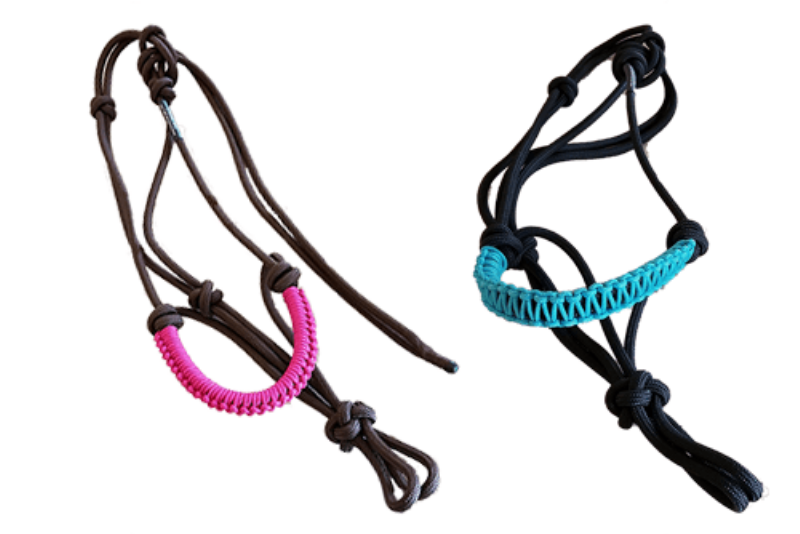 A close-up of a well-fitted rope training halter for horses, showing the specific knots on the noseband.
How to Fit and Tie a Training Halter for Horses
Proper fit and tying are non-negotiable for the halter’s effectiveness and your horse’s safety and comfort. An improperly fitted halter can be ineffective or even cause pain.
Getting the Fit Just Right
A well-fitted rope halter should be snug but not tight. Follow these steps for a correct fit:
- Position the Noseband: The noseband should sit on the bone of the horse’s nose, approximately two fingers’ width below the prominent cheekbone. If it’s too high, it can rub the cheek; if it’s too low, it can put pressure on the soft cartilage of the nose and restrict breathing.
- Check the Connection: The knot where the lead rope attaches should hang below the horse’s chin. You should be able to fit a couple of fingers between the rope and the horse’s jaw.
- Secure the Poll Strap: The strap that goes over the poll (behind the ears) should be tied securely, leaving enough room for comfortable ear movement.
Tying the Essential Knot
The knot used to secure a rope halter is crucial. A correctly tied knot is secure under pressure but can be released easily.
- Pass the tail of the poll strap through the loop on the cheekpiece from the inside out.
- Bring the tail down and wrap it behind the loop.
- Pass the tail through the new opening you just created.
- Pull it snug, ensuring the tail points away from the horse’s eye.
Why this knot matters: This specific knot is designed to tighten on itself in a way that prevents it from becoming impossibly stuck if the horse pulls back. An incorrect knot can become so tight under pressure that you might have to cut the halter off.
Safety First: The Do’s and Don’ts
While a powerful training tool, this halter comes with important safety rules. Its strength is also its biggest liability if used improperly.
- DO use it for active, supervised training sessions where you are communicating with your horse.
- DO practice with soft, quick cues and immediate releases.
- DO double-check the fit and knot every single time you put it on.
- DON’T ever turn a horse out in a rope halter. It is incredibly strong and will not break. If the horse gets caught on a fence post, tree branch, or even its own foot, it can lead to severe or fatal injury.
- DON’T tie a horse solid with a rope halter. If the horse panics and pulls back, the concentrated pressure on the poll can cause serious nerve damage. Always use a breakaway tie ring or a piece of twine that will snap under extreme pressure. There are a variety of horse training tips and tricks that can improve safety during these sessions.
- DON’T use it with harsh, heavy-handed, or jerking motions. This is counterproductive and can damage the trust between you and your horse.
Is a Training Halter Right for My Horse?
A training halter can be beneficial for almost any horse when used correctly. It is particularly helpful for:
- Young horses learning to yield to pressure for the first time. The clarity of the cues can make early lessons much easier to understand. For those interested in the timelines of equine education, exploring topics like what age do race horses start training can provide valuable context.
- Pushy or bargy horses that have learned to lean on and ignore a standard flat halter.
- Refining groundwork with any horse, as it allows for a level of precision that is difficult to achieve with other halters. It’s an excellent tool for many disciplines, including horse training western.
However, for extremely sensitive or head-shy horses, you may need to introduce the halter slowly or start with a softer rope version. The key is to listen to your horse and adjust your tools and techniques accordingly.
Frequently Asked Questions (FAQ)
What is the main purpose of a training halter?
The main purpose is to provide clearer, more precise communication between the handler and the horse during groundwork. Its design applies concentrated pressure, making subtle cues easier for the horse to feel and understand, which encourages a softer, more responsive partnership.
Are rope training halters cruel?
A training halter is a tool, and like any tool, it is only as harsh or as kind as the hands that wield it. When used correctly with gentle pressure and immediate release, it is an effective and humane communication device. However, if used with force, pulling, or jerking, it can be severe and cause pain.
Can I ride my horse with a training halter?
Many people do ride in rope halters, often with a lead rope used as reins, especially in natural horsemanship disciplines. They can be used as a bitless option or fit comfortably under a bridle. However, ensure your horse is responsive to it on the ground before attempting to ride.
How do I clean a rope halter?
Most rope halters made from synthetic materials can be hand-washed with mild soap and water and then hung to air dry. Avoid harsh detergents or bleach, as they can weaken the fibers over time.
Why can’t I leave a training halter on my horse in the pasture?
You should never leave a rope halter on an unsupervised horse. They are designed not to break. If a horse gets the halter caught on an object like a fence or branch, it can panic, pull back, and cause catastrophic injury to itself.
Conclusion
The training halter for horses is far more than just a piece of rope; it’s a tool that can fundamentally change the way you “talk” to your horse. By focusing on the principles of pressure and release, using soft hands, and prioritizing safety, you can unlock a new level of understanding and respect. It encourages your horse to be a willing partner in the dance of training, listening for your subtle cues and responding with lightness. When you pick up a training halter, remember that you are picking up an opportunity for a clearer, more connected conversation.
