
The bond between humans and dogs is a profound connection built on millennia of companionship and mutual support. This relationship reaches an extraordinary level of partnership with service animals, particularly those trained for medical alert tasks. When it comes to epilepsy and seizure disorders, the concept of training a dog for seizure alert is a beacon of hope, offering not just assistance, but a unique form of predictive protection that can transform a person’s life. These incredible animals provide a sense of security and independence that is truly priceless.
Understanding the intricacies of this specialized training is the first step toward appreciating the remarkable capabilities of these canine partners. Unlike seizure response dogs, who are trained to help during or after a seizure, seizure alert dogs possess the innate ability to detect subtle physiological or behavioral changes in their handler before a seizure occurs. While the exact science is still being explored, it’s widely believed that these dogs pick up on specific scent changes, much like dogs trained to detect drops in blood sugar. This early warning, sometimes 15 to 45 minutes in advance, gives the individual precious time to get to a safe place, take medication, or call for help. The journey to harness this natural talent involves a rigorous and dedicated training regimen, a process similar in its dedication to other specialized programs like service dog training new jersey.
The Science and Mystery Behind Seizure Detection
For years, the ability of dogs to predict seizures was considered purely anecdotal. However, a growing body of scientific research is beginning to uncover the mechanisms behind this amazing skill. A pivotal 2019 study published in Scientific Reports found that dogs could indeed detect a specific scent associated with seizures. Researchers collected sweat samples from individuals during seizures and presented them to a group of dogs. The dogs consistently identified the seizure-associated scent with high accuracy.
This confirms the theory that epileptic seizures cause a change in a person’s body chemistry, releasing specific volatile organic compounds (VOCs) that are imperceptible to humans but easily detectable by a dog’s powerful nose. It is this olfactory ability that forms the foundation of seizure alert training.
Dr. Eleanor Vance, a leading veterinary neurologist, explains, > “We are just scratching the surface of understanding canine olfactory capabilities. Their world is a rich tapestry of scents that tell them stories we can’t perceive. For a seizure alert dog, a specific combination of VOCs is like a blaring alarm bell that signals an impending neurological event. The training process is about teaching the dog what that ‘alarm’ means and what to do when they smell it.”
Seizure Alert vs. Seizure Response Dogs
It’s crucial to differentiate between two types of assistance dogs for epilepsy:
- Seizure Alert Dogs: These dogs possess the natural ability to predict an oncoming seizure. They alert their handler proactively, allowing for preparation. This is not a skill that can be universally taught; the dog must have the innate sensitivity to the specific scent cues.
- Seizure Response Dogs: These dogs are trained to perform specific tasks during or immediately after a seizure. This is a learned skill set and is a vital form of support. Their tasks can include:
- Lying next to the person to prevent injury.
- Fetching a phone or medication.
- Activating a medical alert system.
- Finding another person in the house for help.
- Providing comfort and support to help ease the handler out of the postictal phase (the recovery period after a seizure).
While many seizure alert dogs are also trained in seizure response tasks, not all response dogs have the innate ability to alert. The focus of training a dog for seizure alert is to identify and shape that predictive talent.
 An alert and focused Golden Retriever looking intently at its owner, who is sitting on a couch, showcasing the deep bond and attentiveness required for seizure alert dog training.
The Rigorous Path of Training a Dog for Seizure Alert
Training a seizure alert dog is a long and complex process that requires patience, consistency, and a deep understanding of canine behavior. It typically begins when the dog is a puppy and can take up to two years to complete.
Step 1: Selecting the Right Candidate
Not every dog is cut out for this demanding job. The selection process is incredibly stringent. Ideal candidates, often from breeds like Golden Retrievers, Labrador Retrievers, or Poodles, exhibit a specific set of traits:
- Calm Temperament: The dog must remain calm under pressure and not be easily startled or stressed.
- Strong Bond with Handler: A deep, intuitive connection with their owner is paramount. The dog needs to be keenly attuned to their person.
- High Trainability: Intelligence and a willingness to please are essential for mastering complex commands.
- Good Health: The dog must be physically sound and free from genetic conditions that could impede its ability to work.
- Natural Alerting Behavior: Trainers look for puppies or young dogs that naturally show an unusual interest or specific behavior change around a person just before a seizure. This is the raw talent that can be shaped.
Step 2: Foundational Obedience and Socialization
Before any specialized training can begin, the dog must master basic and advanced obedience. This includes perfect leash manners, solid “sit,” “stay,” “come,” and “down” commands, and the ability to remain focused in distracting public environments. This phase is crucial for any service animal, including those undergoing training service dogs atlanta.
Socialization is equally important. The dog must be exposed to a wide variety of sights, sounds, smells, and people to become confident and unfazed in any situation, from a crowded grocery store to a noisy city street.
Step 3: Scent Identification and Alert Shaping
This is the core of training a dog for seizure alert. The process relies on positive reinforcement to connect the seizure scent with a specific alerting action.
- Scent Collection: Trainers collect scent samples (saliva or sweat) from the handler during an actual seizure. These samples are stored in sterile containers and frozen for use in training sessions.
- Scent Introduction: The dog is introduced to the scent in a controlled environment. When the dog shows interest (sniffing the sample), it is immediately rewarded with high-value treats or praise.
- Shaping the Alert: The goal is to teach the dog to perform a clear, unmistakable alert behavior upon detecting the scent. This behavior is chosen based on the dog’s natural tendencies. It could be:
- Nosing or pawing the handler insistently.
- Licking the handler’s hand or face.
- Making eye contact and whining.
- Circling the handler.
- Building Reliability: This process is repeated hundreds, if not thousands, of times. The duration and intensity are gradually increased, and distractions are introduced to ensure the dog will alert reliably, anytime, anywhere.
Step 4: Public Access and Task Training
Once the alert is reliable, the training moves into real-world environments. The dog learns to perform its tasks flawlessly in public, ignoring distractions while remaining focused on its handler. This is where the dog’s training in response tasks is also solidified. The dog learns how to position its body to cushion a fall, how to retrieve a phone, or how to press an alert button. This dual skill set is common in comprehensive programs like service dog training florida.
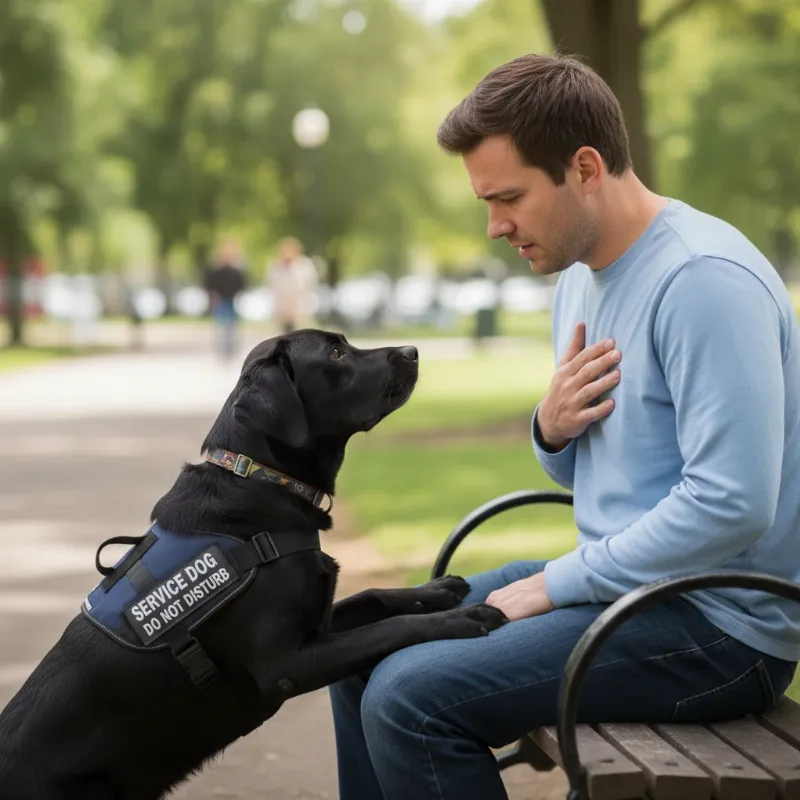 A Labrador Retriever gently but insistently pawing its owner's leg in a public park, demonstrating a clear and trained alert behavior related to seizure alert dog training.
The Impact on Daily Life
Living with a seizure alert dog extends far beyond medical safety. The emotional and psychological benefits are profound. The constant fear of a seizure striking without warning can be debilitating, leading to social isolation and anxiety. A seizure alert dog provides a buffer against this fear.
Handlers report feeling a renewed sense of freedom. They can go to work, attend social events, and even travel with the confidence that their canine partner is watching over them. This partnership is a testament to the power of the human-animal bond and is a core principle behind programs focused on dog training for disabled people.
Frequently Asked Questions (FAQ)
How do I get a seizure alert dog?
The process usually involves applying through a reputable service dog organization. These organizations have specific application processes, and waitlists can be long due to the extensive time and cost involved in training each dog. Some people opt to work with a private trainer to train their own dog, but this requires finding a dog with the right innate abilities.
Can any dog be trained for seizure alert?
No, this is a common misconception. While many dogs can be trained for seizure response, the ability to alert beforehand seems to be an innate talent connected to a dog’s olfactory sensitivity. Only a small percentage of dogs have this natural predisposition.
How much does a seizure alert dog cost?
A fully trained seizure alert dog from an organization can cost anywhere from $20,000 to $50,000. However, most non-profit organizations place dogs with individuals at little to no cost, relying on fundraising and donations to cover the training expenses.
How accurate are seizure alert dogs?
Accuracy can vary between dogs and is often difficult to quantify in scientific terms. However, handlers and their families often report very high reliability. The key is the consistency of the dog’s alert, giving the handler a trustworthy warning signal.
What happens if the dog gives a false alert?
False alerts can happen. Reputable training programs teach handlers how to respond. Generally, it’s advised to always trust the dog’s alert, take precautions, and rest for a few minutes. Consistent positive reinforcement for correct alerts and simply ignoring false alerts helps the dog refine its accuracy over time.
A Partnership for Life
The journey of training a dog for seizure alert is a remarkable testament to the deep capabilities of dogs and their capacity to assist humans in profound ways. It is a partnership forged in trust, dedication, and countless hours of specialized work. For those living with epilepsy, these dogs are not just service animals; they are lifelines, guardians, and constant companions who provide a level of safety and independence that medicine alone cannot. This unique bond empowers individuals to live fuller, less fearful lives, proving once again that the story of dogs is inextricably linked to the story of human well-being.
