
Running with your dog offers a fantastic opportunity to bond, stay active, and boost both your physical and mental well-being. Canine fitness is crucial for overall health, and having a consistent running buddy can be a powerful motivator. However, before you embark on this exciting journey to Train A Dog To Run With You, it’s essential to understand the proper steps and safety precautions. This comprehensive guide will walk you through everything you need to know to transform your dog into the perfect running companion, opening up a world of cool things to train your dog.
The Right Breed and Age for Running
Before commencing any training program, it’s vital to ensure your dog is physically suited for long-distance running. Additionally, it’s generally unsafe for puppies to engage in strenuous running, as their bones are still developing. For most breeds, it’s advisable to wait until your dog is approximately 1.5 years old before introducing them to running.
Even within the same breed, individual dogs possess unique personalities, and some will naturally take to running more enthusiastically than others. Consider your dog’s specific temperament, research their breed’s running characteristics, and, most importantly, consult with your veterinarian for a thorough physical checkup. This will ensure that running is a safe and appropriate activity for your beloved pet.
Master Loose-Leash Walking First
Your dog should master loose-leash walking before you even consider training them to run beside you. A canine companion that pulls on the leash is not only frustrating during a walk but can also be outright dangerous at faster speeds. Remember that the environment is full of exciting distractions, like squirrels and intriguing scents. Therefore, if you want your dog to stay near you, with the leash comfortably slack, you need to make yourself equally rewarding. Utilize treats, toys, and praise to reinforce your dog for maintaining a loose leash. Addressing common behavior issues in dogs like pulling is a foundational step for successful running.
Keeping your dog consistently on one side of you will be essential once you begin running together. If they run in front of you or weave from side to side, they can easily trip you or tangle your legs in the leash, posing a significant safety risk. It doesn’t matter whether you choose the left or right side, but once you pick one, stick with it consistently. Start this training at a walking pace and always be mindful of reward placement. Always give your dog their treats in the exact position you wish to reinforce; for instance, if you want them on your left, only offer treats at your left leg. Once they have thoroughly mastered one side, you can then train them for the other side using a different verbal cue. Many runners also find a hands-free dog leash to be a beneficial tool for improved comfort and control.
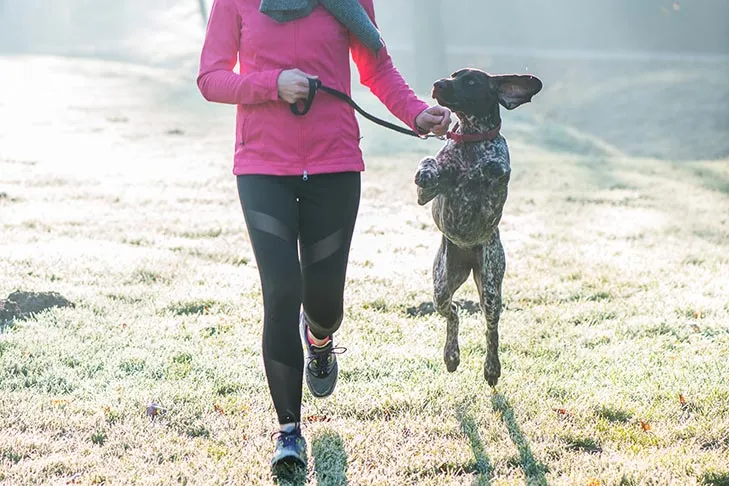 A German Shorthaired Pointer runs gracefully alongside a woman during an early morning jog on a scenic trail.
Introduce Speed Cues Effectively
Now that your dog is adept at politely walking at your side, it’s time to gradually increase your pace. When you’re out for a walk, it’s highly beneficial to have a specific cue, such as “let’s go,” that signals to your dog it’s time to move forward and continue walking. A distinct cue, like “get running” or “move it,” can then be introduced to inform your dog that it’s time to pick up the pace into a run. The more clear and consistent information you provide your dog regarding your expectations, the more adept they will become at responding appropriately to your commands.
To effectively teach the running cue, intersperse short bursts of jogging or actual running with your normal walking pace. Simply give the designated running cue immediately before you accelerate your speed, and then reward your dog promptly when they quicken their pace to catch up and stay by your side. In a similar fashion, you can also teach a cue, such as “whoa,” to signal your dog to slow down or come to a complete stop, ensuring a well-controlled and safe running experience for both of you.
Gradually Building Endurance
With your dog now understanding how to stay by your side and match your pace, the next crucial step is to gradually get them into prime physical shape for running. Just as humans require a slow and steady approach to building strength and endurance, so does your canine companion. Begin by incorporating small, manageable stretches of running into your regular walks. Then, during each subsequent walk, progressively increase the duration of time spent running and concurrently decrease the portion of time spent walking. After a period of several weeks, your dog will have safely adapted and built the necessary stamina for running longer distances. Consistency is key when it comes to building physical stamina, and understanding how to how to get my dog to stop biting might even involve channeling excess energy through structured exercise and consistent training.
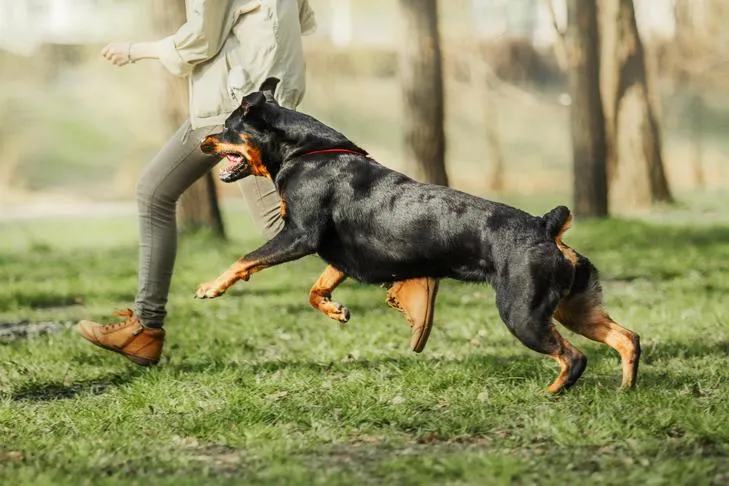 A powerful Rottweiler enjoys a playful run in the park, interacting happily with its owner during an exercise session.
Tips for a Safe and Enjoyable Run
Your dog has successfully been trained and conditioned to be your dedicated running companion. To ensure that every run is both safe and enjoyable for them, keep the following crucial tips in mind:
- Always warm up your dog before you begin running and cool them down when you’re finished by walking for several minutes.
- Be highly aware of prevailing weather conditions. Dogs cannot handle heat and humidity as effectively as humans can, making them susceptible to overheating.
- Always carry water on your runs and offer it to your dog regularly to prevent dehydration.
- Provide your dog with frequent breaks throughout your run, allowing them to recharge, take bathroom breaks, and enjoy their surroundings.
- Only permit your dog to run off-leash in areas where it is explicitly safe and legal to do so, and only if they possess a highly reliable recall command, even amidst significant distractions.
- Continuously observe your dog for any signs that they may have had enough, such as excessive panting, lagging behind you, or attempting to stop. Dogs often run to please their owners, even when they are physically exhausted and wish to rest. Providing a clear way for your dog to communicate needs, such as a bell for dog to ring to go out, reflects a proactive approach to pet care and listening to your dog’s signals.
Extreme Weather Conditioning and Indoor Exercise
Dedicated human runners might brave rain, snow, or intense heat, but there are times when outdoor weather conditions are simply too cold or too hot for your dog’s safety. Even when you can’t run together outdoors, you can still effectively maintain your dog’s physical conditioning through engaging indoor exercise. Depending on their size and energy levels, a vigorous game of fetch down a long hallway or repetitive trips up and down a flight of carpeted stairs can significantly elevate your dog’s heart rate and work their muscles. You can also creatively set up an obstacle course using common household items like a hula hoop or a cardboard box, providing both mental and physical stimulation. Many professional training facilities also offer indoor agility classes, which are excellent for getting your dog running, jumping, and engaged in a structured environment. For puppies who might be prone to how to stop puppy barking at night due to excess energy, indoor games can be a great way to tire them out and promote better sleep.
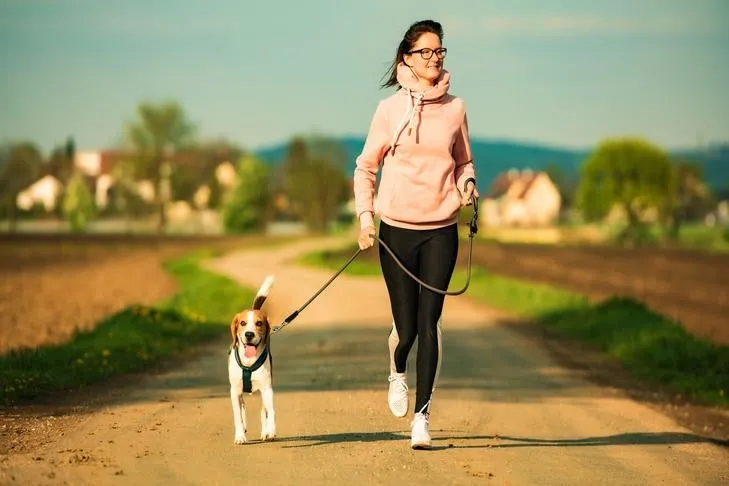 A cheerful Beagle on a leash runs with a woman along a winding trail, enjoying the outdoor activity together.
Many dogs can even be successfully trained to use a treadmill. While some treadmills are specifically designed for dogs, a standard human treadmill can also work perfectly fine, provided its length is appropriate for your dog’s size – larger dogs will naturally require a larger treadmill. Although this is often one of the easiest ways to provide your dog with an indoor workout, you cannot simply place them on it and walk away. It is crucial to thoroughly research proper treadmill training techniques or consult with a professional dog trainer to ensure your dog learns to enjoy the machine and use it safely. Lastly, never ever tie your dog to the treadmill or leave them unsupervised while it is in operation, as this can lead to serious injury.
