
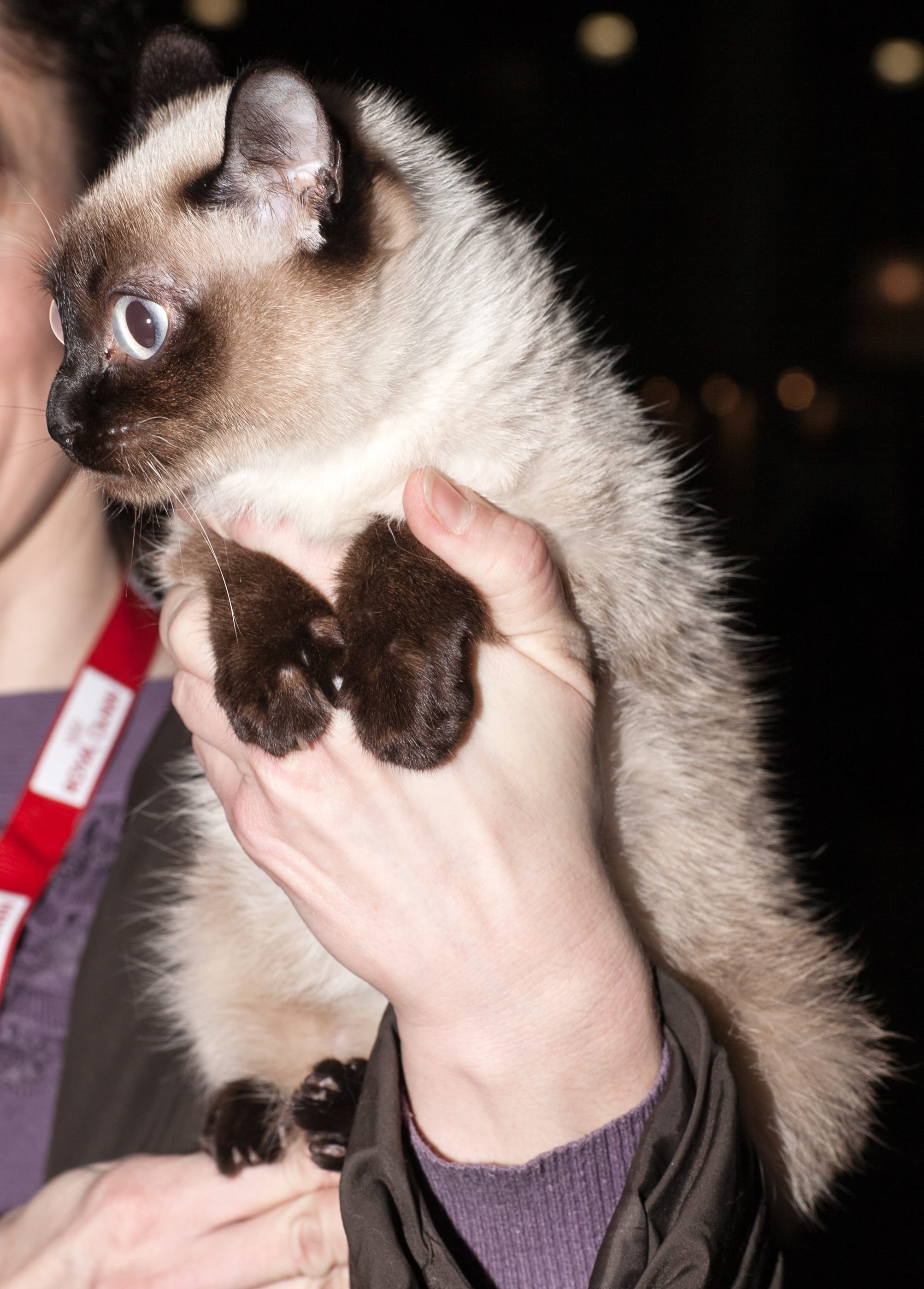
The Toybob is a unique cat breed originating from Russia, distinguished by its naturally small stature and characteristic bobbed tail. The name itself, a blend of “Toy” and “bob,” reflects its playful nature and its most defining physical trait. These cats possess a compact, muscular build that should feel substantial, not delicate. Their short, bobbed tails are the result of spontaneous natural mutations and are a hallmark of the breed. Despite their size, Toybobs are known for their active and playful personalities, often retaining a kitten-like appearance and demeanor even into adulthood, typically reaching full maturity around 1.5 years of age. Interestingly, there is little to no size difference between male and female Toybobs.
Head and Facial Features
The Toybob’s head is a medium-sized, modified wedge shape with rounded contours. The plane above the eyebrows is flat, and the head is slightly longer than it is wide. Rounded cheekbones curve inward towards the mid-muzzle, creating a subtle whisker pinch and ending in a short, gently rounded muzzle. Adult males may exhibit more prominent jowls.
The eyes are a prominent feature, described as large to very large, expressive, and rounded. They possess a slight upward slant, with the line across the outer corners of the eyes leading towards the outer base of the ears. A wide-set eye placement is preferred, contributing to the breed’s characteristically sweet-faced expression.
Ears are medium in height, set about one ear-width apart at the base. While mature males might have a slightly wider ear set, the ears themselves should be as tall as they are wide, with rounded tips and a slight forward tilt.
The muzzle is relatively short and appears square-shaped, with whisker pads that round the contour in proportion to the face, following the wedge line. The nose can be straight or exhibit a slight convex curve.
Body Structure and Tail
The Toybob’s body is small and compact, featuring a solid chest. A broad rib cage and a slight depth of flank contribute to the overall balanced and solid appearance. When viewed from the side in a natural walking position, the back appears almost straight. A primordial pouch is a common and accepted characteristic, adding to the compact body without being indicative of obesity.
The legs are strong and medium in proportion to the body, with hind legs being slightly longer than the front legs. The feet are rounded, and the hind legs have elongated toes.
The tail is the breed’s most distinguishing feature. It is bobbed, meaning it is naturally short and can exhibit a variety of kinks and curves, or it can be almost straight. The minimum length of the tail is two vertebrae, and the maximum length extends to the hock. The bone length defines the tail’s measurement and should be handled gently and unstretched. The very tip of the last bone may feel lightly pointed.
Coat Characteristics
Toybobs come in two coat varieties: Shorthair and Longhair.
The Shorthair coat is medium-short, soft, moderately plush, and slightly crisp to the touch, with medium density. It is resilient and does not lie too close to the body. The topcoat and undercoat are of similar length, with shorter and softer fur on the stomach area and slightly thicker, coarser fur along the spine. The overall texture can vary depending on the coat color. Kittens may have a somewhat wooly coat. Minor seasonal variations in coat density, texture, and length are permissible.
The Longhair coat ranges from semi-long to long and is softer than the shorthair variety. The texture can also vary with coat color. The topcoat is slightly longer than the undercoat, providing a thick, plush feel throughout the body. The coat is typically shorter over the shoulders and may exhibit waves in the stomach area, ruff, and britches. A heavy ruff is desirable. The tail is full and plumed. Ear furnishings and toe tufts are present, but ear tufts are not. Seasonal changes in coat density, texture, and length are also permissible for longhaired Toybobs.
Color, Pattern, and Eye Color
All genetically possible coat colors and patterns are allowed for the Toybob. Buttons, lockets, or small white spots are acceptable and do not disqualify the cat from being considered a bi-color. The soundness of the color and clarity of the pattern are not considered critical factors.
Eye colors are related to coat color and can include green, aqua, gold, copper, yellow, or hazel. Blue eyes are permissible in solid white, calico, bi-color, van, and pointed coat patterns. Odd-eyed cats are also accepted in solid white, calico, bi-color, and van patterns. When all other points are equal, preference is given to the cat with more vivid eye color.
Permissible Outcross
The only permissible outcross for the Toybob is with the Russian Domestic Shorthair and Longhair breeds that share a similar phenotype and lack any structural mutations.
Penalties and Disqualifications
Certain traits are penalized, including an oversized cat, a narrow head, small eyes, eyes set too close, a narrow muzzle, a weak chin, excessively large ears, longer necks in adult cats, delicate boning, an elongated body, a short, tight, close-lying coat, and ear tufts on the Longhaired Toybob.
Disqualifiable offenses include crossed eyes, a docked tail, complete absence of a tail or a tail extending past the hock (without stretching), rapid oscillation of the eyes, the Dominant Blue Eye (DBE) gene in inappropriate coat patterns, disproportionately short legs relative to the cat’s overall body balance, extra toes, evidence of wild ancestry (such as glitter), and an undernourished or frail appearance.
