
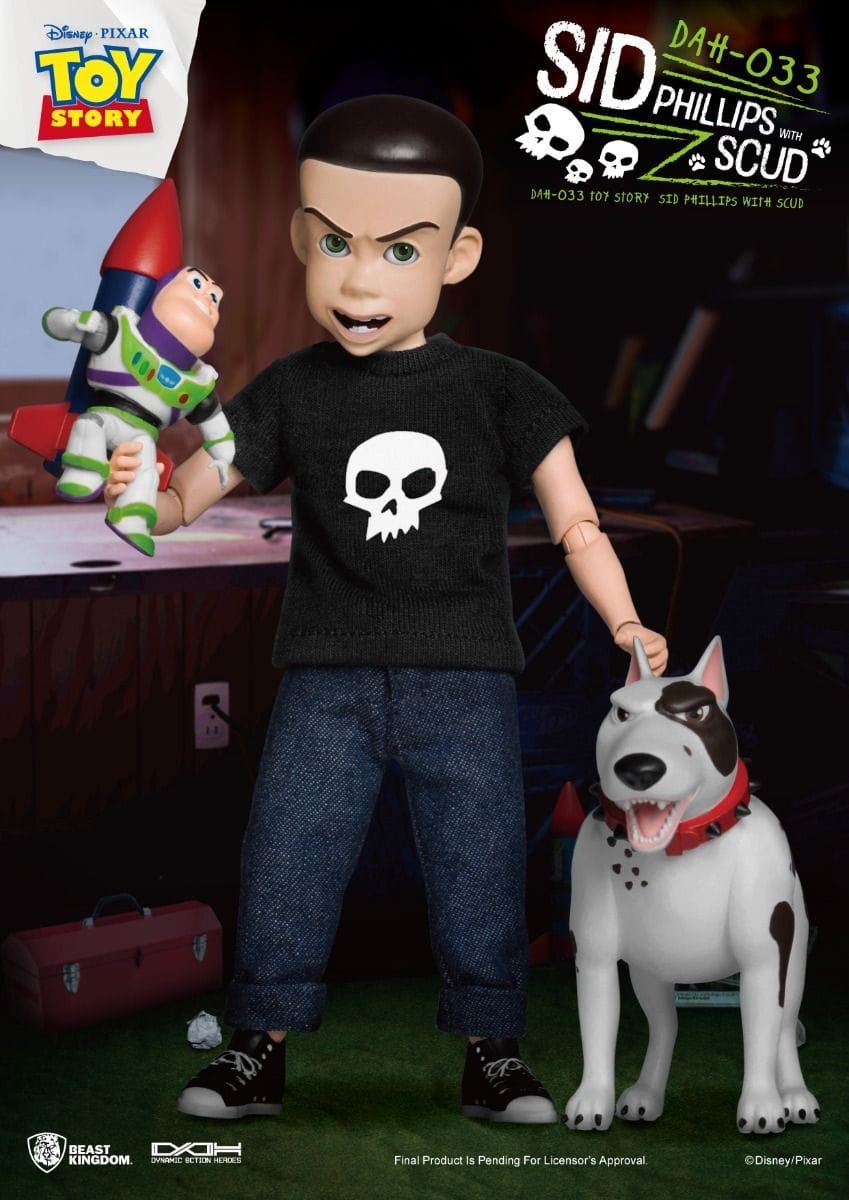
When you think of dogs in Pixar’s beloved “Toy Story” universe, your mind might immediately jump to Slinky Dog, Woody’s loyal spring-powered companion. However, nestled within the chaotic adventures of Andy’s toy collection is another canine presence, often overlooked but certainly memorable: Scud. This bull terrier, belonging to the malicious neighborhood kid Sid Phillips, embodies a different facet of the human-canine relationship, one often characterized by fear and a lack of understanding. Scud’s role, though antagonistic, is crucial in highlighting the vulnerability of toys and the importance of responsible pet ownership, making him a surprisingly significant character in the overarching narrative of “Toy Story.”
Scud’s introduction in the first “Toy Story” film immediately sets him apart from the more friendly animals we encounter. He’s not a pet to be cuddled; he’s a tool of intimidation. Sid uses Scud to terrorize the toys, often siccing him on them to tear them apart or simply to instill fear. Scud’s menacing growls, sharp teeth, and relentless pursuit paint a picture of a dog that is, at best, poorly trained and, at worst, abused or neglected. This portrayal serves a vital narrative purpose: it amplifies the stakes for Woody and his friends. Their entire existence is threatened by Sid’s destructive tendencies, and Scud is the physical manifestation of that threat. The sheer terror the toys experience when Scud is around underscores their fragility and their desperate need to remain hidden.
The design of Scud is also noteworthy. He’s depicted as a muscular bull terrier with a scarred snout and a generally unkempt appearance. This physical description complements his aggressive behavior, presenting him as a formidable and slightly unhinged animal. Unlike the whimsical Slinky Dog or the friendly, albeit brief, appearances of other animated pets, Scud is gritty and realistic in his portrayal of a potentially dangerous dog. His role isn’t to be a lovable companion but to be an obstacle, a symbol of the destructive forces at play in Sid’s world.
One of Scud’s most critical moments occurs when he encounters Woody after Woody has been discarded by Sid. Scud’s instinct is to attack, to tear apart this new “toy.” However, Woody, through his own ingenuity and the help of the other toys, manages to evade Scud. This sequence highlights the intelligence and resourcefulness of the toys, but it also reinforces Scud’s role as a relentless antagonist. He doesn’t exhibit the playful curiosity of a typical pet; his actions are driven by a more primal, aggressive instinct, likely exacerbated by Sid’s own destructive nature.
Interestingly, the narrative doesn’t necessarily demonize Scud himself but rather the environment he’s placed in. Sid is the true villain, a child who lacks empathy and uses both his toys and his dog for cruel amusement. Scud, in this context, becomes a victim of circumstance, a powerful animal whose natural instincts are channeled into destructive behavior by his owner. This nuanced portrayal prompts viewers, especially younger ones, to consider the impact of human actions on animal behavior. It subtly suggests that a dog’s aggression is often a reflection of its upbringing and training, or lack thereof.
The film’s climax, where the toys come to life and confront Sid, indirectly leads to Scud’s eventual “demise” within the narrative. After Sid is thoroughly terrified by the resurrected toys, he ultimately reforms his ways. Scud, presumably, is no longer subjected to Sid’s cruel games. While the film doesn’t explicitly show Scud’s fate, the implication is that he either escapes Sid’s influence or, at the very least, his tormenting of the toys ceases. This resolution offers a sense of justice not just for the toys but also for the animal, suggesting a better future for Scud, free from Sid’s harmful commands.
For those interested in the various canine characters throughout the “Toy Story” saga, understanding Scud’s role is essential. While he may not be a character audiences root for, his presence is undeniably impactful. He serves as a stark contrast to the loyalty and love represented by characters like Slinky Dog and Bullseye in later installments. Scud’s story, brief as it is, is a powerful, albeit unintentional, commentary on animal welfare and the consequences of neglect and poor training. His snarling and chasing might be terrifying for the toys, but they also serve as a catalyst for the toys’ ultimate triumph and a subtle lesson for the audience.
Exploring the nuances of characters like Scud reminds us that even the most minor roles can carry significant thematic weight. His presence in “Toy Story” is a reminder that not all dogs are depicted as perfect companions, and that their behavior is deeply intertwined with human influence. The story of Scud, the bull terrier who served as Sid’s menacing accomplice, is a testament to the complex and often challenging realities of the human-animal bond, subtly woven into the fabric of a beloved animated adventure. If you’re curious about other dogs that played a role in animated films, you might find Sids dog on Toy Story or Toy Story Scud Dog to offer further insights into these memorable canine characters.
