
The Tonkinese cat is a captivating breed celebrated for its distinctive appearance and engaging personality. This guide delves into the official breed standards, providing an in-depth look at the physical characteristics and the stunning array of colors that define the Tonkinese. Understanding these standards is crucial for breeders, enthusiasts, and anyone looking to appreciate the nuances of this beautiful feline.
Understanding the Tonkinese Breed Standard
The Tonkinese is recognized for its balanced and athletic build, embodying an ideal midway point between the cobby and svelte body types. This breed should present an image of an alert, active cat with well-developed musculature, often appearing heavier than expected for its medium size. Proportion and balance are paramount, taking precedence over sheer size.
Head and Facial Features
The head of a Tonkinese is a modified wedge with gently rounded contours, typically longer than it is wide, complemented by high, subtly planed cheekbones. The muzzle is blunt, with its width matching its length. A slight, gentle curve forms the whisker break, aligning with the wedge’s lines. A minimal stop is present at eye level. When viewed in profile, the chin’s tip aligns vertically with the nose’s tip, creating a smooth transition from the nose to the stop and then to the forehead, which features a slight convex curve.
Alert and medium-sized, the ears are set wide at the base with oval tips, positioned both on the sides and top of the head. The ear’s covering is very short and lies close to the skin, allowing the leather to show through.
The eyes are a striking feature, possessing an open almond shape and slanted towards the outer edge of the ear, following the cheekbones. Their size is proportionate to the face. Eye color is highly valued for its depth, clarity, and brilliance, best observed in natural light.
Body and Structure
The Tonkinese torso is medium in length, showcasing significant muscular development without appearing coarse. It strikes a balance between extreme body types, prioritizing harmonious proportions. The abdomen is taut, well-muscled, and firm, contributing to the cat’s athletic appearance.
Legs are fairly slim and proportionate to the body in length and bone structure, with hind legs being slightly longer than the front. Paws are more oval than round and appear trim, with five toes in the front and four in the rear. The tail is proportionate in length to the body and tapers to a fine point.
Coat and Color
The coat is medium-short, lying close to the body, and characterized by its fine, soft, and silky texture, possessing a lustrous sheen.
Body color can be lighter in younger cats and may show less contrast in older ones. For dilute colors, achieving full body color can take up to 16 months, with cats tending to darken as they age. Point color—the markings on the mask, ears, feet, and tail—should be densely marked but blend gently into the body color. Except in kittens, the mask and ears typically connect via tracings. The nose leather color should correspond to the point color’s intensity. A greater contrast between points and body color is noted in the champagne and platinum varieties compared to the natural and blue.
Penalties are given for extreme ranginess or cobbiness, a definite nose break, or round eyes. Disqualifications include yellow eyes in mink colors, white lockets or buttons, crossed eyes, and tail faults.
Exploring Tonkinese Colors
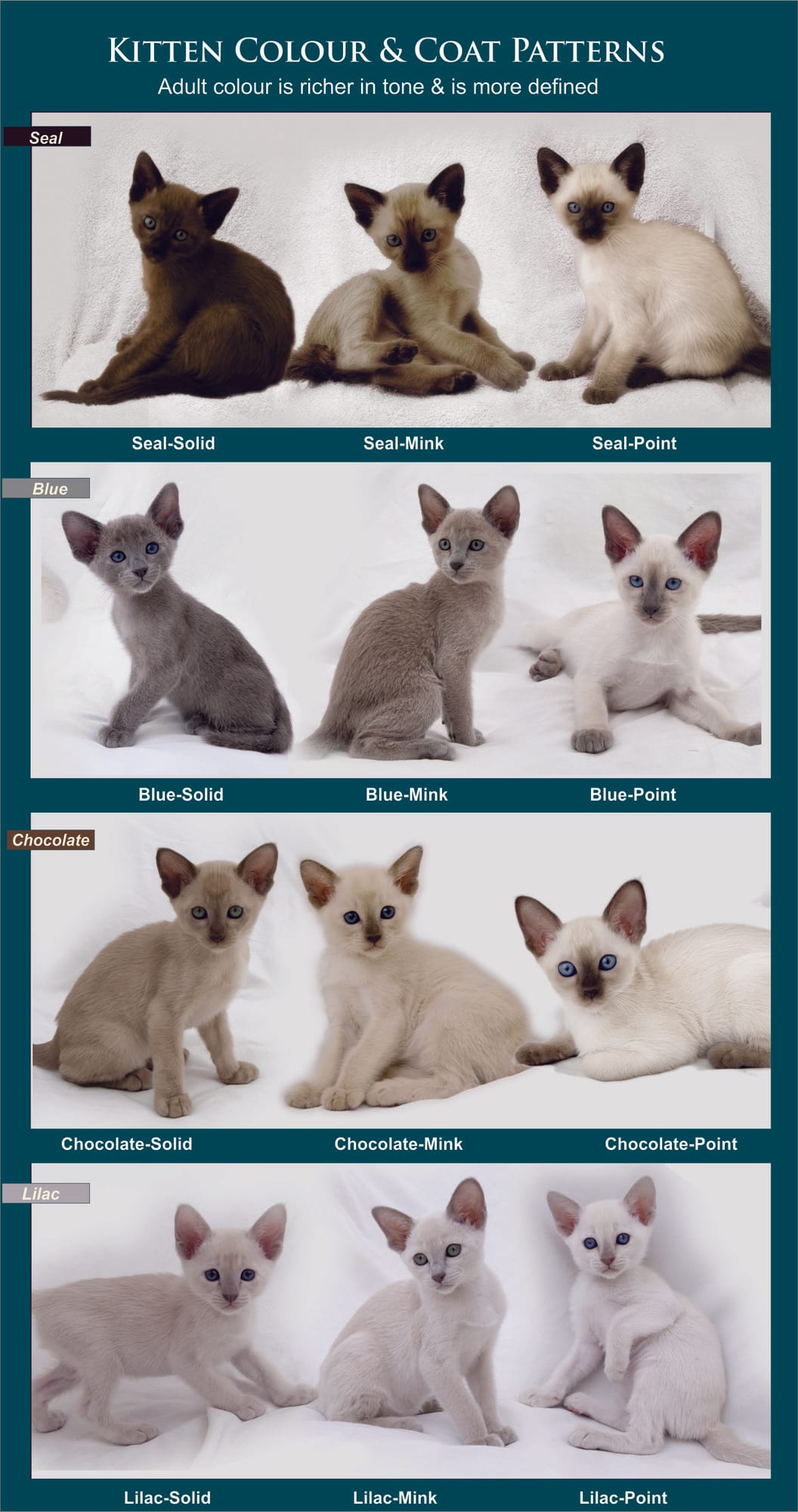
The Tonkinese breed exhibits a stunning spectrum of colors, broadly categorized into Mink, Solid, and Pointed patterns, each with distinct characteristics and eye colors.
Mink Colors
Mink-colored Tonkinese cats have a rich, even body color that shades imperceptibly to a lighter hue on the underparts, with a distinct contrast between body and points. Their signature eye color is aqua.
- Natural Mink: Features a medium brown body with acceptable ruddy highlights, dark brown points, dark brown nose leather, and medium to dark brown paw pads.
- Champagne Mink: Showcases a buff-cream to beige body with acceptable reddish highlights, medium brown points, cinnamon-brown nose leather, and cinnamon-pink to cinnamon-brown paw pads.
- Blue Mink: Characterized by a soft, blue-gray body with warm overtones, slate blue points, blue-gray nose leather, and blue-gray paw pads (which may have a rosy undertone).
- Platinum Mink: Displays a pale, silvery-gray body with warm overtones (not white or cream), frosty gray points, lavender-pink to lavender-gray nose leather, and lavender-pink paw pads.
Solid Colors
In solid-colored Tonkinese cats, the body color can be a slightly lighter shade of the point color, with minimal contrast. Their eye color ranges from green to yellow-green.
- Natural Solid: Features a sable brown body and points, dark brown nose leather, and medium to dark brown paw pads.
- Champagne Solid: Has a golden tan to light coffee-brown body, medium brown points, cinnamon-brown nose leather, and cinnamon-pink to cinnamon-brown paw pads.
- Blue Solid: Displays a slate blue body with warm overtones, slate blue points, blue-gray nose leather, and blue-gray paw pads.
- Platinum Solid: Characterized by a dove gray body, frosty gray points, lavender-pink to lavender-gray nose leather, and lavender-pink paw pads.
Pointed Colors
For pointed Tonkinese cats, the body color is off-white, with shading that relates to the point color, creating a marked contrast. Their eye color is blue.
- Natural Point: Has a fawn to cream body, dark brown points, dark brown nose leather, and medium to dark brown paw pads.
- Champagne Point: Features an ivory body with buff-tan shading, medium brown points, cinnamon-brown nose leather, and cinnamon-pink to cinnamon-brown paw pads.
- Blue Point: Displays an off-white body with warm gray shading, slate blue points, blue-gray nose leather, and blue-gray paw pads.
- Platinum Point: Characterized by a pearly white body, frosty-gray points, lavender-pink to lavender-gray nose leather, and lavender-pink paw pads.
Color Class Numbers
For reference, the following color class numbers are used in show standards:
- Blue Mink: 2600 (male), 2601 (female)
- Champagne Mink: 2602 (male), 2603 (female)
- Natural Mink: 2606 (male), 2607 (female)
- Platinum Mink: 2608 (male), 2609 (female)
- Pointed Class (Natural, Blue, Champagne, Platinum): 2636 (male), 2637 (female)
- Solid Class (Natural, Blue, Champagne, Platinum): 2626 (male), 2627 (female)
- AOV (All Other Variations): 2698 (male), 2699 (female)
The Tonkinese breed standard emphasizes a harmonious blend of structure, color, and temperament, making them a truly unique and cherished companion animal.
