
For centuries, the tale of a giant wooden horse has captivated the world. It’s a story of cunning, deception, and the dramatic fall of a great city. The image of Greek soldiers pouring out of the belly of a wooden beast to conquer the impenetrable city of Troy is one of the most enduring legacies of ancient mythology. But behind this epic legend lies a pressing question that historians and archaeologists have debated for ages: what is The True Story Of The Wooden Horse? Did this ingenious trick really happen, or is it merely a powerful piece of fiction that has stood the test of time?
The narrative is a cornerstone of Western literature, a symbol of the ultimate Trojan horse—a seemingly harmless gift that conceals a sinister purpose. We’ve all heard the story, but few know where it truly comes from or the surprising lack of evidence supporting its literal interpretation. As we peel back the layers of myth, we uncover a fascinating exploration of ancient warfare, masterful storytelling, and the blurred line between historical fact and legendary embellishment. This journey takes us from the poetic verses of ancient bards to the dusty archaeological digs of modern Turkey, all in search of the truth. Understanding this tale is similar to grasping other foundational myths, like the story of the trojan horse greek mythology, where symbol and narrative carry immense weight.
The Legend as Told by the Ancients
Interestingly, the most famous account of the Trojan War, Homer’s Iliad, ends before the city of Troy falls. It focuses on the wrath of Achilles and concludes with the funeral of the Trojan hero Hector. The epic poem describes the brutal, decade-long siege, but it never actually mentions the wooden horse. So, where did the story come from?
The most detailed and influential version comes from the Roman poet Virgil in his epic, the Aeneid, written centuries after the supposed events. Virgil tells the story from the perspective of the Trojan prince Aeneas. He describes how the Greeks, pretending to give up and sail for home, left behind a colossal wooden horse as a supposed offering to the goddess Minerva to ensure their safe voyage. Despite the dire warnings of the priest Laocoön, who famously declared, “I fear the Greeks, even when they bear gifts,” the Trojans were persuaded to bring the effigy into their fortified city.
They tore down a section of their own supposedly impregnable walls to get it inside. That night, while the Trojans celebrated their apparent victory, a Greek soldier named Sinon released the elite force of warriors hidden within the horse. They opened the city gates for the returned Greek army, and Troy was sacked and burned to the ground. This narrative is a masterpiece of drama and irony, but it was written with a specific purpose: to create a foundational myth for Rome, linking its origins to the heroic survivors of Troy. Other, more fragmented accounts also exist in Greek literature, such as Homer’s Odyssey, where the story is recounted by characters who were there, cementing its place in the mythological canon.
Searching for Troy: The Archaeological Clues
For a long time, Troy itself was considered a myth. That changed in the 1870s when German archaeologist Heinrich Schliemann began excavating a hill in modern-day Turkey called Hisarlik. He was a passionate, if somewhat reckless, amateur obsessed with proving Homer’s epics were based on historical fact.
Schliemann’s excavations revealed that Hisarlik was not one city but at least nine, built in layers on top of one another over thousands of years. He triumphantly declared one of these layers, Troy II, to be the city of King Priam from the Iliad and even unearthed a cache of gold he called “Priam’s Treasure.” However, modern archaeologists later determined that Troy II was far too old to be the setting of the Trojan War, which is now generally associated with the layers known as Troy VI or Troy VIIa, dating to the Late Bronze Age around 1250 BCE.
 An archaeological dig showing the layered ruins of the ancient city of Troy, which is central to the true story of the wooden horse, under a clear sky.
These layers show evidence of a powerful, fortified city that was indeed destroyed in a violent conflict, with signs of fire and warfare. This discovery was monumental because it grounded the Trojan War in a real place and a real historical event. It proved that a great city, matching the description of Troy, existed and was destroyed around the time the war was said to have taken place. But while archaeologists found arrowheads, shattered walls, and skeletons, they found no trace of a giant wooden horse. The absence of evidence isn’t evidence of absence, of course—a wooden structure wouldn’t survive for over 3,000 years. But it leaves the central element of the story floating in the realm of the unproven.
Unpacking the True Story of the Wooden Horse: Modern Theories
Given the lack of direct physical evidence, many scholars now believe the true story of the wooden horse is not a literal one. Instead, the horse may be a poetic metaphor for something more grounded in the reality of ancient warfare. Several compelling theories have emerged over the years.
Theory 1: The Siege Engine
The most popular and practical theory suggests the “wooden horse” was actually a sophisticated siege engine. The Assyrians, who were military innovators of the era, were known to use large, wooden siege machines, often covered in damp animal hides to protect them from flaming arrows. These machines, which included battering rams and mobile assault towers, were sometimes named after animals. It is plausible that the Greeks, perhaps with Assyrian influence, built a large battering ram or tower that vaguely resembled a horse in shape or was nicknamed as such.
“To a society that revered horses as symbols of power and war, nicknaming a powerful new weapon ‘The Horse’ would have been a natural fit,” explains Dr. Eleanor Vance, a classical historian specializing in Homeric studies. “The storytellers, years later, would have taken that kernel of truth and spun it into the fantastical, divine-inspired trick we know today.”
This interpretation transforms the story from a fantastical ruse into a more recognizable tale of military innovation. The idea of breaching Troy’s famous walls with a powerful new weapon makes perfect tactical sense.
Theory 2: A Ship as a Trojan Horse
Another theory proposes that the “horse” was a metaphor for the ships that carried the hidden soldiers. The Greek poet Pausanias suggested the story was a reference to a ship bearing a horse figurehead that brought the soldiers back to Troy’s shores under the cover of darkness. In ancient times, ships were often dedicated to gods, and an offering of a ship in the form of a horse to the sea god Poseidon (who was also the god of horses and earthquakes) would have been a plausible religious gesture.
This idea aligns well with the maritime nature of the Greek campaign and offers a less fantastical, yet still clever, explanation for the surprise attack. The Trojans would have been focused on the sea, and a single, decorated ship left behind could have been misinterpreted as a genuine offering. The decision to accept or reject it could still cause debate, as discussed in the context of trojan horse story true or false.
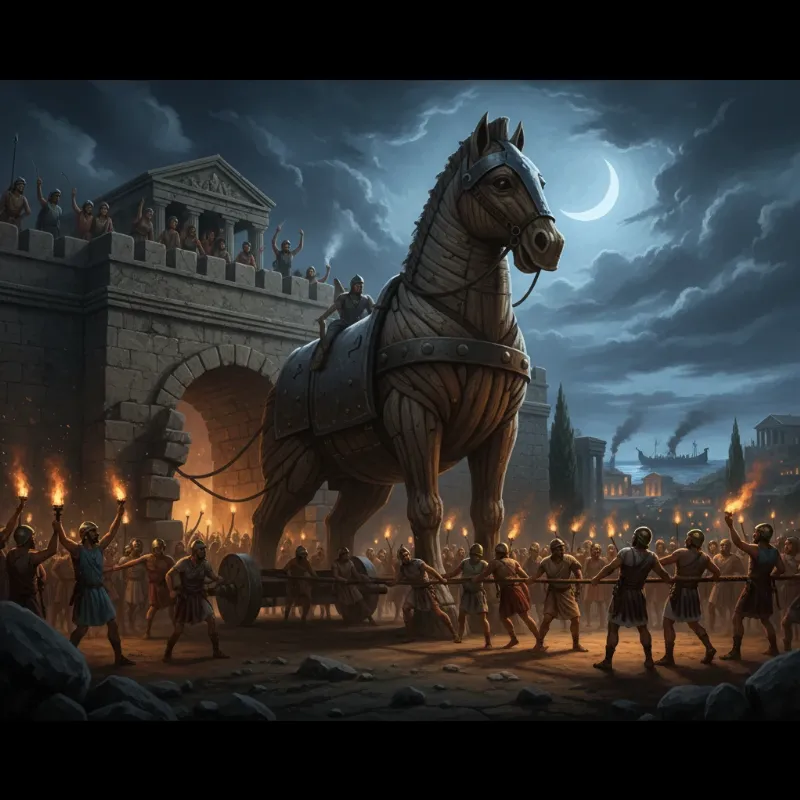 A dramatic illustration of the colossal wooden horse being pulled into the city of Troy, a key scene in the true story of the wooden horse.
Theory 3: The Earthquake God
A more symbolic theory links the wooden horse to Poseidon, “The Earth-Shaker.” As the god of both horses and earthquakes, his symbol was the horse. The walls of Troy VI show evidence of having been destroyed by a major earthquake, not just warfare. It’s possible that an earthquake damaged Troy’s formidable defenses, allowing the Greeks to finally breach them.
In this scenario, the story of the wooden horse would be a mythological explanation for a natural disaster that the Greeks interpreted as divine intervention on their behalf. The “gift” of the horse would symbolize the destructive power of Poseidon that ultimately led to Troy’s downfall. The story would serve as a way to remember and explain a catastrophic event through the lens of their religious beliefs.
Why the Myth Endures
Regardless of whether it was a siege engine, a ship, or an earthquake, the story of the wooden horse has resonated for millennia because it speaks to timeless themes. It is the ultimate story of brains over brawn, of ingenuity triumphing over brute force. The Trojans had impenetrable walls and had held off the Greek army for ten long years. They were defeated not by a frontal assault but by a psychological trick that exploited their piety and their desire for the war to be over.
The narrative also serves as a powerful cautionary tale about deception and the danger of accepting things at face value. The phrase “Trojan horse” has become a permanent part of our lexicon, used to describe any trick or strategy that involves causing a target to invite a foe into a securely protected bastion or place. From computer viruses to political infiltration, the metaphor is as relevant today as it ever was. Perhaps its enduring power is not so different from other tales of deception and consequence, such as the trojan horse true story which continues to fascinate us with its layers of meaning.
In the end, the true story of the wooden horse may not be a single, verifiable fact but a rich tapestry woven from threads of history, metaphor, and myth. While the physical horse probably never existed, the story points to a real, historical conflict and the very real human traits of cunning, desperation, and hubris that decided its outcome. The legend endures not because it’s literally true, but because it feels true on a much deeper, more human level. It reminds us that sometimes, the greatest threats are the ones we willingly bring inside our own walls.
