
The story of the Trojan Horse is one of the most famous tales from Greek mythology, a legendary account of cunning, deception, and the catastrophic fall of a great city. For ten long years, the mighty walls of Troy had withstood the siege of the Achaean (Greek) army. Frustrated and unable to secure a victory through direct assault, the Greeks turned to a brilliant, albeit devious, strategy conceived by their most clever hero, Odysseus. This is not just a tale of a wooden statue; it’s a profound narrative about the art of war, the blindness of pride, and the devastating power of a single, well-placed lie. The narrative has echoed through centuries, serving as a timeless warning to never underestimate an opponent and to always look a gift horse in the mouth.
The Trojan War itself was a conflict of epic proportions, sparked by the abduction of Helen, the queen of Sparta, by the Trojan prince Paris. This act launched a thousand ships across the Aegean Sea, as a coalition of Greek kingdoms united to reclaim her and restore their honor. Yet, despite the presence of legendary warriors like Achilles and Hector, the war dragged on, turning the fields outside Troy into a graveyard. The city’s defenses were impenetrable, and the Greek forces were nearing a breaking point. It was in this climate of desperation that Odysseus, the king of Ithaca, devised a plan that would win the war not with bronze and muscle, but with wood and wit. For a condensed version of this epic, you might enjoy this trojan horse short story which captures the essence of the tale.
A Cunning Plan: The Birth of the Trojan Horse
The plan proposed by Odysseus was a masterpiece of psychological warfare. The Greeks would construct a colossal wooden horse and offer it as a gift to the Trojans, supposedly as a tribute to the goddess Athena to ensure a safe voyage home. The best Greek soldiers, led by Odysseus himself, would hide inside its hollow belly. The rest of the Greek army would pretend to abandon the siege, sailing their ships away from the Trojan coast, but they would only go as far as the nearby island of Tenedos, where they would wait for a signal.
The construction of this monument fell to Epeius, a master carpenter and artisan. He fashioned a magnificent horse of fir planks, so large that it towered over the landscape. An inscription was carved onto its side, dedicating it to Athena. Once the structure was complete, Odysseus and a select group of warriors climbed inside, the heavy doors sealing them in darkness. The remaining Greek forces burned their camps, creating the illusion of a full retreat, and set sail, leaving the solitary wooden horse on the deserted beach before the gates of Troy.
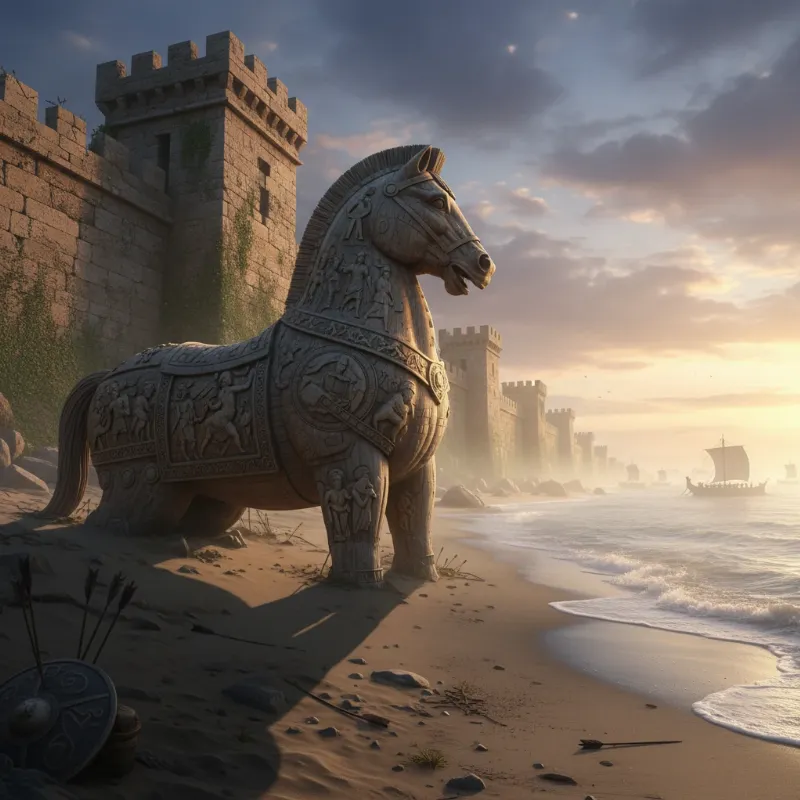 The iconic Trojan Horse from Greek mythology standing ominously outside the impenetrable walls of the ancient city of Troy.
The Deception Unfolds: Selling the Lie
When the Trojans awoke to find the Greek army gone and the strange wooden effigy on their shores, they were overcome with a mix of joy and suspicion. Their decade-long nightmare seemed to be over. As they debated what to do with the horse, they discovered a lone Greek soldier named Sinon, who had been deliberately left behind.
Sinon, a convincing actor, spun a tale of woe. He claimed that he had deserted the cruel Odysseus and that the Greeks had fled. The horse, he explained, was an offering to Athena. He cunningly added that the Greeks had built it to be enormous so that the Trojans would be unable to bring it into their city. If the horse were to be destroyed, he warned, it would bring Athena’s wrath upon Troy. However, if they were to bring it inside their walls, the city would become invincible, protected by the goddess herself.
His story was a calculated manipulation, designed to play on Trojan piety and pride. The Trojans, desperate for a sign of divine favor after years of suffering, were inclined to believe him. The allure of finally winning the war and earning the protection of a powerful goddess began to outweigh their initial caution.
Warnings Ignored: The Voices of Doom
Not everyone was convinced. Two notable figures warned against the Greek gift. The first was Cassandra, a princess of Troy cursed by the god Apollo to utter true prophecies that no one would ever believe. She frantically warned her people that the horse would be their undoing, but her pleas were dismissed as her usual madness.
The second warning came from Laocoön, a Trojan priest of Poseidon. He was far more direct, famously declaring, “Timeo Danaos et dona ferentes” – “I fear the Greeks, even when they bring gifts.” To prove his point, he hurled a spear into the horse’s flank, and the sound of weapons clashing from within was faintly heard. But at that moment, a horrific omen appeared. Two giant sea serpents emerged from the ocean, slithered onto the shore, and attacked Laocoön and his two sons, crushing them to death.
The Trojans interpreted this shocking event as a sign of divine punishment. They believed that Laocoön had been struck down for disrespecting the sacred offering to Athena. This sealed their fate. Any lingering doubts were erased, and with renewed fervor, they breached a section of their own supposedly impregnable walls to accommodate the massive horse and wheeled it into the heart of their city.
The Fall of Troy: A Night of Slaughter
That night, Troy celebrated its victory with feasts and revelry, believing the war was finally over. Drunk on wine and relief, the city fell into a deep sleep. Under the cover of darkness, Sinon released the latch from the outside, and Odysseus and his hidden warriors descended from the belly of the horse. They were the key that unlocked the city from within.
The Greek soldiers swiftly moved to kill the city’s sentries and open the main gates. A signal fire was lit from the top of the walls, and the Greek fleet, which had been hiding behind Tenedos, sailed back to Troy. The full might of the Achaean army poured into the unsuspecting city. The ensuing slaughter was brutal and absolute. The Trojans, roused from their drunken slumber, were disorganized and easily overcome. The city that had stood for a decade was plundered and burned to the ground in a single night. The Trojan War was over, won not by strength, but by the ultimate act of deception.
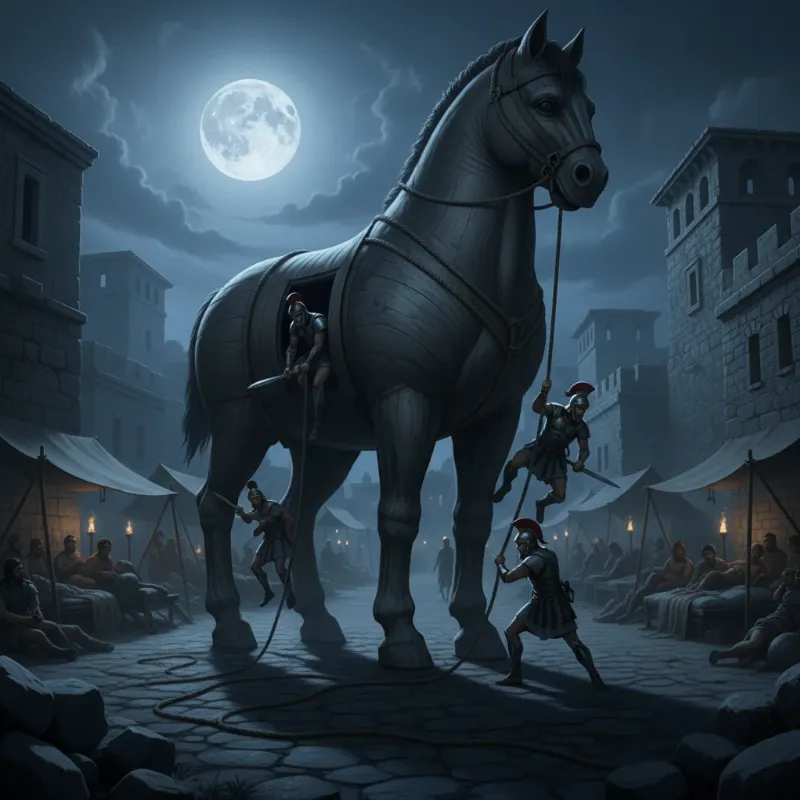 Greek soldiers, led by Odysseus, stealthily emerging from the Trojan Horse into the sleeping city of Troy at night.
Was the Trojan Horse Real? Myth vs. History
For centuries, scholars and historians have debated the veracity of this legendary tale. A key point often missed is that the most famous account of the Trojan Horse comes not from Homer’s Iliad, which ends before the fall of Troy, but from the Roman poet Virgil in his epic, the Aeneid. This has led many to question whether the event actually happened. There is still much discussion around the question of the trojan horse story true or false.
Archaeological evidence for the Trojan War itself is suggestive but not conclusive, centered on the ancient city of Hisarlik in modern-day Turkey. However, there is no direct evidence of a giant wooden horse. Many historians propose that the horse may have been a poetic metaphor for something else. One popular theory is that it represented a powerful siege engine, possibly covered with dampened horsehides to protect it from flaming arrows, which was used to breach the city gates. Another theory suggests the “horse” was a metaphor for an earthquake that damaged Troy’s walls, an event attributed to the god Poseidon, who was also the god of horses. While the literal truth remains elusive, the power of the narrative is undeniable, making it one of the most compelling wooden horse stories ever told.
The Enduring Legacy of the Trojan Horse
Whether fact or fiction, the story of the Trojan Horse has embedded itself deep within Western culture. It serves as the ultimate cautionary tale about the dangers of hubris and the importance of critical thinking. The phrase “Trojan horse” has become a common idiom for any trick or strategy that causes a target to invite a foe into a securely protected bastion or place. In the digital age, it has been famously adapted to describe malicious computer programs that disguise themselves as harmless software to infiltrate computer systems.
The story’s themes are universal and timeless. It explores the duality of human ingenuity—how the same cleverness that can build cities can also be used to destroy them. It is a powerful reminder that the greatest vulnerabilities often lie not in our external defenses, but in our own psychology: our pride, our desires, and our willingness to believe what we want to be true. The story of the Trojan Horse from Greek mythology is more than just a war story; it is a profound lesson on the nature of deception that continues to resonate thousands of years later.
