
Have you ever gazed at the stars and dreamt of soaring through the heavens on the back of a magnificent winged steed? For millennia, one creature has captured this dream like no other: Pegasus, the beautiful, snow-white flying horse of Greek mythology. The Story Of Pegasus The Flying Horse is more than just a simple myth; it’s an epic tale of divine origins, heroic deeds, monstrous foes, and the timeless caution against human pride. This is not just a flying horse story; it is a foundational legend that has galloped through the ages, inspiring art, literature, and even the constellations above. We invite you to journey back to ancient Greece and uncover the incredible saga of this immortal creature, from his shocking birth to his final ascent into the celestial realm.
A Birth of Mythic Proportions
Unlike other horses, Pegasus was not born in a grassy meadow or a quiet stable. His origin story is dramatic, violent, and intrinsically linked to two of the most famous figures in Greek lore: the monstrous Gorgon, Medusa, and the heroic Perseus.
From Monster’s Blood, a Winged Wonder
Before she was a monster with snakes for hair and a gaze that turned men to stone, Medusa was a beautiful priestess in the temple of Athena. Her beauty caught the eye of Poseidon, the mighty god of the sea, who, in an act of desecration, violated her within the sacred temple walls. Enraged by this defilement of her temple, Athena did not punish Poseidon, but instead cursed Medusa, transforming her into the horrifying Gorgon we know today.
Years later, the hero Perseus was sent on an impossible quest: to slay Medusa and bring back her head. Aided by the gods, Perseus succeeded. As his sharp sword severed Medusa’s head from her neck, a miraculous event occurred. From the gushing blood sprang two offspring of her union with Poseidon: the giant Chrysaor and the magnificent, fully-formed winged horse, Pegasus. The name ‘Pegasus’ is believed to derive from the Greek word pēgē, meaning “spring” or “well,” as he was born near the springs of Oceanus. Thus, from a moment of darkness and violence, a creature of pure light and freedom was born.
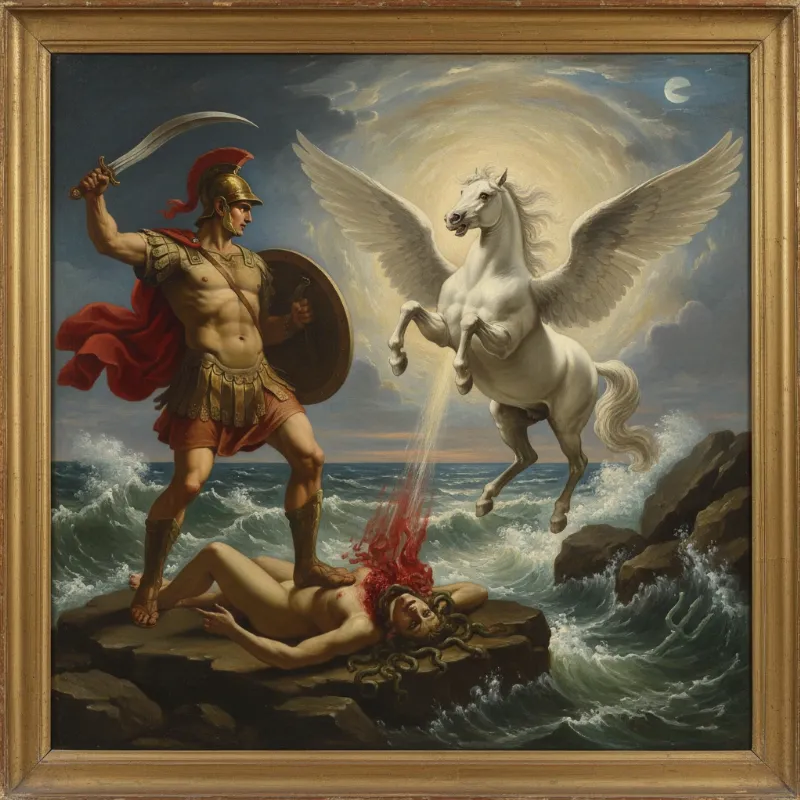 The story of Pegasus the flying horse begins with his dramatic birth from the neck of the slain Medusa, a powerful Greek myth.
The Fountain of Hippocrene
Immediately after his birth, Pegasus took to the skies. He flew to Mount Helicon, the home of the Muses, the goddesses of art and science. Striking the earth with his powerful hoof, Pegasus created a spring of pure, clear water. This spring became known as the Hippocrene, or the “Horse’s Fountain.” It was said that anyone who drank from its waters would be blessed with poetic inspiration. This act established Pegasus not merely as a creature of power, but as a symbol of creativity, inspiration, and the arts, a divine muse in his own right. He spent his early days peacefully among the Muses, a wild and untamable spirit of the heavens.
The Hero Bellerophon and the Golden Bridle
For a time, Pegasus knew no master. He was a free spirit, soaring wherever he pleased. However, a young, ambitious hero named Bellerophon, prince of Corinth, harbored a burning desire to tame the legendary flying horse. He knew that with Pegasus as his mount, he could achieve fame and glory beyond any mortal man.
A Divine Gift from Athena
Bellerophon understood that taming such a divine creature was impossible through brute force alone. He sought the guidance of the wise seer Polyeidos, who advised him to sleep in the temple of Athena. Bellerophon obeyed, and in his dreams, the goddess of wisdom and war appeared before him. She presented him with a magical golden bridle, the key to winning Pegasus’s trust. When Bellerophon awoke, the bridle was lying beside him, a tangible gift from the divine.
Armed with this sacred tool, Bellerophon found Pegasus drinking peacefully at the Pierian spring. Instead of trying to capture the horse, he approached slowly and gently laid the golden bridle upon its head. Pegasus, recognizing the divine magic of the bridle, submitted willingly. In that moment, the untamable spirit of the air and the ambitious heart of a mortal hero were united. This partnership would set the stage for one of the greatest adventures in all of Greek mythology, a truly epic chapter in the flying horse story.
How Do You Confront a Monster?
Bellerophon’s newfound alliance was soon put to the test. He was sent by King Iobates of Lycia on a seemingly suicidal mission: to kill the Chimera. The Chimera was a terrifying, fire-breathing monster, a grotesque hybrid with the head and body of a lion, a goat’s head rising from its back, and a venomous serpent for a tail. Many warriors had tried to slay it, but all had failed, either scorched by its fiery breath or devoured by its powerful jaws.
Bellerophon knew that fighting this beast on the ground was impossible. The true advantage lay in the sky. Mounting Pegasus, he soared into the air, giving him a supreme tactical advantage. He could swoop down to attack and ascend just as quickly, staying clear of the monster’s deadly reach. From his aerial vantage point, Bellerophon rained down arrows on the Chimera, but its hide was thick and resistant. Realizing he needed a more decisive weapon, he devised a clever plan. He attached a block of lead to the tip of his spear and, guiding Pegasus into a steep dive, thrust the spear deep into the Chimera’s fiery throat. The monster’s own flaming breath melted the lead, which flowed down its throat and seared its vital organs, killing the beast from the inside out. The victory was a testament not only to Bellerophon’s courage but to the incredible power and agility of Pegasus.
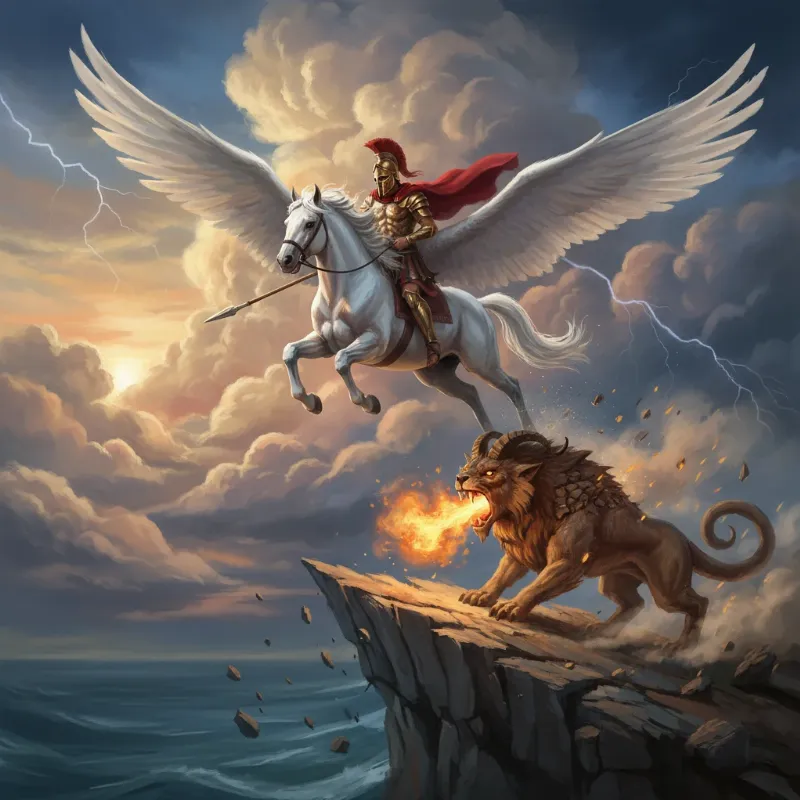 Bellerophon riding Pegasus in the epic story of the flying horse, as they battle the monstrous Chimera from the sky.
A Flight Too Close to the Sun
After defeating the Chimera, Bellerophon and Pegasus embarked on other heroic quests, conquering the warlike Solymi and the fierce Amazons. With every victory, Bellerophon’s fame grew, but so did his pride. He began to see himself as more than a mere mortal, believing his accomplishments made him equal to the gods themselves.
This arrogance, or hubris, was his undoing. In a final, fateful act of pride, Bellerophon decided to fly Pegasus to the home of the gods, Mount Olympus, to take his place among them. Zeus, the king of the gods, was infuriated by this mortal’s insolence. He would not allow such an affront to go unpunished. As Bellerophon and Pegasus ascended towards the heavens, Zeus sent a single gadfly to sting the winged horse.
Startled by the sharp, unexpected pain, Pegasus bucked wildly, throwing the unprepared Bellerophon from his back. The hero tumbled from the sky, his glorious flight ending in a long, ignominious fall back to earth. He survived the fall but was left crippled, blind, and cursed to wander the earth alone, hated by gods and men, a bitter and broken reminder of the dangers of excessive pride. His story serves as a classic Greek tragedy, a cautionary tale about knowing one’s place in the cosmic order.
An Immortal Among the Stars
While Bellerophon met his tragic end, Pegasus’s journey was far from over. After unseating his rider, the noble horse continued his flight to Mount Olympus. There, he was welcomed by the gods. Zeus, who had always admired the creature’s beauty and strength, gave him a new, honored role. Pegasus was tasked with carrying Zeus’s thunderbolts, the most powerful weapons in the divine arsenal.
He served Zeus faithfully for the rest of his days. As a final reward for his loyal service, Zeus immortalized Pegasus by placing him among the stars. To this day, the constellation Pegasus can be seen in the northern sky, a permanent tribute to the magnificent flying horse. And so, the story of Pegasus the flying horse concludes not in tragedy, but in an eternal honor, forever galloping across the cosmic ocean.
Frequently Asked Questions (FAQ)
What does Pegasus symbolize?
Pegasus is a rich symbol representing multiple concepts. Primarily, he symbolizes freedom, power, and elegance due to his ability to fly. His creation of the Hippocrene spring also makes him a powerful symbol of inspiration, poetry, and creativity.
Who was Pegasus’s father?
Pegasus’s father was Poseidon, the Greek god of the sea, earthquakes, and horses. This lineage explains his connection to springs and water, as well as his incredible power and untamable nature.
What is the relationship between Pegasus and Hercules?
In classic Greek mythology, there is no direct relationship or story involving both Pegasus and Hercules. However, in modern adaptations, most notably the 1997 Disney animated film Hercules, Pegasus is portrayed as Hercules’s loyal companion, a gift from Zeus. This is a popular but non-traditional depiction.
Is Pegasus the only flying horse in mythology?
While Pegasus is by far the most famous, other winged horses do appear in mythology, though they are much less prominent. For instance, the Valkyries of Norse mythology were said to ride flying steeds across the sky. However, none have captured the imagination quite like Pegasus.
What happened to Bellerophon after he fell?
After being thrown from Pegasus, Bellerophon survived but lived a miserable life. He was maimed and blinded by the fall and wandered the Aleian Plain (“Wandering Plain”) in utter despair, shunned by everyone for his hubris against the gods, until his death.
How can I find the Pegasus constellation?
The Pegasus constellation is most visible in the autumn in the Northern Hemisphere. It can be identified by a large asterism known as the Great Square of Pegasus, which forms the body of the horse. The constellation is located near other mythological figures like Andromeda and Perseus.
The Enduring Legacy of a Winged Horse
The story of Pegasus the flying horse is a timeless epic that weaves together themes of heroism, ambition, divinity, and the fatal flaw of human pride. From his violent birth to his celestial immortality, Pegasus represents the wild beauty that can emerge from darkness and the inspirational heights we can reach when we respect the balance between the mortal and the divine. He is more than just a mythological creature; he is a symbol of the untamable spirit of creativity and a permanent fixture in our night sky, forever reminding us to dream, to create, and to fly—but never too close to the sun.
