
Of all the animals that have walked alongside humanity, none have shaped our destiny quite like the horse. For millennia, this creature of profound strength and surprising grace has been our partner in work, war, and exploration. The story of the horse is not merely an account of a species; it’s a reflection of our own journey, a sweeping epic of evolution, partnership, and shared history that has fundamentally altered the course of civilization. From the thundering hooves of wild herds on ancient plains to the quiet companionship of a modern steed, the bond between human and horse is woven into the very fabric of our world.
This partnership is so deeply ingrained in our collective psyche that horses feature in our most enduring tales, a testament to their power and significance. Consider the legends we still tell, like the true story of the wooden horse, where the image of a horse was central to the fate of a great city. This deep-seated connection began not in a stable, but millions of years ago, on a continent where the horse would one day vanish, only to return and change everything.
The Dawn of Equus: An Evolutionary Epic
Long before any human laid a hand on a horse’s mane, its story was being written in the fossil record. The tale begins over 55 million years ago in the lush, subtropical forests of North America. Here lived a small, shy creature known as Hyracotherium, or more popularly, Eohippus—the “dawn horse.” No larger than a fox, this early ancestor was utterly unlike the animal we know today. It had an arched back, a short neck, and most surprisingly, multiple toes on each foot—four on the front, three on the back—perfectly adapted for navigating the soft, damp forest floor.
As millions of years passed, the climate changed dramatically. Forests receded, replaced by vast, open grasslands. This environmental shift was the engine of equine evolution, demanding radical adaptation for survival. To outrun new predators on the plains and to thrive on tough prairie grasses, the horse’s ancestors began to change.
From Forest Dweller to Plains Runner
This evolutionary journey is one of the most complete and well-documented in all of paleontology. We see a clear progression through various stages:
- Mesohippus: Appearing around 35 million years ago, this “middle horse” was larger, about the size of a greyhound. Its back was straighter, its neck longer, and its legs grew more slender. Crucially, it stood on three toes on each foot, with the central toe bearing most of the weight—a critical step towards a single hoof.
- Merychippus: This “ruminant horse” of the Miocene epoch (around 17 million years ago) marked a significant leap. It was the first true grazer, with high-crowned teeth built to withstand the abrasive wear of silica-rich grasses. It still had three toes, but it stood permanently on the tip of its large central toe, with the side toes shrinking into insignificance.
- Pliohippus: Arriving about 12 million years ago, this was the first ancestor to possess a single, powerful hoof on each leg. Its size and form were now unmistakably horse-like.
This long, gradual transformation culminated in the genus Equus, which emerged around 4 million years ago. This is the genus to which all modern horses, donkeys, and zebras belong. They spread from their North American homeland across the Bering Land Bridge into Asia, Europe, and Africa. Then, in a mysterious twist of fate, the horse vanished from the Americas about 10,000 years ago, likely due to a combination of climate change and pressure from early human hunters. The horse would not set foot in its ancestral home again for millennia.
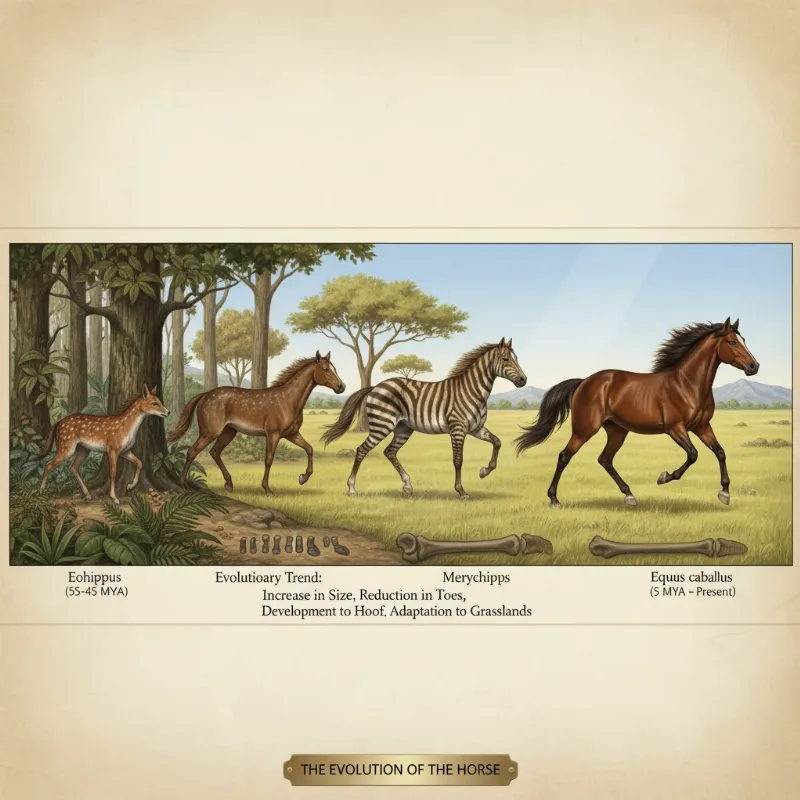 The story of the horse's evolution from the small Eohippus to the modern Equus shown in a timeline.
A Partnership Forged in History: The Domestication of the Horse
While the horse disappeared from the New World, it thrived on the vast, grassy steppes of Eurasia. For thousands of years, early humans saw these wild herds primarily as a source of food. Paleolithic cave paintings across Europe are filled with vibrant depictions of horses, testifying to their importance as prey for our hunter-gatherer ancestors. But a revolutionary idea was taking shape. What if this powerful animal could be a partner, not just a meal?
The first definitive evidence of horse domestication comes from the Botai culture of modern-day Kazakhstan, around 3500 BCE. Archaeological findings, including horse bones in ancient corrals and pottery containing traces of mare’s milk, suggest the Botai people were herding and possibly milking horses. Analysis of ancient teeth from this period even shows wear patterns consistent with the use of a bit.
However, a pivotal moment in the story of the horse occurred around 2200 BCE in the Pontic-Caspian steppe, the region between the Black and Caspian Seas. Genetic studies reveal that a specific lineage of horse emerged here that would go on to conquer the world. These horses possessed key genetic mutations that made them more suitable for human use.
According to Dr. Alistair Croft, a historian specializing in human-animal studies, “The domestication of the horse was not a single event, but a process. Yet, the emergence of the DOM2 genetic lineage on the steppes was the true catalyst. These horses were bred for a stronger back, allowing them to be ridden more effectively, and for a more docile temperament. This wasn’t just taming an animal; it was the beginning of co-creating a new partner for civilization.”
This new, more rideable horse spread across Eurasia with astonishing speed, triggering a cascade of social and technological change. The world, which had once been limited by the speed of walking, was suddenly thrown open.
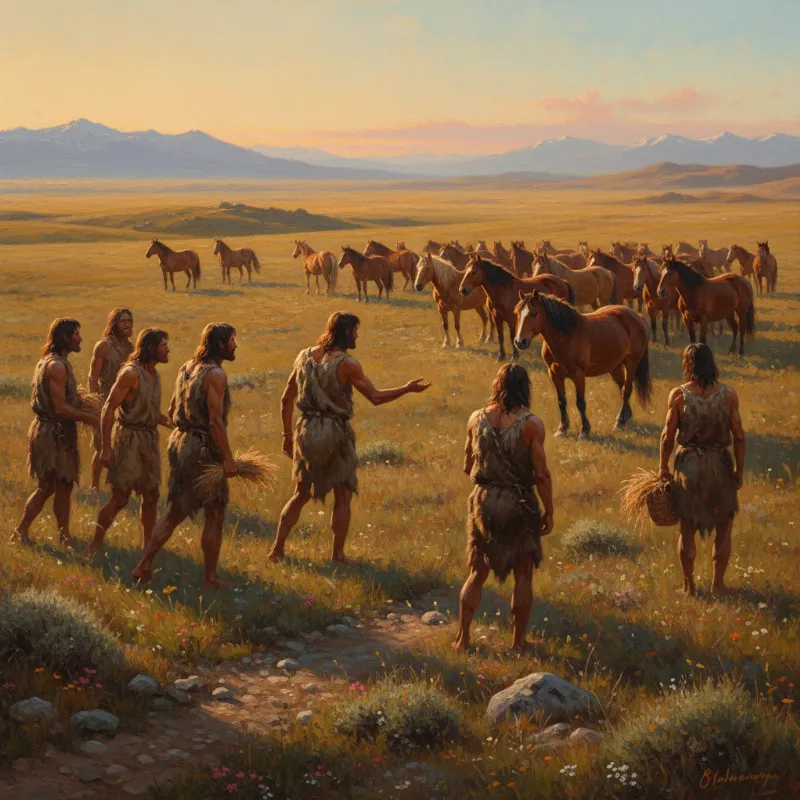 An illustration depicting early humans domesticating wild horses, showcasing the beginning of the story of the horse and human partnership.
How did Horses Reshape Human Civilization?
The introduction of the domesticated horse was an explosion that reshaped nearly every aspect of human life. Its impact was so profound that it’s difficult to imagine our history without it.
Revolution in Warfare and Conquest
Warfare was one of the first and most dramatically altered domains. Around 2000 BCE, the war chariot, a light, two-wheeled vehicle pulled by horses, became the ultimate weapon of the Bronze Age, dominating battlefields from Egypt to China. But it was the act of riding directly on horseback that truly changed the game. Nomadic peoples of the steppes, like the Scythians and later the Mongols, became masters of mounted archery, creating vast, powerful empires. In medieval Europe, the heavily armored knight on his powerful charger became the iconic symbol of military might. The horse provided an unparalleled advantage in speed, mobility, and shock value, often determining the rise and fall of civilizations.
The Engine of Trade, Travel, and Communication
Before the horse, long-distance travel was a slow, arduous, and dangerous affair. Horses compressed time and distance. They enabled the creation of vast trade networks like the Silk Road, facilitating not just the exchange of goods but also of ideas, cultures, and technologies across continents. Messengers on horseback could carry information with unprecedented speed, allowing rulers to govern sprawling empires more effectively. The world became more interconnected, all powered by the hoofbeat of the horse. This legacy of the horse as a character in motion and adventure is even reflected in modern fiction, with memorable figures like the loyal steed in toy story bullseye talking horse embodying the spirit of a trusty companion on a great journey.
A Partner in Agriculture and Industry
Beyond the battlefield and trade routes, the horse became a crucial partner in feeding growing populations. While oxen were strong, horses were faster and more efficient at plowing fields, transforming agricultural productivity. They hauled goods to market, powered mills, and pulled barges. In cities, they were the backbone of public and private transportation until the advent of the engine. They pulled carts, carriages, and omnibuses, shaping the layout and function of our urban centers.
The Modern Horse: A New Chapter in the Story
The Industrial Revolution and the invention of the internal combustion engine in the late 19th and early 20th centuries marked the end of the “horse-powered age.” Tractors replaced them on the farm, and cars replaced them on the roads. For a moment, it seemed the horse’s central role in human affairs might come to an end.
Yet, the bond between humans and horses proved too deep to be broken by technology. Instead of disappearing, the horse’s role evolved. Freed from the drudgery of labor and the brutality of war, the horse transitioned into a new role as a partner in sport, recreation, and companionship.
Today, the world of horses is more vibrant than ever. Equestrian sports like show jumping, dressage, and racing captivate millions. Trail riding offers a unique way to connect with nature. Equine-assisted therapy programs demonstrate the horse’s profound ability to help and heal people. The story of the horse has moved from one of necessity to one of choice and passion. The emotional weight of this connection is something we see explored in fiction, where the loss of an equine friend can be a deeply moving narrative event, much like how the tragic fate of the horse in neverending story died left a lasting impact on a generation of viewers.
This incredible journey—from a fox-sized forest creature to a global partner in building civilization—is a testament to the horse’s remarkable adaptability and enduring spirit. The story of the horse is a story of survival, of a deep and resonant partnership with humanity, and of a bond that continues to enrich our lives in countless ways.
