
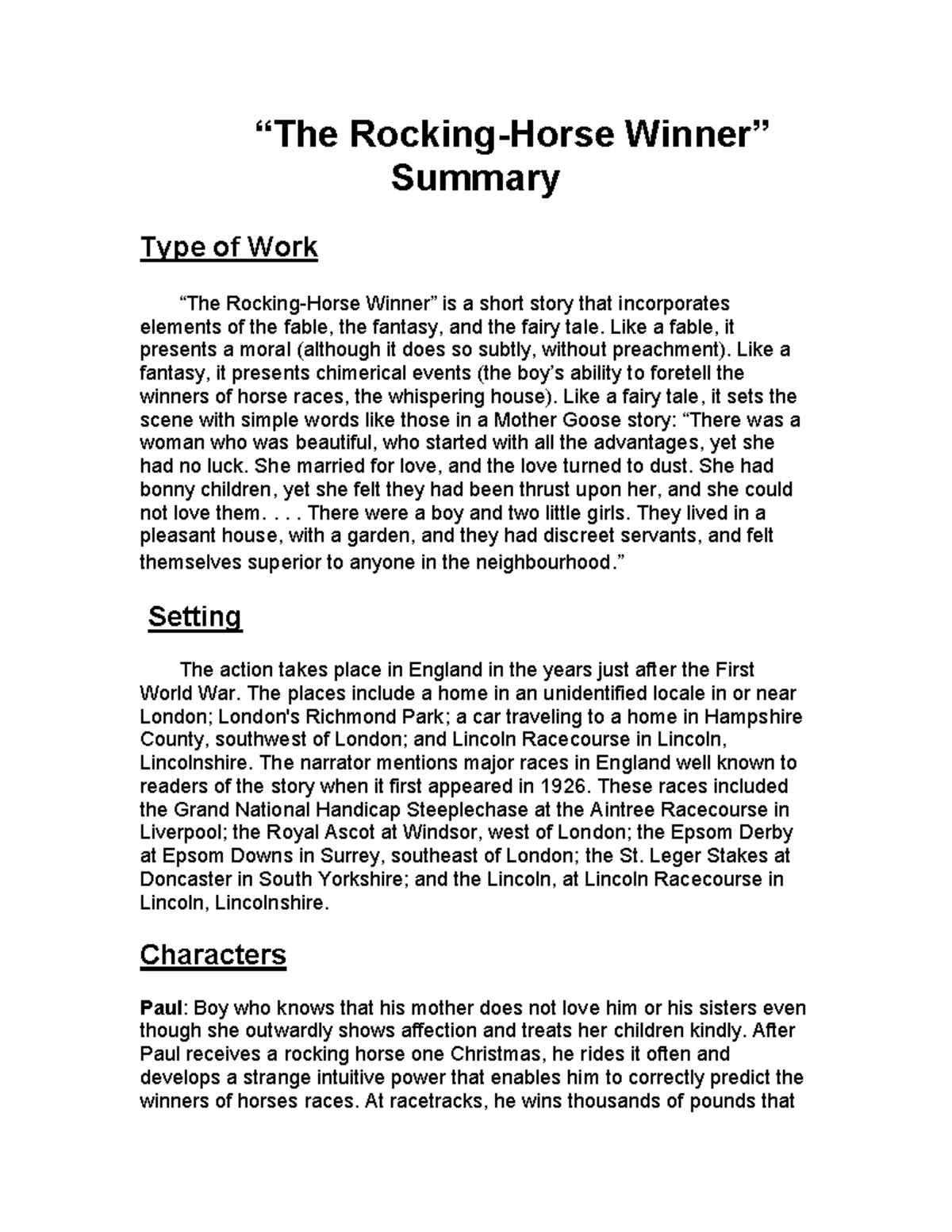
D.H. Lawrence’s “The Rocking-Horse Winner” is a haunting and masterfully crafted short story that stays with you long after you’ve read the final page. It’s a chilling exploration of materialism, family dysfunction, and the desperate, tragic quest for love and approval. If you’ve been searching for The Rocking Horse Winner Short Story Pdf, you’ve likely come across a tale that is as much a dark fable as it is a critique of modern society. This guide will not only help you understand where to find the story but also delve into the intricate layers of its plot, themes, and enduring symbolism.
Published in 1926, this story plunges us into the life of a young boy named Paul, who becomes convinced he can erase his family’s financial anxieties and win his mother’s cold, distant affection by predicting horse race winners. His method? A frantic, almost supernatural ride on his childhood rocking horse. It’s a simple premise that spirals into a devastating tragedy, revealing the corrosive effects of greed and the unspoken pressures within a seemingly ordinary family.
Who Was D.H. Lawrence?
To fully appreciate “The Rocking-Horse Winner,” it helps to know a bit about its author. David Herbert Lawrence (1885-1930) was a prominent English writer, poet, and painter whose work often stirred controversy. He was a key figure in Modernism, a literary movement that sought to break from traditional forms and explore the inner workings of the human mind.
Lawrence’s writing is famous for its intense psychological depth, its frank exploration of human relationships and sexuality, and its sharp critique of industrialization and its impact on the human spirit. He believed that modern society, with its focus on money and social status, had alienated people from their natural instincts and emotions. This very theme is the dark heart that beats within “The Rocking-Horse Winner.”
What Is “The Rocking-Horse Winner” About?
The story centers on a middle-class English family suffocating under the weight of unspoken financial strain. The mother, Hester, believes she is profoundly “unlucky” and harbors a deep-seated resentment for her husband’s lack of financial success. This anxiety becomes a palpable entity in their home, a constant, ghostly whisper: “There must be more money! There must be more money!”
Her young son, Paul, internalizes this desperate cry. He becomes obsessed with the idea of “luck,” believing that if he can become lucky, he can finally win the love his mother withholds. He discovers that by riding his wooden rocking horse with furious intensity, he can somehow divine the names of winning racehorses.
With the help of the family gardener, Bassett, and his Uncle Oscar, Paul begins placing bets. He wins astonishing amounts of money, which he arranges to have given to his mother anonymously. But instead of bringing happiness and quiet to the house, the newfound wealth only makes the whispers louder and more demanding. Paul’s secret gift becomes a terrible burden, driving him to ride his horse more and more frantically, ultimately leading to a tragic and unforgettable climax.
The Unspoken Desires: Core Themes Explored
Beneath its ghost-story surface, “The Rocking-Horse Winner” is a rich tapestry of complex themes that dissect the anxieties of the early 20th century, many of which are still incredibly relevant today.
The Destructive Nature of Materialism
This is the story’s most prominent theme. The family’s obsession with money poisons everything. Hester’s love is conditional, tied directly to wealth and social standing. She equates “luck” with the ability to acquire money, a belief she passes on to her son with devastating consequences. The story serves as a powerful cautionary tale, suggesting that the relentless pursuit of wealth for its own sake leads not to happiness, but to emotional and spiritual decay. The money Paul wins doesn’t solve the family’s problems; it only amplifies their greed.
As Lawrence writes, the house itself is infected with this anxiety: “And so the house came to be haunted by the unspoken phrase: There must be more money! … Nobody said it aloud. But the boy could hear it.”
Oedipus Complex and Family Dysfunction
Literary critics often point to the story’s strong Oedipal undertones. Paul is not just trying to help his family; he is on a desperate mission to replace his “unlucky” father in his mother’s affections. His frantic rocking horse rides are a substitute for the adult passion and success he cannot otherwise provide. He seeks to become the source of his mother’s happiness, a role that is both impossible and psychologically damaging. This dynamic highlights a deeply dysfunctional family unit where love is treated as a transaction rather than a natural bond.
Luck, Greed, and Unhappiness
What is luck? For Hester, it’s a mystical quality that brings wealth. For Paul, it’s a power he must seize, no matter the cost. The story masterfully shows how the pursuit of “luck” is just a euphemism for greed. Paul’s initial desire to please his mother morphs into a frantic obsession. His gift, which could be seen as magical, becomes a curse under the weight of this greed. Lawrence argues that true contentment can never be found through external gains, and the constant desire for “more” is a direct path to misery.
Symbolism in The Rocking Horse Winner
Lawrence uses powerful symbols to convey the story’s underlying message. These objects and descriptions are not just part of the setting; they are imbued with deep psychological meaning.
The Rocking Horse
The central symbol of the story is the rocking horse itself. On one level, it represents a tool for Paul’s supernatural gift. On another, it symbolizes the useless, frantic energy of chasing wealth. Paul rides furiously, expending immense effort, but ultimately goes nowhere. This mirrors the hollow pursuit of materialism—a constant, exhausting motion that doesn’t lead to genuine progress or fulfillment. It’s also a symbol of his arrested development, as he engages in a childish activity to solve a complex adult problem.
The Whispering House
The house is more than just a setting; it’s a character in its own right. The constant, insidious whisper for “more money” is the external manifestation of the family’s internal anxiety and greed. It represents the psychological prison they have built for themselves. The fact that only the children can hear it suggests their sensitivity to the unspoken tensions and corruption that the adults ignore or deny.
Paul’s “Feverish” Eyes
Throughout the story, Lawrence repeatedly describes Paul’s eyes as “blazing,” “uncanny,” and “feverish.” His eyes are windows to his tormented soul. They reflect the unnatural and self-destructive intensity of his obsession. While others see only a child, his eyes reveal the terrifying, all-consuming quest that is literally costing him his life.
Where to Find The Rocking Horse Winner Short Story PDF
Because “The Rocking-Horse Winner” was published in 1926, it is in the public domain in many countries, including the United States. This means it is legally available for free online. When searching for the rocking horse winner short story pdf, you can find reliable versions at several reputable sources.
Here are some excellent places to look:
- Project Gutenberg: An online library of free eBooks, Project Gutenberg often has works whose copyright has expired.
- University Websites: Many university English departments post public domain texts for their students, which are accessible to the public. A search for
"The Rocking-Horse Winner" site:.educan yield high-quality results. - Internet Archive: This non-profit library has a vast collection of digitized materials, including many classic short stories.
Always be cautious of websites that ask for personal information or payment for a public domain work. The legitimate sources will provide direct, free access.
Why Does This Story Still Resonate Today?
Over a century after it was written, “The Rocking-Horse Winner” remains a deeply unsettling and powerful piece of literature. Its critique of consumer culture and the pressure to maintain a certain lifestyle feels more relevant than ever in our age of social media and instant gratification. The story forces us to ask uncomfortable questions: What is the true cost of our desires? What unspoken anxieties do we pass on to our children? And can love, once commodified, ever be pure?
It’s a tragic fable about a boy who had everything he needed but gave his life for what his mother thought she wanted. It serves as a timeless warning about the dangers of confusing monetary value with genuine human worth.
Frequently Asked Questions (FAQ)
What is the main conflict in The Rocking-Horse Winner?
The main conflict is between Paul and his mother’s insatiable desire for money and affection. Paul internalizes this pressure and tries to solve an adult emotional and financial crisis through a child’s obsessive and ultimately fatal quest for “luck.”
Why is the mother, Hester, so unhappy?
Hester is unhappy because she believes she is “unlucky” and married a man who couldn’t provide the wealthy lifestyle she craves. Her love for her children is stifled by her resentment and materialism, making her incapable of giving the affection Paul so desperately seeks.
What do the whispering voices in the house symbolize?
The whispering voices, saying “There must be more money,” symbolize the family’s overwhelming greed and anxiety about their financial situation. They are a manifestation of the toxic, unspoken obsession that haunts the family and drives the story’s tragic events.
What is the climax of the story?
The climax occurs when Paul, in a state of delirium, rides his rocking horse one last time to determine the winner of the Derby. He screams the horse’s name, “Malabar!”, before collapsing with a brain fever from which he never recovers.
Is The Rocking-Horse Winner a supernatural story?
While it has supernatural elements—namely, Paul’s psychic ability to predict winners—the story is primarily a work of psychological realism. The “supernatural” gift is used as a vehicle to explore very real human themes of greed, obsession, and dysfunctional family dynamics.
A Story That Rides On
“The Rocking-Horse Winner” is far more than just a spooky tale. It’s a profound psychological drama and a sharp social critique wrapped in the guise of a dark fairy tale. D.H. Lawrence masterfully exposes the poison of materialism and the tragedy of a love that is never freely given. As you read the rocking horse winner short story pdf, you’ll find it’s a story that challenges you to look past the surface and question the true meaning of luck, love, and happiness in a world that so often seems to demand “more.”
