
The Pale Horse stands as one of the most haunting and powerful images in Western culture. When you first hear the phrase, it conjures a sense of dread and finality, a specter riding at the edge of human understanding. The story of this enigmatic figure is not just a simple tale but a complex symbol woven through theology, literature, and art. To get the full picture of the pale horse story explained, we must journey back to its origins in a prophetic ancient text, trace its path through classic literature, and see how it continues to captivate the modern imagination.
This symbol is far more than a mere ghost story; it represents one of the most profound and universal human experiences: death. But it’s not just about the end. The narrative surrounding the Pale Horse is also about judgment, consequence, and the powerful forces that shape human destiny. Whether you encounter it in the final book of the Bible or in a gripping detective novel, its appearance always signals a moment of ultimate reckoning. We will explore its biblical roots, its literary adaptations, and its lasting impact on our collective consciousness.
The Biblical Origin: The Fourth Horseman of the Apocalypse
The primary source and the definitive origin of the Pale Horse is the New Testament’s Book of Revelation. In chapter 6, the apostle John describes a vision of a scroll sealed with seven seals. As each of the first four seals is broken, a different colored horse with a rider is released upon the Earth. The Pale Horse is the last and most terrifying of them all.
The text reads: “And I looked, and behold a pale horse: and his name that sat on him was Death, and Hell followed with him. And power was given unto them over the fourth part of the earth, to kill with sword, and with hunger, and with death, and with the beasts of the earth” (Revelation 6:8, KJV).
This passage is dense with symbolism. The horse’s color, “pale,” is a translation of the Greek word khlōros, which can also mean a sickly, greenish-yellow, the color of a corpse. It immediately evokes feelings of disease, decay, and lifelessness. Unlike the other horsemen who represent concepts like conquest or war, this rider is explicitly named: Death. The entity that follows him, Hell (or Hades), is depicted as a companion, ready to claim the souls of those Death takes. Understanding the complete story of the pale horse reveals its role as the culmination of the destructive forces unleashed by the other horsemen.
Who is the Rider of the Pale Horse?
The rider is explicitly identified as Death. This personification makes the concept of mortality tangible and terrifying. He is not just a force of nature but an active agent of destruction. The authority given to him is immense, holding power over a quarter of the world’s population. This figure is the ultimate end, the final consequence of the chaos brought by the preceding horsemen. His methods are all-encompassing: war (“sword”), famine (“hunger”), plagues (“death,” or pestilence), and even nature turning against humanity (“beasts of the earth”).
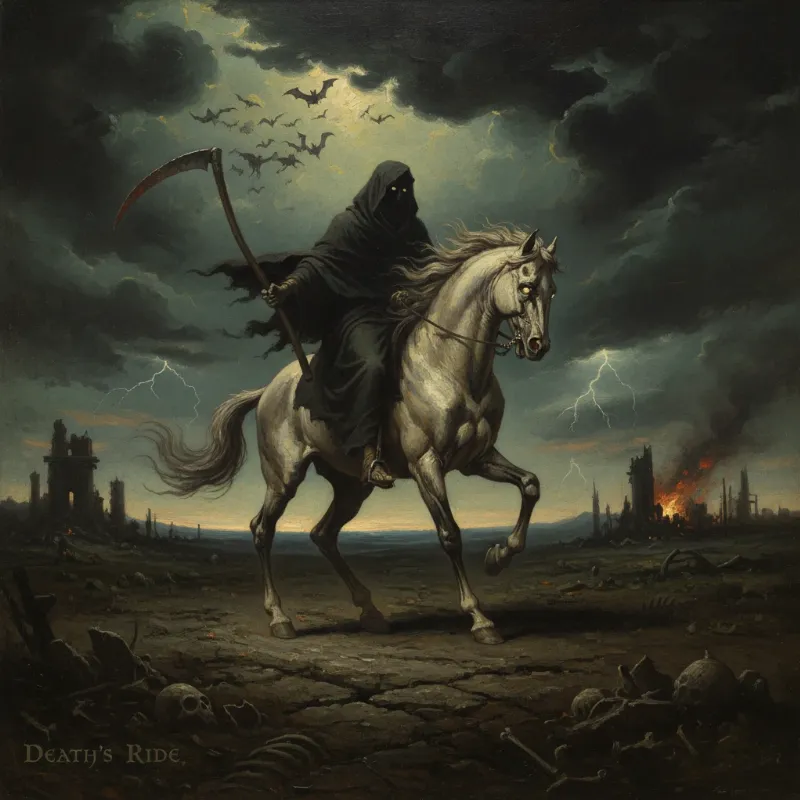 The Pale Horse story explained through the depiction of its rider, Death, as one of the Four Horsemen of the Apocalypse.
The Context of the Four Horsemen
To fully grasp the significance of the Pale Horse, it is essential to see it in context with the other three horsemen who precede it. Each represents a different facet of humanity’s downfall during the end times.
- The White Horse: The first horseman rides a white horse and is given a crown, going forth “conquering, and to conquer.” This figure is often interpreted as representing conquest, the rise of powerful empires, or sometimes even the Antichrist.
- The Red Horse: The second rider appears on a fiery red horse and is given a great sword, with the power to “take peace from the earth.” This horseman is the embodiment of War and civil strife, turning people against one another in bloody conflict.
- The Black Horse: The third horseman rides a black horse and carries a pair of scales. He represents Famine, where the basic necessities of life, like wheat and barley, become exorbitantly expensive, while luxury items remain untouched, highlighting social and economic collapse.
The Pale Horse and its rider, Death, are the climax of this grim procession. They are the final, devastating outcome of conquest, war, and famine. They don’t just cause suffering; they bring it to its ultimate conclusion.
Agatha Christie’s “The Pale Horse”: A Modern Reimagining
Centuries after the Book of Revelation was written, its powerful imagery found new life in an entirely different genre: the murder mystery. In 1961, Agatha Christie published The Pale Horse, a novel that masterfully borrows the biblical allusion to craft a tale of modern-day wickedness.
In Christie’s story, a series of mysterious deaths leads the protagonist, Mark Easterbrook, to investigate an organization called “The Pale Horse.” This shadowy group, run by three women believed to be witches, claims to have the power to kill from a distance. They operate out of a former inn named The Pale Horse, making the connection to the biblical harbinger of death explicit.
Christie’s genius lies in her ability to translate the supernatural horror of the apocalypse into a rational, albeit sinister, plot. The novel explores themes of suggestion, fear, and the power of belief. The “witches” appear to wield supernatural power, much like the biblical Death, but the explanation is ultimately rooted in scientific, albeit diabolical, means: thallium poisoning. The symptoms of this poison—hair loss, weakness, and nerve damage—mimic a slow, wasting disease, making the deaths appear natural or psychosomatic. The name of the organization and the inn isn’t just a clever title; it’s a brand. It’s how they market their “service” of contract killing, cloaking their crimes in a veil of dark magic and biblical dread.
The Enduring Cultural Impact of the Pale Horse
The image of Death on a Pale Horse is too potent to be confined to just two texts. It has galloped through centuries of art, music, and film, becoming a universal shorthand for the apocalypse, doom, and inescapable mortality.
In Art and Literature
From the medieval period onward, artists have been captivated by the Four Horsemen. Albrecht Dürer’s 1498 woodcut, The Four Horsemen of the Apocalypse, is one of the most famous depictions, portraying a dynamic and terrifying scene of the horsemen trampling humanity. In this work, the rider of the Pale Horse is shown as an emaciated, bearded man, a grim figure of decay. William Blake’s paintings also captured the ethereal and horrifying nature of the vision, solidifying its place in the artistic canon.
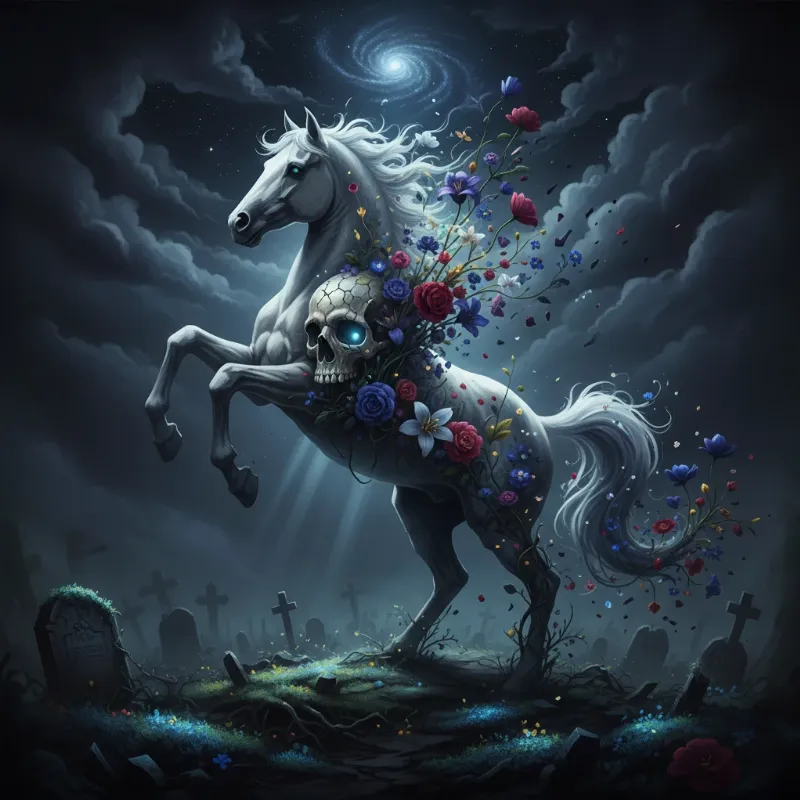 A modern artistic interpretation of the Pale Horse story explained through symbolic imagery of decay and rebirth.
In Film and Modern Media
In modern times, the Pale Horse has made countless appearances. The film Pale Rider (1985), starring Clint Eastwood, uses the title to allude to its mysterious protagonist, a preacher who arrives to deliver a community from evil, acting as a force of judgment and death for his enemies. The Western film Tombstone (1993) features a famous scene where Wyatt Earp, on a quest for vengeance, tells his enemies, “You tell ’em I’m coming, and hell’s coming with me,” a direct echo of Revelation 6:8.
Video games like the Darksiders series allow players to take on the roles of the Four Horsemen, with Death being the protagonist of the second game. The imagery is also a staple in heavy metal music, where themes of apocalypse and judgment are common.
The enduring appeal of the Pale Horse story lies in its raw, elemental power. It taps into a primal fear of death and the unknown while also serving as a potent symbol of justice and reckoning. It reminds us that some forces are beyond our control and that all actions ultimately have consequences. Whether as a divine agent of judgment, a clever murder plot device, or a symbol of righteous vengeance, the Pale Horse continues to ride through our culture, a timeless emblem of the end.
Frequently Asked Questions (FAQ)
What is the name of the rider of the Pale Horse?
In the Book of Revelation, the rider of the Pale Horse is explicitly named Death. He is the only one of the four horsemen whose name is stated directly in the text.
What does the pale color of the horse signify?
The Greek word used is khlōros, which translates to pale, but more accurately describes a pale green or sickly yellow-green hue. This color is intentionally used to symbolize sickness, decay, and the pallor of a corpse, reinforcing the rider’s identity as Death.
How is Agatha Christie’s novel related to the Bible?
Agatha Christie uses the biblical imagery of the Pale Horse as a central motif for her mystery novel. The organization of assassins in her story is named “The Pale Horse,” and they operate out of an old inn of the same name. This name serves as a cover for their crimes, making people believe the deaths they cause are the result of a curse or supernatural forces rather than poison.
What are the other three Horsemen of the Apocalypse?
The other three horsemen are: the rider on the White Horse, often interpreted as Conquest or the Antichrist; the rider on the Red Horse, who represents War and civil strife; and the rider on the Black Horse, who symbolizes Famine and economic collapse.
Is the Pale Horse considered an evil figure?
In the biblical context, the Pale Horse and its rider, Death, are not depicted as “evil” in the sense of being demonic or acting against God’s will. Rather, they are presented as instruments of divine judgment, unleashed to carry out a specific purpose as part of a prophesied sequence of events during the end times. Their actions are terrifying and destructive, but they are acting under a given authority.
