
In the vast kingdom of fables, where animals speak and their actions teach profound truths, few narratives capture the eternal struggle between brain and brawn as perfectly as The Lion And The Horse Story. This enduring tale, passed down through generations, serves as a masterclass in strategy, perception, and the art of turning a predator’s strength into their ultimate weakness. While several versions exist, each with its own unique flavor, they all converge on a single, powerful moral: true power lies not in sharp claws and a mighty roar, but in a sharp and mighty mind.
This narrative is more than just a simple animal tale; it is a blueprint for overcoming seemingly insurmountable challenges. Whether it’s the self-reliant horse in Aesop’s classic rendition or the desperate steed aided by a cunning fox, the story provides a timeless lesson on the importance of intelligence. Understanding the full depth of this fable requires exploring its different tellings and the rich symbolism embodied by its two iconic protagonists. Similarly, to fully appreciate the fable, one must understand the horses story as a symbol of nobility and intelligence throughout human culture.
The Classic Aesopian Fable: A Predator in Disguise
The most widely known version of this tale comes from the master storyteller Aesop. It’s a short, sharp, and brilliantly conceived narrative that highlights skepticism and quick thinking.
A magnificent Lion, powerful yet cunning, spotted a fine Horse grazing peacefully in a meadow. The Lion, desiring the Horse for his next meal, knew that a direct chase would be futile; the Horse’s speed was legendary. So, the predator decided to rely on trickery instead of terror. He approached the Horse not as a hunter, but with a gentle demeanor, claiming to be a skilled physician with vast knowledge of all ailments.
“Good day, friend Horse,” the Lion said in a soothing voice. “I am a doctor, and I couldn’t help but notice you seem to be limping. Perhaps I can be of service?”
The Horse, immediately suspicious of a lion offering help instead of harm, played along. He was no fool and understood the game being played.
“Why, yes, Doctor,” the Horse replied, feigning relief. “It is most fortunate that you have come. I seem to have stepped on a sharp thorn, and it has lodged itself deep within my rear hoof. The pain is quite unbearable.”
The Lion, believing his ruse had worked, was overjoyed. This was the perfect opportunity to strike. “Hold still,” he instructed, moving behind the Horse. “Allow me to examine the hoof closely and I shall have that thorn out in a moment.”
As the Lion lowered his head, pretending to inspect the hoof but truly preparing to pounce, the Horse saw his chance. In one swift, powerful motion, he unleashed a mighty kick with the very hoof in question, striking the Lion square in the jaw. The self-proclaimed doctor was sent tumbling, his teeth shattered and his pride utterly broken. The Horse galloped away to safety, leaving the dazed predator to learn a painful lesson.
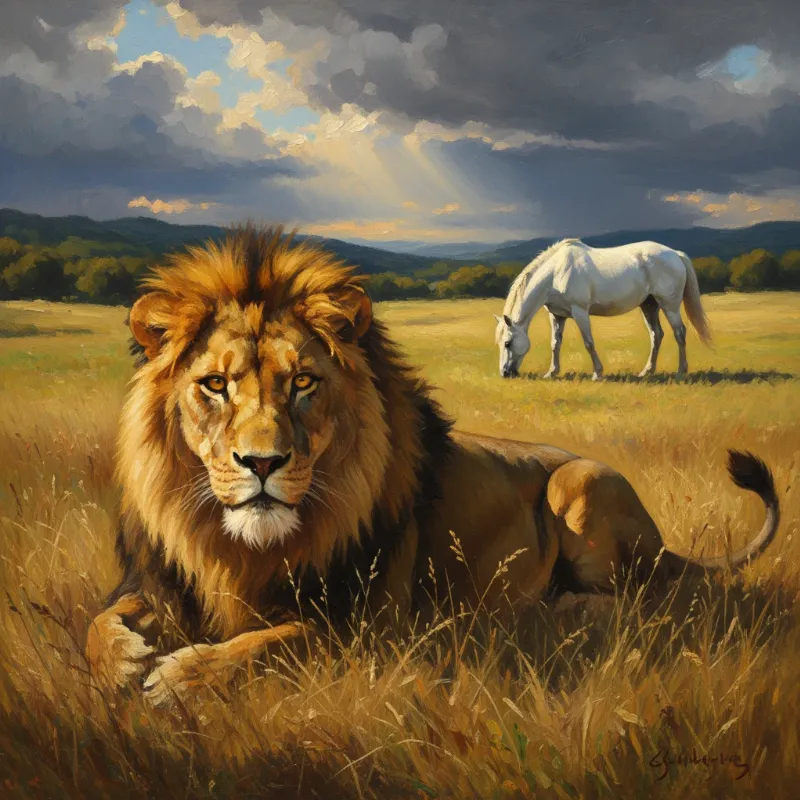 The lion and the horse story depicted with a powerful lion watching a graceful horse from a distance in a golden-hour meadow.
The Moral of the Tale
The beauty of this version lies in its directness. The moral is twofold:
- Intelligence Triumphs Over Brute Force: The horse could never overpower a lion in a direct fight. However, by using its intellect, it not only survived but soundly defeated its would-be attacker.
- Beware of Those Who Pretend to Be Something They’re Not: The lion’s disguise as a helper was its chosen weapon. The horse’s ability to see through this deception was its shield. It’s a lesson in vigilance and recognizing that a predator’s nature cannot be concealed by a gentle voice.
The Panchatantra Version: A Tale of Alliance
Another powerful version of the lion and the horse story, often associated with the ancient Indian collection of fables, the Panchatantra, introduces a third character and a different motivation.
An old Horse, having served his master faithfully for many years, was cruelly cast out when he became too weak to work. The farmer told him, “You are of no more use to me. But if you can prove you are still strong and bring me a lion, I will take you back.”
The task was impossible, and the Horse wandered into the forest, despondent and awaiting his end. There, he met a clever Fox who, upon hearing his sad tale, decided to help.
“I have a plan,” the Fox said. “Lie down here and stretch out as if you are dead. Do not move, no matter what happens.”
The Horse did as he was told. The Fox then went to the Lion’s den and said, “Your Majesty, I have found a fine, dead horse in the forest. It will be a magnificent feast for you.”
The Lion, delighted, followed the Fox. When they reached the spot, the Fox said, “It may be difficult to drag this heavy creature back to your den. Allow me to tie his tail securely to your tail, and you can pull him with ease.”
The arrogant Lion, blinded by the promise of an easy meal, agreed. The Fox made a great show of tying their tails together with strong knots. Once he was certain they were securely bound, the Fox gave the Horse a signal.
“Now, Horse, run!” he shouted.
The Horse sprang to its feet with all its remaining might and galloped away. The Lion, taken completely by surprise and tied fast, was helplessly dragged behind. He was slammed against rocks and trees until he was no more. The Horse returned to the farm, dragging the defeated lion, and presented it to his astonished master, earning his place back in the stable for the rest of his days. While this tale showcases animal cunning, other short stories about horses often highlight themes of enduring loyalty and unbreakable spirit.
What Do These Stories Teach Us Today?
Though ancient, these fables are startlingly relevant in the modern world. They are not just stories for children but strategic guides for adults. The core message—that wit and wisdom are superior weapons to brute strength—can be applied everywhere.
Recognizing Modern-Day “Lions”
In the digital age, we constantly encounter “lions in doctor’s clothing.” These are the phishing emails pretending to be from your bank, the deceptive online ads promising unrealistic outcomes, or the charming manipulator with a hidden agenda. The Aesopian fable teaches us to be like the horse: to remain skeptical of offers that seem too good to be true and to use our critical thinking to see through the disguise. It champions self-reliance and the power of a single, brilliant idea to avert disaster. The horse in the fable is an archetype of cleverness; one might even imagine a creature as intelligent as a legendary arabian story horse when picturing its quick thinking.
The Power of Collaboration and Strategy
The Panchatantra version speaks to a different, yet equally important, modern truth: the power of collaboration. The horse, on its own, had given up. It was the strategic counsel of the fox—the consultant, the mentor, the experienced friend—that turned the situation around. This version tells us that when we face an “impossible” task, we should not despair. Instead, we should seek expert advice and form strategic alliances. It reminds us that sometimes, the key to defeating a powerful adversary is to use their own weight and arrogance against them through a well-executed plan. This contrasts with a character like Bullseye, the famous toy story 3 horse name, who relies on loyalty rather than cunning.
The Symbolism of the Lion and the Horse
To fully grasp the depth of the lion and the horse story, we must look at what each animal represents.
The Lion: The Archetype of Power and Pride
Across cultures, the lion is the undisputed king of the beasts. It symbolizes:
- Raw Power: Its physical strength is unmatched.
- Authority and Royalty: The “King of the Jungle” mentality.
- Pride and Arrogance: This is the lion’s fatal flaw in both fables. Its overconfidence and belief in its own superiority make it blind to the intelligence of its “prey.” It cannot imagine being outsmarted, and that is precisely why it is.
The Horse: A Symbol of Grace, Spirit, and Intelligence
The horse represents a different kind of strength. It is a symbol of:
- Nobility and Spirit: Horses are seen as majestic, free, and graceful creatures.
- Endurance and Strength: While not a predator, its power is undeniable.
- Intelligence: The horse is often portrayed as a wise and perceptive animal. In these fables, its intelligence is its primary weapon, proving that perception and quick thinking are more valuable than brute force. The horse’s value is in its cleverness, a stark contrast to how value is assigned in other narratives, such as the search for the most expensive horse in rdr2 story mode, which is based on speed and stamina stats.
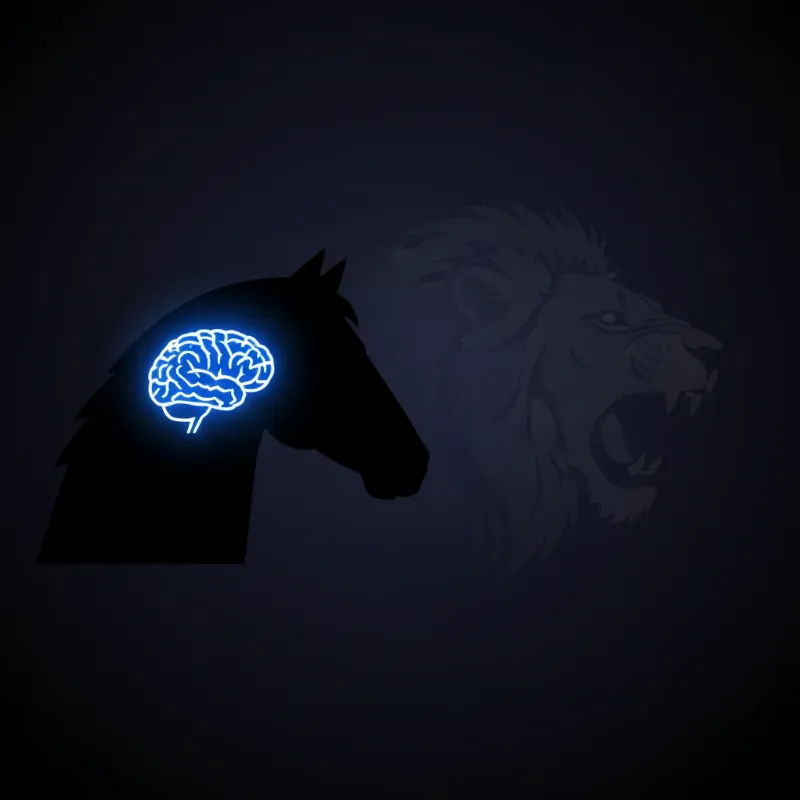 A conceptual image of the lion and the horse story's moral, showing a horse silhouette with a glowing brain, symbolizing wit over the lion's strength.
Frequently Asked Questions (FAQ)
What is the main moral of the lion and the horse story?
The central moral across all versions is that intelligence, wit, and strategy are superior to brute force and raw power. Cleverness can overcome even the most formidable physical threats.
What are the two main versions of this fable?
The two most common versions are Aesop’s fable, where a clever horse outsmarts a lion pretending to be a doctor, and a version from the Panchatantra tradition, where an old horse, with the help of a fox, tricks a lion into being tied to him and drags the predator to its demise.
How does the horse outsmart the lion in Aesop’s fable?
The horse pretends to have a thorn in its hoof to lure the lion, who is disguised as a doctor, into a vulnerable position. When the lion bends down to “examine” the hoof, the horse delivers a powerful kick to its face and escapes.
What does the lion symbolize in the story?
The lion symbolizes raw power, authority, pride, and overconfidence. Its arrogance is its critical weakness, as it consistently underestimates the intelligence of the horse.
Who is the trickster in the Panchatantra version?
In the Panchatantra-style story, the clever fox serves as the primary trickster and strategist. The fox devises the plan for the horse to play dead and tricks the lion into being tied to the horse.
A Lesson for the Ages
The lion and the horse story, in all its forms, remains a cornerstone of moral storytelling. It’s a powerful reminder that the circumstances we are born into do not define our outcomes. A lion is born a predator, and a horse is born prey, yet the narrative flips this dynamic on its head. It teaches us to look beyond the obvious, to question authority, and to trust in the power of our own minds. Whether facing a challenge at work, in personal relationships, or within ourselves, the wisdom of this ancient fable holds true: the strongest muscle you have is your brain. Mastering the lessons from the lion and the horse story is to understand that true victory is not about being the strongest, but about being the smartest.
