
The world of fables offers timeless wisdom, wrapped in simple narratives that resonate across generations. Among the most enduring of these is Aesop’s tale of the proud horse and the humble donkey. For centuries, this story has served as a powerful lesson in empathy, shared responsibility, and the consequences of selfishness. If you’ve been searching for The Horse And The Donkey Story Pdf, you’ve come to the right place. This is more than just a downloadable file; it’s an opportunity to explore a profound moral that remains incredibly relevant in our modern lives, from our workplaces to our relationships with our beloved pets.
The Enduring Fable: The Horse and The Donkey
A man once owned a magnificent Horse and a hard-working Donkey. The Horse was groomed daily, wore a fine saddle, and was used only for riding, a task he performed with pride and a toss of his majestic mane. The Donkey, however, was tasked with carrying heavy loads from the village to the mill, his back often aching under the strain.
One hot afternoon, they were traveling together along a dusty road. The Donkey was laden with a particularly heavy burden, and the sun beat down mercilessly. He struggled with every step, his legs trembling with effort.
“Brother,” the Donkey panted, turning to the Horse trotting lightly beside him. “This load is too much for me. Could you not, in your strength, take even a small portion of it? If you help me, I might just make it to our destination. If you don’t, I fear I will collapse and die right here on this road.”
The Horse flicked his ears and snorted with disdain. “Why should I? That is your burden, not mine. Our master has assigned our roles, and carrying loads is your job. I am for riding.” He continued his easy trot, leaving the Donkey to stumble behind.
The Donkey, with a heavy heart, pushed onward for a few more steps. But his strength was gone. He groaned, staggered, and finally collapsed onto the road, dead from exhaustion.
Just then, their master arrived. Seeing what had happened, he was filled with regret, but what was done was done. He ungirthed the heavy load from the dead Donkey and, to the Horse’s horror, placed the entire burden onto the Horse’s back. To add to the indignity, he also skinned the Donkey and placed the hide on top of the load.
The Horse, now groaning under the immense weight, lamented his fate. “How foolish I was!” he cried. “By refusing to carry a small part of the Donkey’s burden, I am now forced to carry it all—and his dead skin as well. My pride has cost me everything.”
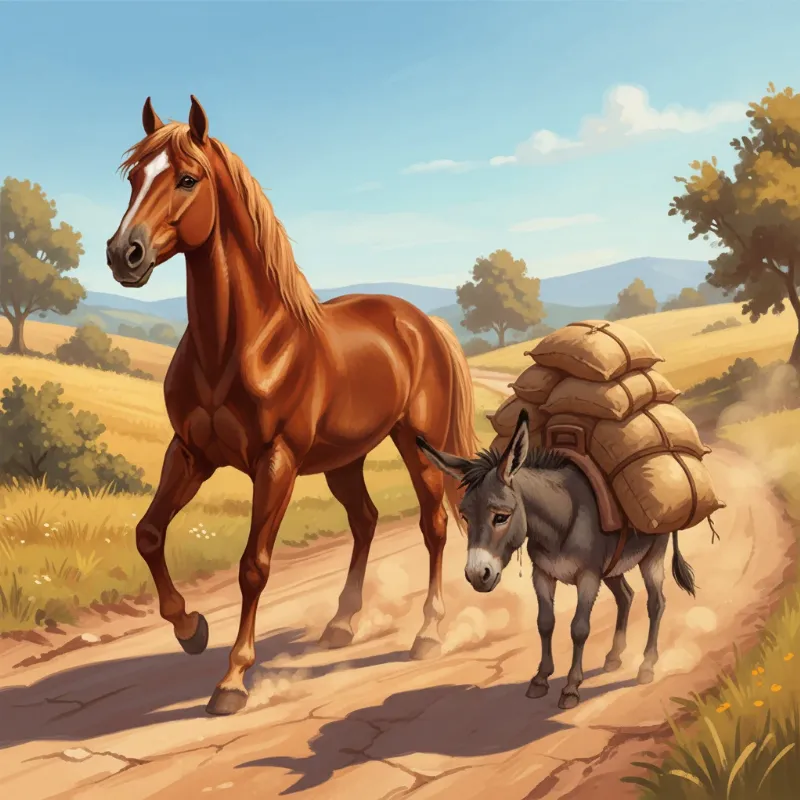 A vibrant illustration of the horse and the donkey story PDF, showing a proud, unburdened horse walking beside a donkey struggling under a heavy load on a sunny day.
What is the Moral of The Horse and the Donkey?
The power of this story lies in its direct and unambiguous moral. It’s a stark reminder that we are all connected and that our actions—or inactions—have consequences for ourselves and others. The fable highlights several key themes that are as important today as they were in ancient Greece.
The Consequences of Selfishness
At its core, the story is a cautionary tale about the high price of selfishness. The Horse, blinded by his own pride and sense of superiority, fails to see the Donkey not just as a fellow worker but as a fellow creature in need. He operates from a purely individualistic perspective: “That is your burden, not mine.” This refusal to offer a small amount of help leads directly to a far worse outcome for himself. The lesson is clear: refusing to share a small burden can result in having to carry a much larger one alone. It teaches that a little compassion and effort upfront can prevent a catastrophe later.
The Power of Mutual Support and Teamwork
The fable beautifully illustrates the principle of synergy and shared responsibility. Had the Horse agreed to take even a small portion of the load, both animals would have likely reached their destination safely and in good health. It underscores the idea that by helping others, we often help ourselves. In any group, family, or team, the well-being of the whole is dependent on the willingness of individuals to support one another. When one member falters, the entire system is at risk. Dr. Alistair Finch, a fictional sociologist specializing in collaborative behaviors, often states, “Community strength is not measured by its strongest link, but by its willingness to support the weakest.” This story is a perfect allegory for that concept.
Character Analysis: A Study in Pride and Humility
The effectiveness of the fable comes from its two starkly contrasting characters. They represent two very different approaches to life and responsibility, making the moral lesson easy to understand.
The Proud and Shortsighted Horse
The Horse represents arrogance, pride, and a lack of foresight. He sees the world only through the lens of his own comfort and status. His role is “for riding,” and he views the Donkey’s struggle as beneath him. He is unable to see beyond the immediate inconvenience of helping and fails to calculate the potential long-term consequences of his refusal. His downfall is a direct result of this narrow, self-centered worldview. He learns too late that his well-being was intrinsically linked to the Donkey’s.
The Overburdened and Humble Donkey
The Donkey symbolizes humility, hard work, and the plight of the overburdened. He is not asking for a complete release from his duties but simply for a bit of assistance to survive a difficult situation. His polite and reasonable request—”Could you not… take even a small portion?”—makes the Horse’s refusal seem all the more cruel. The Donkey’s tragic end serves as the catalyst for the story’s moral, forcing the Horse (and the reader) to confront the fatal outcome of a lack of empathy.
 An allegorical image representing the moral of the horse and the donkey story, showing two dogs working together to carry a large stick, symbolizing shared burdens.
Why is “The Horse and the Donkey Story PDF” So Popular?
The continued search for the horse and the donkey story PDF speaks to its enduring appeal as an educational and moral tool. Its simplicity makes it accessible to all ages, while its message remains deeply profound.
A Powerful Tool for Parents and Educators
For parents and teachers, the story is an invaluable resource. It’s a simple, effective way to introduce complex concepts like empathy, cooperation, and consequence to children. The clear narrative allows for easy discussion:
- What could the Horse have done differently?
- How do you think the Donkey felt when the Horse refused to help?
- Have you ever felt like the Donkey? Or acted like the Horse?
Having a printable PDF version makes it easy to share in a classroom, use for a bedtime story, or include in a lesson plan about fables and moral reasoning. It serves as a perfect springboard for conversations about how we should treat one another.
Timeless Lessons for Adults in the Modern World
The fable’s wisdom is not limited to children. Its lessons are directly applicable to the adult world, particularly in professional settings. In any workplace, projects and workloads can become overwhelming for certain team members. The “Horse” in the office is the colleague who says, “That’s not my job,” refusing to lend a hand to a struggling coworker. The story serves as a potent reminder that such an attitude ultimately harms the entire team and, often, the individual who refuses to help. A collaborative environment where burdens are shared leads to greater productivity, morale, and success for everyone.
Frequently Asked Questions (FAQ)
Who originally wrote the story of the Horse and the Donkey?
The story is attributed to Aesop, a storyteller believed to have lived in ancient Greece between 620 and 564 BCE. Like his other fables, it was originally passed down through oral tradition before being written down by later authors.
What is the main theme of the horse and the donkey story?
The main theme is the importance of mutual help and the negative consequences of selfishness. It teaches that we should help others in need, as their well-being is often connected to our own. A secondary theme is the danger of pride and arrogance.
How can this story be applied to everyday life?
The story’s moral can be applied to countless situations: in the workplace by helping a colleague with a heavy workload, at home by sharing household chores, or in a community by volunteering to help a neighbor. It encourages a mindset of cooperation over individualism.
Is there another name for this fable?
Yes, it is sometimes referred to as “The Ass and the Horse” or simply “The Horse and His Rider.” However, “The Horse and the Donkey” is the most common title used in modern collections.
Why is a PDF version of the story useful?
A PDF version is a convenient, portable format that allows for easy printing and sharing. It’s perfect for educators who need handouts for their students, parents who want a physical copy for storytime, or anyone who wants to keep a collection of classic fables.
A Lesson We Should Never Forget
The Horse and the Donkey is more than just a simple animal tale. It is a fundamental lesson in humanity. It teaches us that empathy is not a weakness but a strength, and that community thrives when its members are willing to lighten each other’s loads. By choosing to help, we not only save others from collapsing under their burdens, but we also safeguard our own future. The enduring popularity of the horse and the donkey story PDF is a testament to this powerful truth—a truth we would all do well to remember as we travel our own dusty roads.
