
Welcome to the essential journey of dog ownership: house training. Whether you have a brand-new puppy or are welcoming an adult dog into your home, mastering this skill is fundamental to a happy, clean, and stress-free life together. The term The Dog House Training can be a little misleading; we’re not teaching your dog to use a literal doghouse in the yard. We’re talking about housebreaking—teaching your furry friend the appropriate place to eliminate. This process is a cornerstone of your relationship, building communication, trust, and mutual respect from day one. It requires patience, consistency, and a positive attitude, but the rewards are immeasurable. This journey requires patience, but with the right dog house training tips, you’ll build a wonderful bond and a beautifully behaved companion.
Understanding the Core Principles
Before you start, it’s crucial to grasp the three pillars of successful house training: a consistent routine, positive reinforcement, and vigilant supervision. Dogs are creatures of habit; they thrive on predictability. Punishing a dog for an accident is counterproductive—it only teaches them to fear you, not to understand what you want. Instead, focus on rewarding the behavior you do want.
As Dr. Emily Carter, a veterinary behaviorist, often says, “Successful house training isn’t about punishing mistakes; it’s about creating so many opportunities for success that accidents become irrelevant.”
This positive approach forms the foundation of a trusting relationship and makes the learning process faster and more enjoyable for both of you.
Getting Started: Your House Training Toolkit
To set yourself up for success with the dog house training, gather a few essential items. Having these on hand will make the process smoother and more efficient.
- A Crate: This is your most valuable tool. A crate serves as a safe, den-like space for your dog and is instrumental in preventing accidents when you can’t supervise them directly. Choose a size that allows your dog to stand up and turn around comfortably, but not so large that they can use one end as a bathroom and the other as a bed.
- High-Value Treats: Find a treat that your dog absolutely loves. These will be used exclusively for rewarding successful potty breaks. The reward should be immediate and enthusiastic to create a strong positive association.
- Enzymatic Cleaner: Standard cleaners won’t cut it. You need an enzymatic cleaner specifically designed to break down and eliminate the proteins in pet urine. If you don’t remove the scent completely, your dog will be drawn back to the same spot to eliminate again.
- A Leash and Collar/Harness: Keeping your puppy on a leash, even indoors, is a great way to supervise them closely during the initial training phases.
The Step-by-Step Guide to House Training a Puppy
Puppies have small bladders and limited control, so consistency is key. Follow this step-by-step process to guide your new companion.
1. Establish a Strict Potty Schedule
A routine is everything. Take your puppy out frequently, especially at key moments:
- First thing in the morning.
- Last thing before bed.
- After waking up from a nap.
- After playing or training sessions.
- After eating or drinking.
- At least once every one to two hours initially.
2. Choose a Designated Potty Spot
Always take your puppy to the same spot in your yard. The lingering scent will encourage them to go. Be patient and stand still, letting them sniff around. This isn’t playtime; it’s potty time.
3. Use a Verbal Cue
As your puppy begins to eliminate, introduce a consistent verbal cue like “Go potty” or “Do your business” in a calm, encouraging tone. Over time, they will associate this phrase with the action, which can be incredibly useful later on.
4. Reward Success Lavishly
The moment your puppy finishes, praise them enthusiastically and give them a high-value treat. This immediate reward is the most critical part of the dog house training. It solidifies the connection between going potty outside and receiving something wonderful.
5. Supervise, Supervise, Supervise
When your puppy is indoors and not in their crate, they need your undivided attention. Keep them in the same room with you at all times. Using a leash to tether them to you is an excellent management technique that prevents them from wandering off to have an accident. Learning to recognize the signs that they need to go—such as circling, whining, or sniffing the ground intently—is a skill that will develop over time. Dealing with setbacks is normal, and understanding common dog training housebreaking problems can prepare you for them.
What to Do When Accidents Happen
Accidents will happen. It’s a normal part of the process. How you react is what matters.
- Never Punish Your Dog: Do not scold, yell at, or push your dog’s nose in the mess. This will only create fear and anxiety, which can lead to more accidents. Your dog won’t understand why you’re angry, only that you are a source of fear.
- Interrupt the Act: If you catch your dog in the middle of an accident, make a noise to startle them (like a sharp “Ah-ah!” or a clap) to interrupt them. Immediately scoop them up and take them outside to their designated spot. If they finish outside, praise and reward them.
- Clean Thoroughly: Use your enzymatic cleaner to clean the soiled area completely. This is non-negotiable. If any scent remains, your dog’s powerful nose will identify it as a pre-approved bathroom spot.
The Role of Crate Training
A crate is not a punishment; it’s a management tool that taps into a dog’s natural denning instinct. Dogs instinctively avoid soiling their sleeping area. When used correctly, a crate helps with the dog house training in several ways.
How to Use a Crate for House Training
- Make it a Haven: Introduce the crate as a wonderful place. Feed your dog their meals in the crate, give them special toys that they only get in the crate, and praise them for going inside.
- Keep it Short: Start with short periods and gradually increase the time. Never leave a young puppy in a crate for longer than they can reasonably hold their bladder (a general rule is one hour for every month of age, plus one).
- Use it for Supervision Gaps: Crate your dog when you can’t watch them, such as when you’re sleeping, showering, or running a quick errand. This prevents accidents and keeps them safe.
For dogs that have a particularly hard time, you may need to look into more specific strategies like indoor dog house training before transitioning outside.
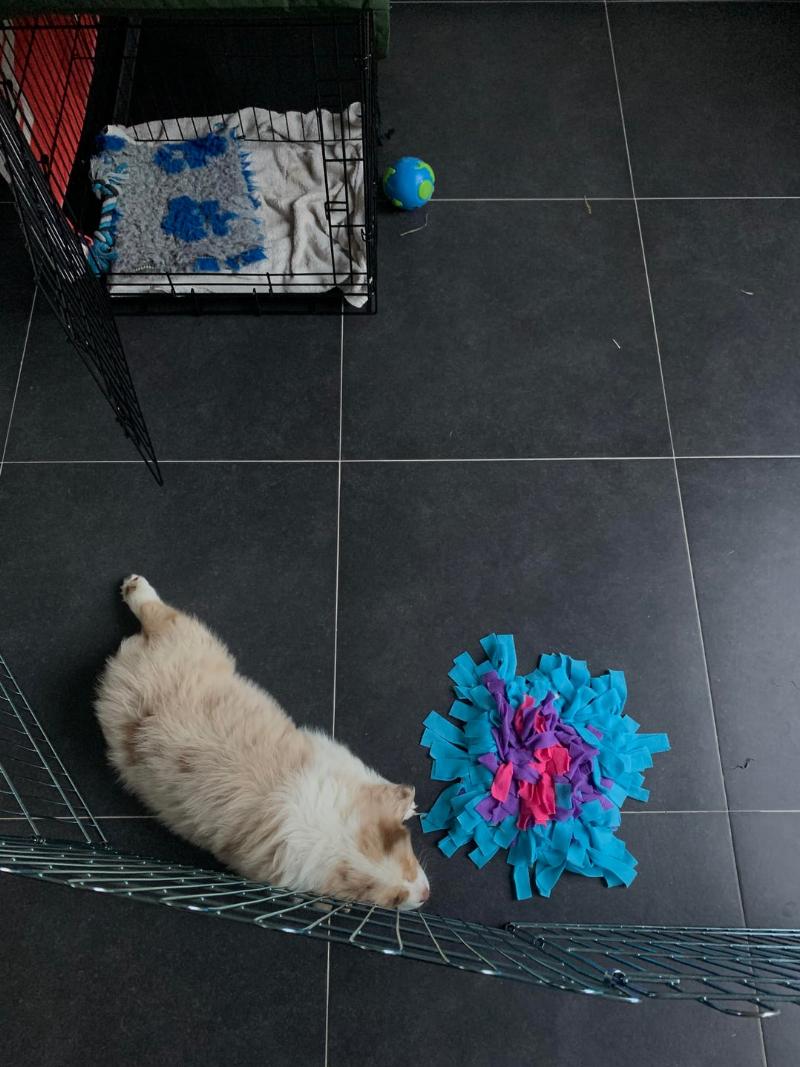 A modern wire dog crate with an open door, featuring a plush, comfortable bed and a chew toy inside, presented as a safe and inviting den.
House Training an Adult Dog
The principles for training an adult dog are the same as for a puppy, but you may face different challenges. Your adult dog might have learned bad habits, or they may have never been properly house-trained in the first place.
- Start from Scratch: Assume your new adult dog is not house-trained, regardless of what you were told. Begin with the same puppy schedule of frequent potty breaks.
- Be Patient: It can take longer for an adult dog to unlearn old habits and form new ones. Consistency is even more critical.
- Rule Out Medical Issues: If an adult dog that was previously house-trained suddenly starts having accidents, a trip to the veterinarian is in order. Urinary tract infections, kidney issues, or other medical problems could be the underlying cause.
Conclusion: The Path to a Potty-Trained Pal
Successfully mastering the dog house training is a rite of passage for every dog owner. It’s a process built on a foundation of patience, consistency, and positive reinforcement. By establishing a predictable routine, rewarding your dog’s successes, managing their environment to prevent mistakes, and never resorting to punishment, you are not just teaching them where to go to the bathroom. You are building a powerful language of trust and communication that will strengthen your bond for years to come. Embrace the journey, celebrate the small victories, and soon you’ll have a well-behaved companion and a clean, happy home.
Frequently Asked Questions (FAQ)
1. How long does it take to house train a puppy?
The timeline for the dog house training varies widely depending on the puppy’s age, breed, and individual learning ability, as well as the owner’s consistency. On average, it can take anywhere from 4 to 6 months for a puppy to be fully reliable, but some may learn more quickly, while others might take up to a year.
2. Why is my puppy having accidents after being good for a while?
This is known as regression and it’s a common part of the process. It can be caused by a change in routine, stress, or simply a developmental phase. The best response is to go back to basics: increase the frequency of potty breaks, reinforce positive behavior, and increase supervision for a while.
3. Should I use puppy pads?
Puppy pads can be a useful tool for those living in high-rise apartments or for people with mobility issues. However, they can sometimes confuse the puppy, teaching them that it’s acceptable to go potty inside the house. If you use them, have a clear plan to eventually transition the training to the outdoors.
4. What is the difference between house soiling and marking?
House soiling is when a dog empties their bladder because they genuinely have to go. Marking, on the other hand, is a behavioral issue where a dog (usually male, but females do it too) deposits a small amount of urine to claim territory. Marking is often triggered by new people, objects, or animals in the home.
5. My dog has accidents only when I’m gone. What should I do?
This could be a sign of separation anxiety rather than a house training issue. A dog with separation anxiety is experiencing genuine panic and distress. If you suspect this is the case, it’s best to consult with a veterinarian or a professional dog trainer to address the underlying anxiety.
