
In the smoldering aftermath of September 11, 2001, as a stunned world grappled with the new reality of terror, a secret and unprecedented mission was set in motion. While the public narrative focused on conventional military responses, a small team of 12 Green Berets embarked on a task so audacious it sounds like fiction. This is The Declassified True Story Of The Horse Soldiers, the men of Operational Detachment Alpha (ODA) 595, who rode into a 21st-century war on horseback, armed with modern technology and unwavering courage. Their story, once shrouded in classification, reveals one of the most successful, yet least known, campaigns in modern military history.
A New Kind of War: Responding to 9/11
Within hours of the attacks, the call for retribution was clear. The United States and its allies turned their focus to Afghanistan, the sanctuary for the Al-Qaeda terrorists responsible. The immediate challenge was immense: how to project force into a landlocked, notoriously treacherous country known as the “graveyard of empires.” The answer was not a massive invasion force, but something far more agile and specialized.
The mission, codenamed Task Force Dagger, was assigned to the U.S. Army’s 5th Special Forces Group. The spearhead of this operation would be a handful of 12-man teams, including ODA 595. Their objective was not to conquer, but to enable. They were to embed with the Afghan Northern Alliance, a loose coalition of local warlords and militia fighters who had been resisting the Taliban for years, and help them overthrow the brutal regime. On October 19, 2001, flown by the elite 160th Special Operations Aviation Regiment (SOAR), ODA 595 was covertly inserted deep behind enemy lines into the rugged mountains of northern Afghanistan.
Forging an Unlikely and Crucial Alliance
Landing in the dead of night, the 12 members of ODA 595, led by Captain Mark Nutsch (portrayed as Mitch Nelson by Chris Hemsworth in the film “12 Strong”), faced their first challenge: linking up with their local counterpart. They were to work with General Abdul Rashid Dostum, a powerful and unpredictable Uzbek warlord. Building trust was paramount and fraught with difficulty. These were men from two different centuries, two different worlds, united only by a common enemy.
The Green Berets had to navigate a complex web of tribal politics, historical grievances, and cultural divides. They were not an occupying force; they were advisors, diplomats, and warriors rolled into one. Their success depended entirely on their ability to convince Dostum and other Northern Alliance leaders that they could be trusted and, more importantly, that they could deliver on their promise of American airpower.
“Our American presence on the ground gave them hope and emboldened them that they can have a little better future,” stated Mark Nutsch, reflecting on the bond forged with their Afghan allies.
This alliance was the cornerstone of the entire operation. Without the Northern Alliance’s manpower, knowledge of the terrain, and will to fight, the mission would have been impossible. The Americans brought the technological advantage that could break the Taliban’s grip on the country.
Why Horses? The Declassified True Story of the Horse Soldiers
The most iconic image of this mission is that of a highly trained U.S. Special Forces soldier on horseback. In an age of GPS, stealth bombers, and satellite communications, why resort to such an ancient form of transportation? The answer lies in the unforgiving geography of northern Afghanistan. The steep, narrow mountain passes and rocky trails that crisscross the region are completely inaccessible to vehicles like Humvees or tanks.
The members of ODA 595 had to adapt or fail. They quickly embraced the tactics of their Afghan partners, trading their modern vehicles for the sure-footed local horses. Many of the soldiers, including Captain Nutsch who grew up on a ranch in Kansas, had riding experience, but this was different. They were learning on the job, riding with local saddles and gear into combat. This incredible contrast—elite soldiers laden with futuristic gear riding into battle on horseback—became the defining legend of the Horse Soldiers.
A Symphony of Old and New Warfare
The genius of Task Force Dagger was the seamless fusion of 19th-century cavalry tactics with 21st-century military technology. While on horseback, members of ODA 595 carried sophisticated equipment that would turn the tide of the war. Using satellite phones, laser rangefinders, and GPS locators, these Green Berets could identify Taliban and Al-Qaeda positions with pinpoint accuracy.
They would then relay the coordinates to U.S. Air Force bombers, including massive B-52s circling tens of thousands of feet overhead, unleashing a devastating firestorm of precision-guided munitions. This combination was lethally effective. The Taliban, who had tanks, artillery, and thousands of fighters, were bewildered. They could not see their attackers, who moved swiftly through the mountains on horseback, directing destruction from the sky. This unprecedented blend of tactics allowed a small force to have a strategic impact far beyond its numbers.
The Decisive Battle for Mazar-i-Sharif
The critical objective for ODA 595 and Dostum’s forces was the city of Mazar-i-Sharif. A strategic hub and a longtime Taliban stronghold, its capture would shatter the regime’s control over northern Afghanistan. Military planners had predicted that taking the city could take up to two years.
In early November 2001, the Horse Soldiers and their Afghan allies launched their assault. In a scene that could have been pulled from a history book, they conducted cavalry charges across the plains, riding toward enemy lines. But as they charged, they called in air strikes that decimated Taliban defenses. On November 10, after weeks of intense fighting, Mazar-i-Sharif fell. It was a stunning victory that military strategists had deemed impossible in such a short timeframe. The fall of the city triggered a domino effect, leading to the collapse of the Taliban government just weeks later.
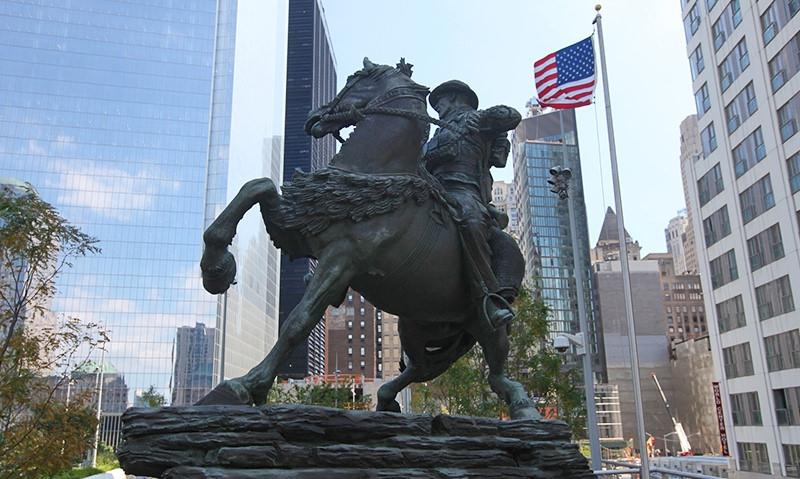 The declassified true story of the horse soldiers is honored by the America's Response Monument near Ground Zero.
Legacy and Declassification: A Story Finally Told
For years, the incredible accomplishments of ODA 595 and the other Task Force Dagger teams remained classified. The men returned home without fanfare or public recognition, quietly resuming their lives. The full scope of their mission was unknown to the American public they had fought to protect.
The story began to emerge with Doug Stanton’s meticulously researched 2009 best-selling book, Horse Soldiers, which finally brought their heroism to light. This was later adapted into the major motion picture “12 Strong,” sharing their declassified true story with a global audience.
Perhaps the most poignant tribute is the America’s Response Monument. This life-and-a-half scale bronze statue of a Green Beret on horseback stands overlooking the 9/11 Memorial in New York City. It is a permanent and powerful testament to the first brave few who took the fight to the enemy in the earliest days of the War on Terror. All twelve members of ODA 595 survived the mission, a miraculous outcome given the overwhelming odds they faced.
Frequently Asked Questions
How accurate is the movie “12 Strong”?
While “12 Strong” takes some cinematic liberties for storytelling purposes, it is largely faithful to the core events of ODA 595’s mission. The film accurately portrays the unconventional nature of the warfare, the reliance on horses, the critical alliance with General Dostum, and the successful campaign to liberate Mazar-i-Sharif. The main character, Mitch Nelson, is based on the real team commander, Mark Nutsch.
Did the Green Berets really have experience riding horses?
Some members of the team had prior horse riding experience, but none were professional cavalrymen. Captain Mark Nutsch, for instance, grew up riding horses on a cattle ranch. However, they had to adapt quickly to the small, hardy Afghan horses and the local style of riding, often under extreme combat conditions.
What was the official name of the “Horse Soldiers” team?
The team was officially designated as U.S. Army Special Forces Operational Detachment Alpha 595, or ODA 595. The nickname “Horse Soldiers” was given to them by the media after their incredible story became public.
How were they able to defeat a much larger enemy force?
Their success was due to a combination of factors. They acted as a force multiplier, uniting disparate Afghan militias into a cohesive fighting force. Most importantly, they combined ancient cavalry tactics with modern technology, using their position on the ground to call in overwhelming and precise American airpower on Taliban positions.
Is the “America’s Response Monument” a real statue?
Yes, it is very real. The bronze statue, also known as De Oppresso Liber, is located in Liberty Park, overlooking the National September 11 Memorial & Museum in New York City. It was dedicated in 2011 to honor all United States Special Forces personnel.
Conclusion
The declassified true story of the Horse Soldiers is a powerful saga of adaptation, innovation, and courage in the face of overwhelming odds. It is a testament to the core principles of Special Forces: the ability to operate in any environment, to build alliances with indigenous partners, and to achieve strategic victory with a small footprint. The 12 men of ODA 595 were the tip of the spear in America’s response to 9/11, proving that sometimes the most effective weapon in modern warfare is the seamless combination of the oldest traditions of battle with the newest technology, all driven by the unbreakable spirit of the American soldier.
