
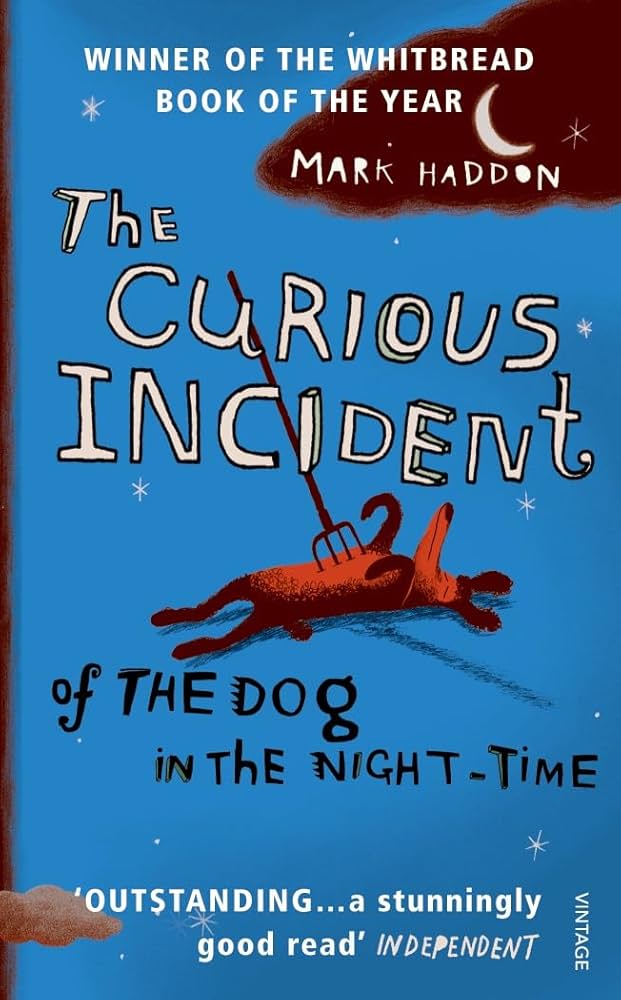
Christopher Boone, a fifteen-year-old navigating the world with Asperger’s Syndrome, embarks on an unexpected detective journey in Mark Haddon’s novel, “The Curious Incident Of The Dog in the Night-Time.” This internally narrated tale plunges readers into Christopher’s unique perspective as he investigates the mysterious death of a neighbor’s dog. While primarily aimed at a Young Adult audience, the book offers profound insights that resonate with adult readers as well.
A Mind Structured by Prime Numbers and Logic
The novel’s structure itself mirrors Christopher’s way of thinking. Chapters are numbered using prime numbers, and mathematical puzzles and diagrams are interspersed throughout the narrative. This reflects his logical, detail-oriented approach to life, often characterized by an avoidance of metaphor and an intense focus on factual accuracy. Haddon masterfully uses these stylistic choices to authentically portray Christopher’s experiences and coping mechanisms. The narrative’s stilted yet precise tone offers a plausible glimpse into a mind that processes information differently, aligning with descriptions of individuals on the autism spectrum.
The Narrator: Truthful, Yet Unseen Truths
Christopher’s defining characteristic is his profound commitment to truth, a direct consequence of his literal interpretation of the world. He struggles with social niceties that require “white lies” and finds metaphors, even the word itself, to be a conceptual hurdle. This fascination with truth and language also invites comparisons to China Mieville’s novel, Embassytown, which explores the intricate relationship between language, thought, and deception. While many novels focus on uncovering external truths, Christopher’s investigation delves deeper, revealing how his neurodivergent perspective, though pathologically truthful, can sometimes obscure the nuanced realities of human interaction. Despite his earnestness, his condition means his observations, while detailed, can miss the underlying emotional truths of a situation.
The book is replete with humor, often stemming from Christopher’s innocent misunderstandings and the contrast between his desire for anonymity and his unintentional social awkwardness. His fascination with dogs, whom he perceives as having clear, predictable moods—happy, sad, cross, and concentrating—highlights his preference for the unambiguous nature of animals over the complexities of human emotions and communication. He famously states, “I like dogs. You always know what a dog is thinking.” This preference underscores his struggle with interpreting human cues, which he likens to observing through a one-way mirror. Even the concept of love is defined through actions and truth, as in his understanding of his father’s care: “Loving someone is helping them when they get into trouble, and looking after them, and telling them the truth…”
Logic, Order, and the World’s Obvious Truths
Christopher’s affinity for mathematics stems from its inherent safety, order, and definitive answers, a stark contrast to the often-unpredictable nature of life. His explanation of prime numbers—”Prime numbers are what is left when you have taken all the patterns away”—encapsulates his analytical approach. His seemingly illogical preferences, such as having favorite and hated colors, are presented as ingenious coping strategies to manage sensory overload and the constant influx of details his brain processes. This ability to recall every detail at will, unlike the “imaginary stuff” in neurotypical minds, draws parallels to his hero, Sherlock Holmes, who observed that “The world is full of obvious things which nobody by any chance observes.” Christopher’s method of defining a good or bad day by the number of red or yellow cars is, in his view, no less logical than an office worker’s mood being swayed by the weather.
This novel invites comparison with other works that explore unique cognitive perspectives. Iris Murdoch’s The Word Child features a protagonist with latent Asperger’s tendencies, while Yōko Ogawa’s The Housekeeper and the Professor centers on a mathematician whose mind operates differently and finds patterns in everyday life. Both offer compelling explorations of unconventional ways of understanding the world.
“The Curious Incident of the Dog in the Night-Time” is a remarkable exploration of a unique mind. Through Christopher’s voice, the novel sheds light on the challenges and triumphs of navigating a world not always built for neurodivergent individuals, offering a deeply moving and often humorous narrative that celebrates the power of observation, logic, and truth.
