
A successful horse breeding program hinges on the health and management of the stallion. Understanding the role of the stallion in reproduction, along with proper management practices, is crucial for maximizing fertility and ensuring a productive breeding season. This guide delves into the essential aspects of stallion care and utilization.
The Stallion’s Role in Equine Reproduction
The primary function of the stallion is to deliver healthy spermatozoa, carrying his genetic material, into the mare’s reproductive tract during service. A stallion must possess sufficient libido, or sex drive, to actively tease and service mares frequently. Furthermore, he needs to maintain the production of viable spermatozoa throughout the entire breeding season.
The male reproductive system comprises the testes, where spermatozoa are produced, and accessory sex glands. Spermatozoa develop in coiled seminiferous tubules within the testes. Crucially, these developing cells are sensitive to body temperature, making scrotal thermoregulation vital. The scrotal muscles contract and expand to regulate temperature. Horses with undescended testes (cryptorchidism) are typically sterile in the affected testis, and this condition is hereditary, meaning it should not be propagated. natural breeding in horses.
The accessory sex glands—seminal vesicles, prostate, and bulbourethral gland—secrete alkaline fluids that neutralize the urethra, facilitating the transport of spermatozoa. The lifespan of sperm within the mare’s tract is generally 24 to 48 hours, rarely exceeding this period. While sperm can reach the Fallopian tube shortly after coitus, the typical transit time is five to eight hours. Given the mare’s relatively long estrous cycle and the short lifespan of both sperm and egg, conception rates below 50 percent are not uncommon.
Care and Management of a Healthy Stallion
Breeding Rates and Capacity
Yearlings are not recommended for breeding. Two-year-old stallions can typically settle around 10 mares, while three-year-olds may handle up to 30. Mature stallions, when hand-mated, can manage approximately 50 mares. Pasture mating reduces this capacity by about half. The length of the breeding season and the individual stallion’s sexual performance significantly influence his siring ability.
Feeding and Management Practices
A breeding stallion requires nutrition akin to a horse engaged in hard work. A general guideline suggests 1.5 pounds of grain and 1 pound of hay per 100 pounds of body weight. Increased feed is necessary if the stallion is also worked under saddle. Due to potential distractions, a highly palatable ration might be needed to ensure adequate intake.
Regular exercise is fundamental for enhancing vigor, including libido and fertility. Incorporating periods of regular grazing on good quality grass is also highly recommended. For safety, pastures housing stallions should be secured with strong, tall fences. If mares are in adjacent pastures, exceptionally tall fencing is essential to prevent unwanted interactions.
Methods of Mating
The primary methods of equine mating include pasture mating, hand mating, and artificial insemination, with variations within each. Breed registry regulations may differ concerning the use of artificial insemination.
horses for breeding information can be found through various breed registries and equine organizations.
Pasture Mating
Pasture mating offers advantages such as reduced labor, owner convenience, and the ability to “catch” shy breeding mares, potentially leading to a higher settling percentage. However, it limits the number of mares a stallion can serve and obscures accurate breeding dates. There is also an inherent risk of injury to the stallion. Stallions utilized in pasture breeding programs are often turned out in a large pasture with a few older mares after being hand-mated a few times as two-year-olds. This method is less common in breeds where blemishes are highly discriminated against but is widely practiced among stock horses in range country. Combining hand mating with subsequent pasture mating can extend the number of mares bred and improve conception rates.
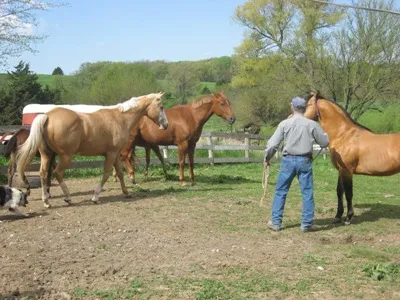 Group teasing mares.
Hand Mating
Hand mating is performed under diverse conditions, ranging from casual environments to highly supervised settings with veterinary attendance. Stallions involved in hand mating should be proficient at teasing mares, which can be done at a teasing pole, over a stall door, or any other secure fixture that poses no harm to the horses or handlers.
Signs of estrus (heat) in mares include frequent urination, vaginal discharge, and increased interest in the stallion. As ovulation nears, hormonal changes intensify these signs. The vaginal discharge may transition from a stringy consistency to a more profuse, liquid discharge.
Once a mare is identified as being in heat, she may be hobbled or placed in a breeding stock. While hobbles offer convenience and safety for the mare, they can pose risks to the handler, and stallions have been known to become entangled. The mare’s hindquarters may be washed, and her tail bandaged. The stallion is then allowed to mount quietly from behind. It is imperative that stallions do not exhibit rough behavior during breeding. Removing the stallion’s front shoes before the breeding season is a common safety precaution. live horse breeding practices often involve careful observation and management to ensure safety and efficiency.
Optimizing Foal Crop Percentage
To maximize the percentage of foals produced, consider the following:
- Breed only healthy animals.
- Breed mares as frequently as possible during their heat cycle.
- Utilize pasture breeding when practical.
- Avoid breeding at “foal heat” (the first heat cycle after foaling).
- Ensure mares are in good body condition, but not overweight, when bred.
- Understand the unique heat cycle characteristics of each mare.
- Regularly tease mares after breeding to monitor for return to estrus.
- Have mares pregnancy-checked by a qualified veterinarian.
mc horse breeding is a specialized area that requires in-depth knowledge and careful planning, often involving experienced professionals. For those seeking local options, searching for a horse breeder near me can connect you with reputable individuals or facilities.
References
Andrews, F.N., and F.F. McKenzie. 1941. Estrus, Ovulation and Related Phenomena in the Mare. Missouri Agricultural Research Bulletin 329. University of Missouri-Columbia.
Loch, Wayne and John W. Massey. Horse Breeding Basics. 2000. Horse Breeding Arithmetic: 2+2=1. Missouri Agricultural Research Bulletin 2790. University of Missouri-Columbia.
