
Bringing a new puppy into your home is an exciting time, filled with cuddles and playful antics. As a dog owner, ensuring your puppy develops into a well-mannered companion is often a top priority. While early socialization is crucial for a well-adjusted dog, it’s equally important to instill good manners from the start, particularly when it comes to Teaching A Puppy Not To Jump Up On You or other people. Many owners struggle to find the right balance, fearing that correcting a young pup during socialization might create negative associations. However, with a thoughtful approach, you can achieve both a well-socialized and well-behaved dog. The key lies in two simple steps: preventing bad habits from forming and teaching an alternative, desirable behavior. By understanding how dogs learn what’s rewarding, you can proactively shape your puppy’s interactions with the world. For a happy and well-behaved canine, consistency and early intervention are your best tools in guiding them toward appropriate greetings. how to get my dog to stop biting is another important aspect of puppy training to consider early on for overall good manners.
Prevent Bad Habits Before They Start
The easiest way to stop a puppy from jumping up on people is to prevent the habit from ever developing. Dogs, especially puppies, learn through reinforcement; they will repeat behaviors that lead to a rewarding outcome. If your puppy discovers that jumping up leads to them reaching your face – often seen as a highly rewarding interaction – they will continue to jump.
For small puppies, a simple and effective prevention method is to pick them up when people greet them. Holding your puppy in your arms allows them to socialize without being able to practice the jumping behavior. This ensures they still get positive interactions with new people without learning the undesired action.
If you have a large breed puppy or one that is too heavy to lift consistently, you can encourage people to get down to your dog’s level. By having greeters kneel or sit, your puppy can interact with them without needing to jump to make contact. The goal is always to cut off the opportunity for the bad habit to form, rather than trying to correct it later. Nipping these behaviors in the bud through proactive prevention is far more effective than extensive remedial training. Understanding how to address behaviors like how to stop dog pulling while walking also highlights the importance of early prevention in other areas of training.
Teach an Alternative Behavior: The Key to Success
The most powerful strategy for teaching a puppy not to jump up on you is to replace the jumping with an incompatible, desired behavior. If your puppy learns to sit consistently for attention, they physically cannot jump up at the same time. This simple substitution can solve the vast majority of jumping issues. Imagine how pleasant greetings will become when your dog automatically sits instead of launching themselves at guests! The crucial step now is to effectively communicate this message to your canine companion.
Teaching Your Dog to Sit Reliably
The “sit” command is fundamental to almost all dog training, yet it’s often taken for granted. Many owners assume their puppy fully understands “sit” after just a few repetitions. However, for “sit” to be an effective alternative to jumping, your dog needs to understand it deeply and consistently. Use high-value rewards – your pup needs to learn that sitting is an incredibly good thing.
Your criteria for “sit” should be high: we want “sit” to mean “sit and hold position until I release you,” even in the presence of distractions. Do not rush this step. Spend ample time teaching and reinforcing the idea of longevity and stability in the sit position. Once your puppy can hold a sit reliably in a calm environment, gradually introduce distractions. Reward generously with their favorite treats whenever they make the good choice to hold their sit. A strong foundation in “sit” will be invaluable for future training, including mastering how to train your dog to not pull on leash.
Teaching Your Dog to Greet in a Sit
Once your puppy has mastered holding the sit position, it’s time to integrate this into the greeting process. Start by making it easy for them. You might begin with a person simply approaching or standing nearby while you reward your dog for maintaining their sit. Remember to use their favorite rewards to keep the motivation high.
Gradually increase the challenge and excitement of the greeting. Progress from a person nearby, to a person speaking to the dog, to a person gently touching the dog, and so on. Always reward your dog for staying in the sit position. This consistent reinforcement teaches them that calm, four-paws-on-the-floor greetings are the most rewarding. This systematic approach is also crucial when addressing issues like how to stop your dog from pulling on a walk, reinforcing good behavior during interactions.
Generalize Your Training Over Different Environments
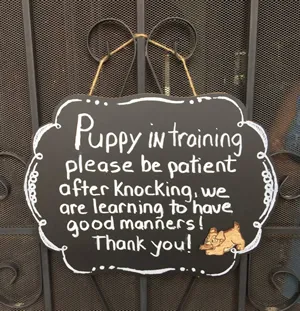 Sign to alert guests about a puppy in training
After your dog understands how to sit for greetings in a controlled environment, it’s vital to generalize this training to various locations and situations. A common challenge area is the front door at home, where the excitement of a ringing doorbell can quickly override learned behaviors. Training in this specific scenario is priceless for solidifying your dog’s understanding.
Initially, set up practice sessions with other household members or familiar friends your dog isn’t overly excited to see. Start simply: have the person stand outside the closed door. Reward your dog for remaining in a sit. Progress to an open door, then have them ring the bell with the door open. Finally, work through the entire ritual of a closed door, the bell ringing, and the door opening. By setting up these situations and having complete control, you can create and reward success. Don’t wait for a real guest to arrive to practice; instead, be prepared for these common occurrences. A sign like the one pictured is an excellent example of thoughtful planning, reminding guests to help maintain your puppy’s good manners during training. This proactive approach ensures your puppy understands expectations in real-world scenarios, much like training a dog to walk on a leash without pulling requires consistent practice in different environments.
Ultimately, the adage holds true: dogs do what’s rewarding! By setting up scenarios to your advantage, consistently rewarding desired behaviors, and preventing the practice of unwanted ones, your puppy will learn to possess both excellent social skills and impeccable manners. Happy Training!
