
Walking your dog should be an enjoyable experience for both of you, a chance to bond and explore the world together. However, a common frustration for many dog owners is a dog that constantly pulls on the leash. Not only can this be unpleasant, making walks feel like a tug-of-war, but it can also be unsafe. A dog pulling excessively might lead to you losing your grip, causing injury, or even allowing your dog to run into traffic or confront other animals. Beyond the immediate risks, it’s often against local ordinances to have an uncontrolled dog in public areas, emphasizing the importance of polite leash manners.
Knowing how to teach a dog to stop pulling on leash is crucial for their safety and your peace of mind. While it’s a widespread issue, thankfully, there are straightforward and effective techniques you can implement to transform your walks. By understanding your dog’s motivations and adjusting your own behavior, you can transition from being dragged down the street to enjoying harmonious walks side-by-side. The following ten tips will guide you through the process, helping you and your canine companion achieve loose-leash walking mastery.
1. Always Reward Good Leash Behavior
It’s easy to overlook good behavior, especially when you’re focused on correcting unwanted actions. However, dogs are far more likely to repeat behaviors that are rewarding. This principle applies strongly to walking politely on the leash. Whether the reward is a tasty treat, enthusiastic praise, or even the chance to sniff something interesting, positive reinforcement is key. If you only pay attention when your dog pulls, you risk reinforcing the very behavior you want to eliminate, as they learn that pulling gets your attention or moves them forward.
Make it a habit to carry treats or be ready with verbal praise and gentle pets during every walk. When your dog walks beside you with a loose leash, immediately acknowledge and reward that behavior. In the initial stages of training, be generous with your rewards, offering them frequently. As your dog’s skills improve and they consistently walk politely, you can gradually reduce the frequency of treats, substituting them with “life rewards” like allowing them to explore a patch of grass or briefly greet a calm passerby. By consistently rewarding this behavior, you’re actively working to teach your dog to stop pulling on the leash.
2. Never Let Your Dog Walk When They Are Pulling
The fundamental reason dogs pull is their desire to move forward and explore. If you continue to walk while your dog is pulling, you are inadvertently giving them precisely what they want – forward momentum. This acts as a powerful reward, reinforcing the pulling behavior and making it more likely to occur in the future. To counteract this, implement a strict “stop when they pull” rule. The moment you feel tension on the leash, stop immediately. Plant your feet firmly and wait.
Your dog will eventually turn back to you or ease the tension on the leash, wondering why you’ve stopped. This brief pause teaches them a direct consequence: pulling stops the walk.
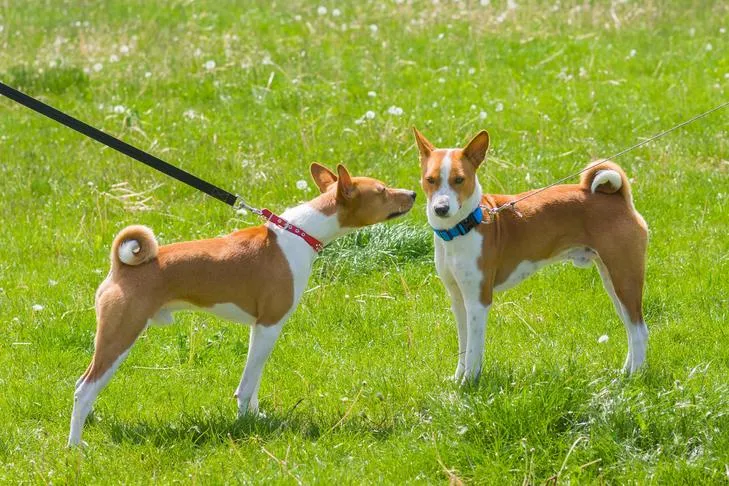 Two Basenjis meet in a grassy field outdoors, one is on a leash.
3. Wait for a Loose Leash Before You Walk
Once you’ve stopped due to pulling, the next crucial step is knowing when to resume the walk. The signal to move forward again is a slack leash – it should hang loosely, often forming a “J” shape – and your dog turning their attention back to you. This might require patience, especially in the beginning. Your dog may initially be confused, looking around to see what has caused the halt.
The moment they look back at you or the leash goes slack, praise them calmly and reward them with a treat held at your side. Then, you can continue walking. You might find yourself stopping and starting every few steps at first. However, your dog will quickly learn the connection: pulling makes the walk stop, while a relaxed leash allows it to continue. This early training sets the foundation, especially when considering when should you start walking a puppy on a leash to instill good habits early.
4. Incorporate Life Rewards on Your Walk
For dogs, walks are much more than just a bathroom break; they are enriching experiences that provide physical exercise and vital mental stimulation. While you’re in the midst of no-pull training, it can sometimes feel like your dog isn’t getting to enjoy these aspects fully. To enhance both your training and your dog’s enjoyment, strategically incorporate “life rewards.” These are the everyday pleasures your dog loves, such as sniffing a particular bush, greeting a friendly person, or investigating an interesting scent on the ground.
Use these desired activities as rewards for polite walking. For instance, if your dog walks for a certain distance without pulling, release them with a verbal cue like “Go sniff!” for a few minutes. This reinforces that polite behavior leads to desirable outcomes, making the walk more enjoyable and convincing your dog that walking nicely truly pays off.
5. Walk at a Good Pace
Often, humans walk at a much slower pace than their canine companions would prefer. Even smaller breeds possess an energetic stride that might be faster than your comfortable walking speed. This mismatch in pace is a significant reason why dogs pull – they naturally want to move faster and get going. To make the walk more engaging and reduce the urge to pull, try to find a pace that is comfortable and brisk for both of you.
While you can certainly train your dog to match your exact speed, a slightly quicker pace during the training phase can make it easier for them to learn not to pull. It helps to keep their focus forward and discourages meandering, which can sometimes lead to pulling as they veer off to investigate something.
6. Be Consistent With Your No-Pulling Rule
Consistency is paramount in dog training. It can be incredibly tempting to let your dog pull when you’re in a rush – perhaps you’re running late for an appointment, or the weather is unpleasant, and you just want to get the potty break over with. However, every single time you allow your dog to pull on the leash, you effectively undo previous training efforts and set yourself back to square one. Dogs learn through repetition and clear boundaries.
Therefore, you must be absolutely consistent with your “no-pulling” rule, regardless of the situation or your personal timeline. Until your dog reliably walks with a loose leash for more than a few feet, consider letting them do their business in the yard or directly at the curb. Reserve proper walks for when you have ample time and patience to dedicate to consistent training.
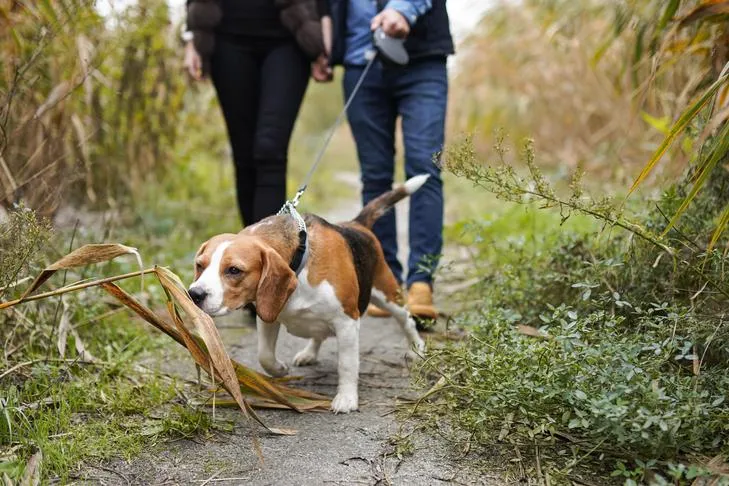 A Beagle pulls strongly on its leash to sniff something on the ground during an outdoor walk.
7. Keep Training Sessions Short and Fun
Training a dog that consistently pulls can be a frustrating and demanding endeavor. In the early stages, you might find that you can only manage to walk a short distance, perhaps just to the end of your driveway, before needing to stop and restart. Instead of pushing your dog until both of you are feeling irritated and discouraged by a lack of progress, keep your training sessions brief, positive, and enjoyable.
Puppies, in particular, have very short attention spans, and asking too much of them too soon is likely to lead to negative results rather than effective learning. Remember, the primary goal isn’t to cover a certain distance; it’s to achieve loose-leash walking, even if that means only making it to the neighbor’s house and back initially. Focus on quality over quantity, ending each session on a high note before your dog loses interest or gets frustrated.
8. Be Interesting and Engaging on Walks
For a dog, the outside world is an exhilarating tapestry of new sights, sounds, and, most powerfully, smells. This abundance of stimuli means there are countless distractions vying for your dog’s attention, often enticing them to pull you along the sidewalk. If you are distracted, perhaps on your phone or simply not interacting with your dog, there is little incentive for them to remain focused on you.
To keep your dog engaged and less prone to pulling, you need to be the most interesting thing on the walk. Talk to your dog, offer unexpected praise, initiate quick training breaks, or stop for a brief game of “find it” with a treat. By being unpredictable and engaging, your dog will be more inclined to pay attention to your cues and look to you for direction, making them more likely to follow your lead rather than their nose. With patience and the right techniques, you can effectively learn how to teach a dog to stop pulling.
9. Stay Calm
Walks can present a variety of emotionally charged situations, whether it’s the excitement of seeing a favorite neighbor or the apprehension caused by an approaching barking dog. In such moments, it’s vital for you to maintain control over your own emotions. Dogs are remarkably adept at reading human emotions, and your mood can transmit directly down the leash to your dog, potentially escalating their excitement or intensifying their anxiety.
To help your dog remain calm and focused, you must stay calm yourself. Demonstrate to your dog that there’s nothing to be overly excited or worried about. The more relaxed and composed you are, the more likely your dog will be able to listen to your commands and respond appropriately. Your calm demeanor acts as an anchor for your dog, helping them navigate potentially stressful or overstimulating environments.
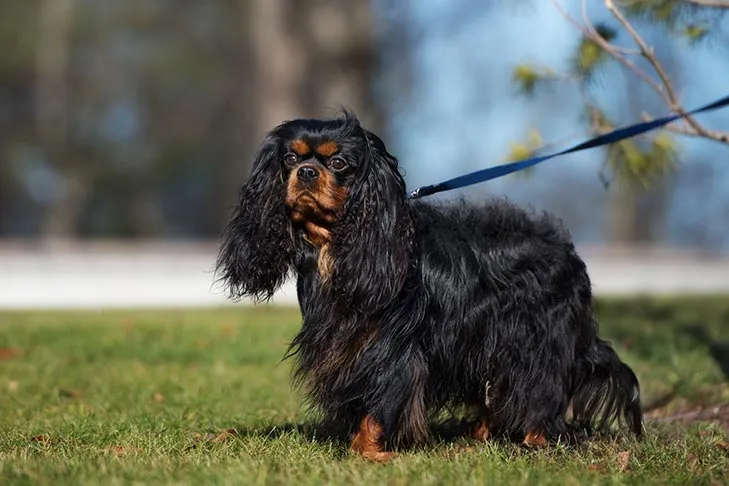 A Cavalier King Charles Spaniel walks calmly on a lead outdoors.
10. Engage Your Dog In Distracting Situations
When faced with powerful distractions like other dogs, squirrels, or even unfamiliar people, it’s easy for a dog to forget all their learned leash manners and revert to pulling. Some dogs might pull intensely to greet a distraction, while others might pull to retreat in fear. In either scenario, polite walking often goes out the window.
To help your dog manage these distractions, proactively redirect their focus to you. Before they become overly fixated, calmly offer them treats or initiate a simple training game. For example, ask for a “sit” or a “hand target.” These exercises are usually easy for your dog and serve to re-engage their attention on you as the distraction passes. You can also teach a “watch me” cue, encouraging direct eye contact, which helps you control where their attention is directed. The key is to be proactive: grab your dog’s attention before they even fully notice the distraction, increasing the chances they will walk past it without incident. Understanding your dog’s reactions to everyday situations, much like learning how do i stop my puppy jumping on the sofa requires consistent behavior modification.
By consistently applying these ten practical tips, you can effectively train your dog to stop pulling on the leash. Remember that patience, consistency, and positive reinforcement are your most valuable tools. Transforming your dog’s leash manners not only makes walks more enjoyable but also strengthens your bond and ensures a safer, more enriching experience for both of you. Embrace the journey, celebrate small successes, and soon you’ll be enjoying peaceful, loose-leash walks with your well-behaved companion. For more expert advice and detailed guides on various dog training challenges, visit Dog Care Story.
