
Caring for parrots has been a rewarding experience for several years, revealing many unique aspects of life with these colorful companions that often surprise those unfamiliar with them. While the boisterous squawks and occasional avian disagreements might be commonplace in a parrot household, they can be astonishing to visitors. Among the most frequently asked questions, especially from those considering or newly adopting a parrot, is: “Can they learn to talk?” This fascination with talking birds stems from a deep-seated human desire to connect with and understand other species.
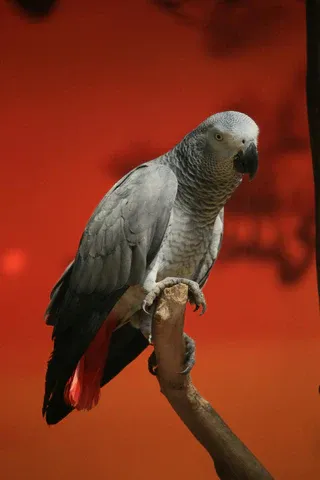 A colorful parrot perched on a branch
Bridging the Communication Gap: Why We Relate to Talking Birds
Historically, animal intelligence was often measured by how closely it resembled human capabilities. For a long time, even within the scientific community, birds were largely regarded as simple automatons. However, extensive research now recognizes many bird species, particularly corvids and parrots, as among the most intelligent animals on Earth. The difficulty for many people in relating to birds lies in their perceived differences from humans. Unlike dogs, with whom humans have coexisted for millennia and share similar expressions of affection like cuddling and playful interaction, parrots exhibit distinct behaviors. They can be loud, prone to nipping, and possess a strong sense of independence when raised healthily. Understanding their unique communication methods, which differ significantly from mammalian cues, requires time and dedicated observation. When humans discovered that parrots could imitate human sounds, it sparked immense fascination. To some, it was an amusing talent; in ancient cultures, it was even considered a spiritual or divine phenomenon, leading to their veneration. This captivating ability of parrots to mimic human speech continues to intrigue people today.
The “Why” Behind Mimicry: A Desire to Belong
When a parrot mimics human language, it’s largely driven by a fundamental need to integrate into its “flock,” which in a domestic setting includes its human family. Beyond mere imitation, parrots have demonstrated the capacity to grasp concepts related to shapes, colors, and the association between human language, behavior, and daily routines. Dr. Irene Pepperberg, a Research Professor at Boston University, has dedicated years to studying African Grey parrots. Her findings suggest that with appropriate training, parrots can comprehend these concepts and even use language contextually. Pet owners often observe this firsthand; for instance, a Sun conure might consistently say “go ninight” when ready for bed, or a Green-cheeked conure might inquire “what’re you doin’?” when something new occurs in its environment. This suggests an learned association between specific phrases and the events or actions happening around them.
The expression of “flock language” is crucial for parrots to foster integration within their social group. In the wild, acceptance into a flock is paramount for survival, as cooperation is essential for group well-being. Domesticated parrots perceive their human caretakers as integral members of their flock, providing essential resources like food, enrichment, and social interaction, while also largely dictating the daily schedule. It is therefore natural for a parrot to seek integration into the human household’s life and communication.
Beyond Talking: The Holistic Appeal of Parrots
The allure of a talking parrot, much like the novelty of a new gadget or vehicle, can eventually fade. When a parrot is acquired solely for its vocal abilities, and that novelty wears off, the owner’s enchantment may diminish. Furthermore, there is no guarantee that every parrot will become a proficient talker. While some species readily mimic human speech with enthusiasm, others may prefer vocalizing different noises or remain relatively quiet. This can unfortunately lead to birds being rehomed or, in unfortunate cases, neglected when the initial excitement wanes or the expected vocalizations never materialize. Many potential owners overlook the myriad of other fascinating ways parrots communicate, which may not be as overtly human-like. Parrots are intelligent, engaging, and capable of expressing deep affection in their own unique ways.
For those who welcome a parrot with the understanding that each bird is a unique individual with its own communication style, a profoundly rewarding bond can develop. Over time, it becomes apparent that despite the species differences, humans and parrots share more common ground than initially perceived. Embracing and respecting these differences allows the shared commonalities to surface, revealing one of the most beautiful aspects of having a parrot as a family member.
References:
Pepperberg, Irene M. “Vocal learning in Grey Parrots: A brief review of perception, production, and cross-species comparisons.” Brain and Language, vol. 115, no. 1, Oct. 2010, pp. 81–91, https://doi.org/10.1016/j.bandl.2009.11.002.
Bradbury, Jack. “Vocal communication of Wild Parrots.” The Journal of the Acoustical Society of America, vol. 115, no. 5_Supplement, 1 May 2004, pp. 2373–2373, https://doi.org/10.1121/1.4780035.
