
In a world that constantly rushes to label every event as a victory or a disaster, there exists a timeless narrative that offers a powerful antidote: the Story Of The Farmer And His Horse. This ancient Chinese parable, passed down through generations, is more than just a simple tale; it’s a profound lesson in perspective, acceptance, and the unpredictable nature of fortune. It gently nudges us to question our immediate judgments and embrace the vast, unfolding mystery of life, reminding us that what appears to be a setback might just be a setup for a future blessing, and vice-versa.
The wisdom embedded in this story feels more relevant today than ever. We live with constant news cycles and social media feeds that demand instant reactions, pushing us into emotional highs and lows based on fleeting moments. But what if we adopted the farmer’s calm detachment? What if we paused before labeling an event “good” or “bad”? This story serves as a guide. Exploring this tale is not just about understanding a piece of folklore; it’s about discovering a tool for navigating the complexities of our own lives with greater peace and resilience. The narrative has parallels in different cultures, much like how the lessons in the zen story farmer horse resonate with universal truths.
Recounting the Parable: The Farmer, His Son, and the Horse
The beauty of the story of the farmer and his horse lies in its simplicity. It unfolds in a small, rural village in ancient China, where a wise old farmer lived with his son.
The tale begins when the farmer’s only horse, a prized possession essential for his livelihood, runs away. Upon hearing the news, his neighbors rush to his home to offer their condolences. “What terrible luck!” they exclaim. “Your only horse is gone. This is a disaster.”
The farmer simply listens, and after a moment, he replies calmly, “Maybe.”
A few weeks later, something incredible happens. The farmer’s horse returns, and it isn’t alone. It has brought with it a magnificent herd of wild horses from the mountains. The farmer’s fortune has multiplied overnight. His neighbors, hearing of this development, hurry back to his house, this time to congratulate him. “What amazing luck!” they cheer. “You’ve gone from having one horse to a whole herd. This is a blessing!”
The farmer, once again, remains unfazed by their excitement. He looks at the new horses and says quietly, “Maybe.”
The story continues. The farmer’s son, eager to train the new wild horses, decides to ride one. The horse, untamed and powerful, throws him to the ground, and the fall is brutal. The young man’s leg is badly broken. The neighbors gather again, their faces filled with pity. “Oh, what dreadful luck,” they murmur. “Your son, your only help, is now crippled. This is the worst thing that could have happened.”
And the farmer, looking at his son resting, responds with the same unwavering equanimity: “Maybe.”
Not long after, the emperor’s army marches into the village. They are conscripting all able-bodied young men for a brutal war from which few are expected to return. Every family is forced to send their sons to the battlefield. When the soldiers arrive at the farmer’s house, they see his son with his broken leg, unable to walk, and they pass him by. He is spared from the war.
The neighbors, their own sons now gone, come to the farmer one last time, their eyes wide with awe and understanding. “What incredible luck you have,” they say. “Your son’s injury saved his life.”
The farmer, looking out towards the mountains where the army disappeared, offers his final, gentle reply: “Maybe.”
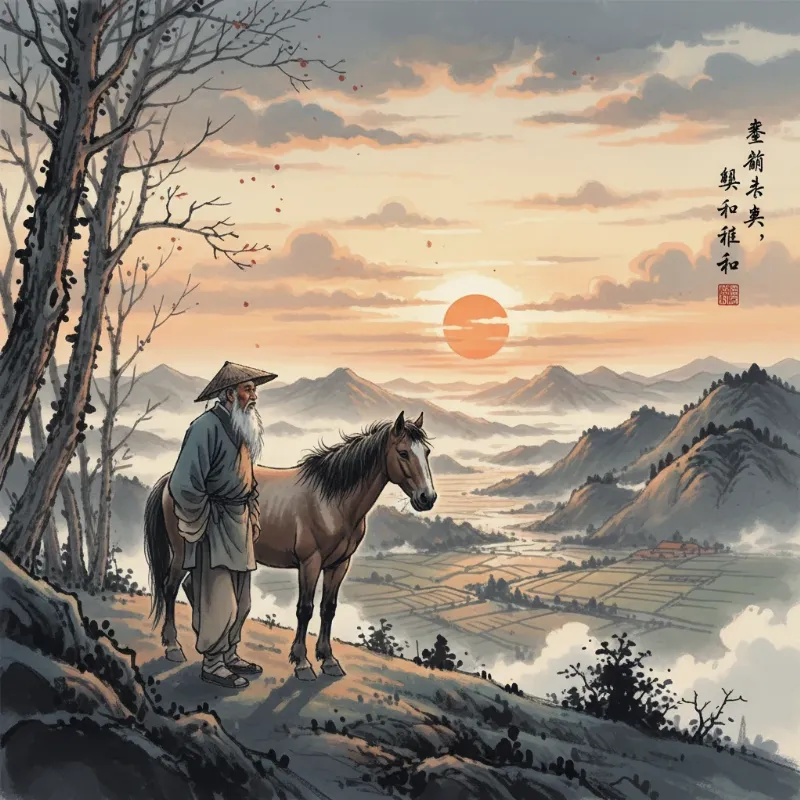 A serene digital painting of an old Chinese farmer and his horse standing on a hill at sunrise, overlooking a misty valley. The style is reminiscent of traditional ink wash paintings, conveying a sense of peace and wisdom. The farmer is looking at the horse with a calm expression, illustrating the central theme of the story of the farmer and his horse.
The Core Message: Beyond Good Luck and Bad Luck
The farmer’s consistent, enigmatic response—”Maybe”—is the heart of the story. It’s not a sign of indifference or ignorance, but of profound wisdom. He understands a fundamental truth that his neighbors, caught in the grip of immediate emotional reaction, cannot see: life is a complex, interconnected web of events. The story of the farmer and his horse teaches us that it is impossible to know the full consequences of any single event at the moment it occurs.
As Dr. Sarah Miller, a philosopher specializing in Eastern traditions, notes, “The farmer embodies the Taoist principle of Wu Wei, which is often translated as ‘non-action’ or ‘effortless action.’ It’s about flowing with the natural course of things rather than resisting or imposing our own rigid judgments upon them. The farmer doesn’t deny the reality of the situation—the horse is gone, the son’s leg is broken—but he refuses to attach a final, definitive label of ‘good’ or ‘bad’ to it.”
This parable challenges our deep-seated human tendency to categorize our experiences. We crave certainty and control, and labeling events gives us a false sense of understanding.
A Lesson in Perception
The story brilliantly illustrates that our perception of an event is not the event itself. The neighbors see a series of isolated incidents:
- Lost horse = bad
- Return with more horses = good
- Broken leg = bad
- Avoiding war = good
The farmer, however, sees a continuous, unfolding process. He recognizes that each event is a link in a chain, and the end of that chain is never in sight. What seems like a curse can become a blessing, and a stroke of luck can lead to misfortune. His perspective is not pessimistic; it’s realistic. He accepts reality as it is, without the added layer of emotional judgment. This concept of shifting fortunes is a theme found in many tales, even in those that seem different on the surface, such as the lion and the horse story.
Embracing Uncertainty in Modern Life
Living with a “maybe” mindset is a powerful strategy for reducing anxiety in our chaotic modern world. We often expend enormous amounts of mental and emotional energy worrying about things that might happen or regretting things that have already occurred. The farmer’s wisdom encourages us to:
- Pause Before Reacting: When something happens, give yourself a moment before assigning a judgment.
- Acknowledge Interconnectedness: Understand that the full story is not yet known. Today’s challenge could be the catalyst for tomorrow’s growth.
- Focus on the Present: Instead of getting lost in speculation about the future, deal with the situation at hand. The farmer didn’t waste time lamenting his lost horse; he simply continued with his life.
Who First Told the Story of the Farmer and His Horse?
While it is often attributed to general Chinese folklore or Zen Buddhism, the earliest known version of the story of the farmer and his horse appears in the Huainanzi, a 2nd-century BC Chinese philosophical text. The collection of essays was written by scholars at the court of Liu An, Prince of Huainan, and it blends Taoist, Confucianist, and Legalist concepts.
The story is found in a chapter titled “The Lessons of the Human World” and is used to illustrate a key Taoist idea: that fortune and misfortune are intertwined and constantly transforming into one another. The original text puts it this way: “Thus, what is fortunate may be the precursor of misfortune, and what is misfortune may be the foundation of fortune. Who can know the ultimate limit?” The farmer’s tale, sometimes known as “Sai Weng Shi Ma” (塞翁失馬), which translates to “The Old Man at the Frontier Lost His Horse,” became a perfect, enduring vehicle for this complex philosophical idea.
Applying the Farmer’s Wisdom Today
Adopting the farmer’s perspective doesn’t mean becoming passive or emotionless. It means becoming more resilient, centered, and emotionally intelligent. It’s about freeing yourself from the rollercoaster of reactive emotions. While some narratives in history are deeply rooted in verifiable events, like exploring is the war horse based on a true story, this parable’s power is in its metaphorical truth.
Cultivating a “Maybe” Mindset
So, how can you bring this ancient wisdom into your daily life?
- Practice Mindful Observation: When you face a challenge, such as a project delay at work or a disagreement with a friend, try to observe the situation without immediate judgment. Acknowledge the facts and your feelings, but add a mental “maybe” to the outcome.
- Keep a “Gain from Loss” Journal: At the end of each week, reflect on a perceived “negative” event. Can you find any unexpected positive outcomes or lessons learned that arose from it? This trains your brain to see the bigger picture.
- Reframe Your Language: Pay attention to how you talk about events. Instead of saying “This is awful,” try “This is challenging, and I’m not sure where it will lead.” This subtle shift opens up possibilities instead of closing them down. The stories we tell ourselves matter, a theme also seen when examining the true story of horse soldiers.
How This Perspective Reduces Stress and Anxiety
Much of our anxiety stems from trying to predict and control the future. We create narratives about what should happen, and we suffer when reality doesn’t conform to our script. The farmer’s wisdom liberates us from this self-imposed pressure. By accepting that we cannot know the ultimate outcome of any event, we can let go of the need to control everything. This acceptance leads to a profound sense of peace. It allows us to face life’s ups and downs with a steady heart, knowing that the story is always unfolding.
Frequently Asked Questions (FAQ)
What is the main moral of the story of the farmer and his horse?
The main moral is that we should not be too quick to judge events as “good” or “bad.” Life is unpredictable, and what appears to be a misfortune can turn into a blessing, and vice versa. It teaches the wisdom of accepting uncertainty and maintaining a balanced perspective.
Is this a true story?
No, the story of the farmer and his horse is a parable, a fictional story created to illustrate a philosophical or moral lesson. Its origins trace back to the ancient Chinese text, the Huainanzi, from the 2nd century BC.
What philosophy is the story associated with?
The story is most closely associated with Taoism, a Chinese philosophy that emphasizes living in harmony with the Tao, or the natural order of the universe. It perfectly illustrates Taoist concepts like acceptance, non-judgment, and the cyclical nature of fortune and misfortune.
How can the farmer’s response “maybe” help in daily life?
Using “maybe” as a mental tool can help you pause before reacting emotionally to situations. It reduces anxiety by reminding you that you don’t know the full story yet. It encourages a more open, resilient, and less judgmental mindset when facing life’s challenges.
What does “Sai Weng Shi Ma” mean?
“Sai Weng Shi Ma” (塞翁失馬) is the Chinese title for the story, which translates to “The Old Man at the Frontier Lost His Horse.” It has become a popular idiom in Chinese culture, used to describe a situation where an apparent loss might actually be a blessing in disguise.
The Unfolding Path
The story of the farmer and his horse is a quiet revolution in a loud world. It doesn’t offer a magic solution to life’s problems, but it provides something far more valuable: a sustainable framework for peace of mind. It teaches us to hold our experiences lightly, to trust in the process, and to find stability not in our circumstances, but in our response to them. By embracing the farmer’s simple yet profound wisdom, we can learn to navigate the unpredictable currents of life not with fear and anxiety, but with curiosity, resilience, and an unwavering sense of calm. The next time you find yourself facing an unexpected turn of events, take a breath and remember the old farmer. Maybe.
