
In the heart of South Dakota’s Black Hills, a mountain is slowly being transformed. For decades, this monumental undertaking has captivated visitors, a silent testament to a promise made between two men from different worlds. This is the incredible story of the Crazy Horse monument, a project far grander than just carving a sculpture; it’s about carving a permanent place in history for a people and their culture. It’s a narrative of defiance, dedication, and a dream that spans generations, aiming to be not just a memorial but a living, breathing center for Native American culture and education.
The vision for this mountain carving is staggering, dwarfing even the nearby Mount Rushmore. When completed, it will depict the legendary Oglala Lakota warrior, Crazy Horse, mounted on his steed and pointing forward over his ancestral lands. This isn’t merely a tourist attraction; it’s a profound statement. The story began with a simple, powerful request from Lakota Chief Henry Standing Bear, who wanted the white man to know that the red man had great heroes, too. The project’s history, much like the carving process itself, is a slow, deliberate, and often challenging journey. To truly understand its significance, one must delve into the life of the man it honors, the sculptor who dedicated his life to it, and the family that carries his torch today. This ongoing saga is a powerful chapter in the broader story of crazy horse, a narrative of resilience and cultural pride.
A Promise Carved in Stone: The Monument’s Origin
The genesis of the Crazy Horse Memorial is a tale of two very different men united by a shared vision. It wasn’t born from a government committee or a state-funded project, but from a heartfelt letter and a handshake. The story began in the late 1930s, fueled by a desire to create a lasting tribute to the spirit and heroes of the Native American people.
The Vision of Chief Henry Standing Bear
Chief Henry Standing Bear, an Oglala Lakota elder, was a key figure in the monument’s conception. He watched as the faces of four American presidents were carved into the sacred Black Hills at Mount Rushmore. While he respected the artistry, he felt a profound need for a counter-narrative. He envisioned a monument that would honor a Native American hero, a figure who represented the unyielding spirit of his people.
In 1939, he wrote a letter to a sculptor named Korczak Ziolkowski, who had recently won acclaim for his work at the New York World’s Fair. His message was simple yet profound: “My fellow chiefs and I would like the white man to know that the red man has great heroes also.” This single sentence sparked a lifelong commitment. Chief Standing Bear wasn’t just commissioning a statue; he was initiating a movement to reclaim a piece of his people’s sacred land and dedicate it to their legacy. He chose Crazy Horse not just for his legendary battle prowess at the Little Bighorn, but for his integrity, his fierce dedication to his culture, and his refusal to be subjugated or confined to a reservation.
The Sculptor with a Mountain-Sized Task: Korczak Ziolkowski
Korczak Ziolkowski was a self-taught, Polish-American sculptor known for his powerful, classical style and immense work ethic. Having worked briefly on Mount Rushmore under Gutzon Borglum, he was no stranger to the challenges of mountain carving. When he received Chief Standing Bear’s letter, he was intrigued. After meeting with the chiefs and visiting the Black Hills, he was completely captivated by their vision.
In 1947, Korczak accepted the invitation, leaving behind a promising career to move to South Dakota and dedicate the rest of his life to a project with no guaranteed funding and an almost unimaginable scope. He arrived with just $174 to his name, living in a tent as he began the monumental task. He and Chief Standing Bear selected the mountain, which would be named Thunderhead Mountain, and Korczak began meticulously planning the sculpture. He refused to accept federal funding, fearing government interference would compromise the project’s integrity and mission. This decision meant the entire project would rely on private donations and visitor fees, a principle that continues to this day and explains much of the project’s timeline. The crazy horse story is as much about Korczak’s dedication as it is about the warrior himself.
The Monumental Task: Carving a Mountain
The first blast on Thunderhead Mountain occurred on June 3, 1948. It was a moment of immense hope, attended by several Lakota chiefs, including survivors of the Battle of the Little Bighorn. From that day forward, the work was slow, arduous, and often dangerous. Korczak worked mostly alone for years, scaling the mountain, drilling blast holes by hand, and meticulously calculating every explosion to remove rock without damaging the future sculpture.
The scale is hard to comprehend. The completed monument is planned to be 641 feet long and 563 feet high. Crazy Horse’s head alone is over 87 feet tall, large enough to contain all four 60-foot heads at Mount Rushmore. The engineering challenges are immense, requiring a deep understanding of geology, explosives, and artistry.
“When the legends die, the dreams end. When the dreams end, there is no more greatness.” – Korczak Ziolkowski
This quote, often attributed to the sculptor, captures the spirit behind his relentless work. He wasn’t just blasting rock; he was trying to keep a legend alive and inspire future greatness.
Decades of Dedication: The Ziolkowski Family Legacy
Korczak Ziolkowski passed away in 1982, long before his vision could be fully realized. Many assumed the project would die with him. However, he had spent years preparing for this eventuality, creating detailed plans and models for his family to follow. His wife, Ruth Ziolkowski, immediately stepped in to lead the project, along with seven of their ten children.
Under Ruth’s guidance, the focus shifted from the overall form to completing Crazy Horse’s face. This strategic decision provided a tangible sign of progress for visitors and supporters. The face was finally dedicated in 1998, fifty years after the first blast. Today, the Ziolkowski children and grandchildren continue the work, operating the heavy machinery, managing the foundation, and carrying their patriarch’s dream into the 21st century. The story of the Crazy Horse monument is inextricably linked with the story of this incredibly dedicated family.
Why is it Taking So Long to Build?
This is one of the most common questions visitors ask. The answer lies in Korczak’s founding principles.
- No Federal Funding: The refusal to accept government money means the project is entirely dependent on visitor admissions and private contributions. Work progresses only when funds are available.
- Weather: The harsh South Dakota winters mean that carving work can only be done for about half the year.
- Precision: Carving a mountain isn’t a fast process. Every blast must be precise to avoid creating irreparable cracks in the rock. The work is more akin to slow, careful surgery than demolition.
- Scale: The sheer size of the sculpture is unlike anything ever attempted before. Millions of tons of granite have been removed, and millions more must still be cleared.
What Will the Finished Crazy Horse Monument Look Like?
The completed monument will be a breathtaking sight. It will depict Crazy Horse with his arm extended, pointing forward. According to Lakota oral history, when a trader taunted Crazy Horse about his lands, the warrior gestured toward the horizon and proclaimed, “My lands are where my dead lie buried.” This powerful statement is the inspiration for the sculpture’s final form.
The sculpture is designed in the round, meaning it will be fully three-dimensional, unlike the facial carvings at Mount Rushmore. Visitors will eventually be able to walk out onto the horse’s outstretched arm. The final design is intended to be a dynamic, powerful representation of the unconquerable spirit of the Lakota people. Understanding the full scope of the vision is central to appreciating the crazy horse memorial story.
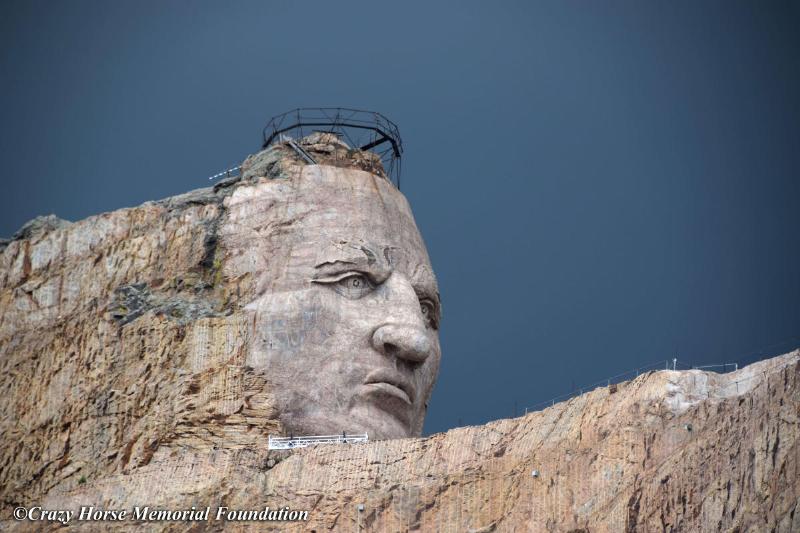 Workers carving the stone on the Crazy Horse monument in the Black Hills
More Than a Sculpture: The Monument’s Mission
From the very beginning, Korczak and Chief Standing Bear agreed that the mountain carving was only one part of a much larger dream. The ultimate goal was to create a comprehensive humanitarian project, a place of cultural and educational significance for all people, but especially for Native Americans. This broader mission is being fulfilled through several key components at the memorial site.
The Indian Museum of North America
The Indian Museum of North America is a vast complex that houses a remarkable collection of art and artifacts representing the diverse cultures of Native American tribes across the continent. It is not just a place to display objects; it is a place where Native people can share their stories, traditions, and contemporary lives in their own voices. The museum provides a vital platform for cultural preservation and education, helping to dispel stereotypes and foster a deeper understanding of Native American history.
The Indian University of North America and Medical Training Center
A core part of the long-term vision is the establishment of a university and medical training center on the memorial grounds. While the full university is still a future goal, the first step has been taken with the Indian University of North America summer program. Each year, a select group of college students from various tribes participate in an intensive academic program, earning college credit while working as interns at the memorial. This program is a living embodiment of the dream to provide educational opportunities and empower the next generation of Native American leaders.
Frequently Asked Questions (FAQ)
Who was Crazy Horse?
Crazy Horse (Tasunke Witko) was a highly respected Oglala Lakota war leader who fought against the U.S. federal government to protect the Lakota way of life. He is most famous for his leadership at the Battle of the Little Bighorn in 1876. He was known for his fierce bravery, humility, and unwavering commitment to his people’s freedom and culture.
Why was Crazy Horse chosen for the monument?
Chief Henry Standing Bear and other Lakota elders chose Crazy Horse because he embodied the spirit of resistance and pride for his people. He never signed a treaty, never surrendered his culture, and is revered as one of the great heroes of Native American history. He represents integrity and the fight for freedom.
Is the Crazy Horse monument bigger than Mount Rushmore?
Yes, significantly. If completed as planned, the Crazy Horse Memorial will be 563 feet high and 641 feet long. In comparison, the presidents’ heads at Mount Rushmore are each about 60 feet high. The entire Mount Rushmore carving could fit inside the head of the Crazy Horse sculpture.
Will the Crazy Horse monument ever be finished?
The Ziolkowski family and the Crazy Horse Memorial Foundation remain fully committed to completing the sculpture. While there is no set completion date due to the reliance on private funding and the sheer scale of the work, progress continues steadily each year. The family sees it as a multi-generational commitment.
Can you see the monument without paying?
While the monument is visible from certain points along the highway, the best views and access to the visitor center, museum, and viewing deck require an admission fee. This fee is the primary source of funding for the carving and the associated educational and cultural programs.
The Unfinished Story Continues
The story of the Crazy Horse monument is far from over. It remains an unfinished symphony in stone, a testament to a promise kept across generations. It stands as a powerful symbol of cultural pride and a rebuke to a history that too often ignored the heroes of its native people. More than just a carving, it is a dynamic educational and cultural center that actively works to fulfill the second part of its mission: to protect and preserve the culture, tradition, and living heritage of the North American Indians. The slow, deliberate pace of the work is not a sign of failure, but a reflection of its enduring principles of self-reliance and integrity. It is a story being written one blast, one dollar, and one student at a time, ensuring that the dream of Chief Henry Standing Bear and Korczak Ziolkowski will echo through the Black Hills for centuries to come.
