
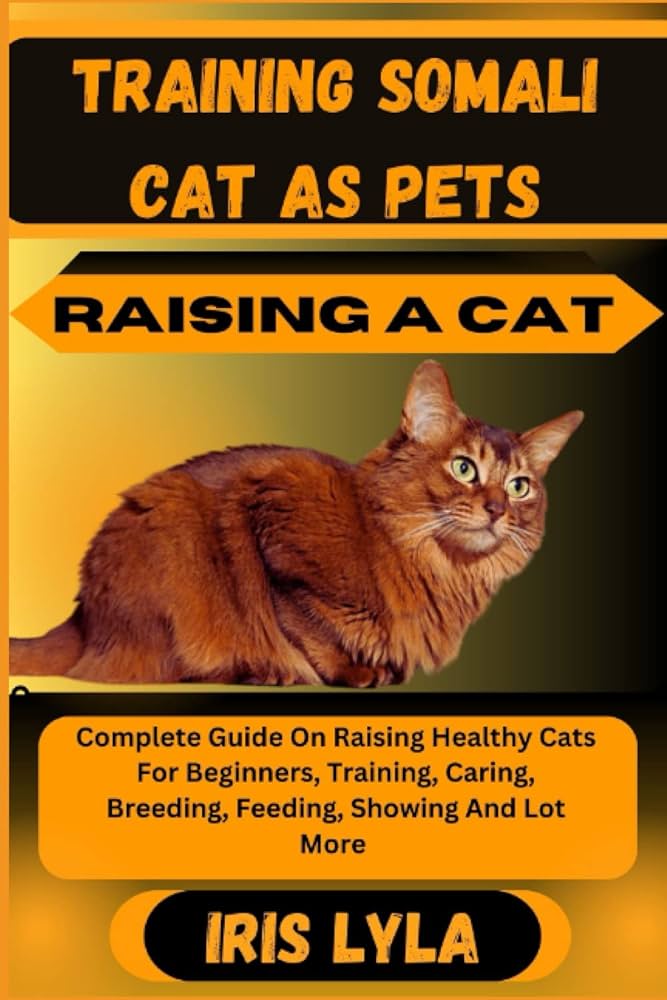
The Somali cat is an elegant and lively breed, often described as a “fox-like” Abyssinian with a semi-long coat. This guide delves into the detailed breed standard, providing aspiring and current Somali owners with a thorough understanding of what defines this captivating feline. The Somali is characterized by its well-proportioned, medium to large size, muscular build, and an alert, engaging demeanor. Its overall appearance conveys sound health and vibrant energy, making it an active and endearing companion.
HEAD
The Somali’s head is designed with a modified, slightly rounded wedge shape, avoiding any flat surfaces. The brow, cheeks, and profile lines exhibit a gentle contour. A subtle rise from the bridge of the nose to the forehead creates a pleasing proportion, with good width between the ears that seamlessly flows into the arched neck.
MUZZLE
The muzzle follows the gentle contours of the skull, presenting a rounded appearance when viewed from the front. The chin is full, neither undershot nor overshot. It is crucial to avoid a sharply pointed muzzle, snippiness, foxy appearance, or whisker pinch. Allowance is made for jowls in adult males.
EARS
Ears are a prominent feature of the Somali, being large, alert, and moderately pointed. They are broad at the base and well-cupped. The ear set is positioned on a line that angles towards the rear of the skull. Desirable horizontal ear tufts should extend from the inner ear, reaching almost to the opposite side of the ear.
EYES
Somali eyes are large, brilliant, and expressive, with an almond shape. The aperture of the eye is neither perfectly round nor distinctly oriental. The eyes are further enhanced by dark lid skin, encircled by a lighter-colored area. A short, dark vertical pencil stroke above each eye, with a dark line continuing from the upper lid towards the ear, accentuates their allure.
BODY
The Somali’s body is medium in length, exhibiting a lithe and graceful form with well-developed musculature. The rib cage is rounded, and the back features a slight arch, giving the impression of a cat poised for action. The flank is level with no tuck-up, striking a balance between the extremes of cobby and svelte body types.
LEGS AND FEET
The legs are in proportion to the torso, supporting an oval and compact foot. When standing, the Somali should appear nimble and quick. There are five toes on the front paws and four on the hind paws.
TAIL
The tail is characterized by a full brush, appearing thick at the base and tapering slightly. Its length should be in balance with the torso, contributing to the breed’s overall harmonious appearance.
COAT
The Somali’s coat is a defining feature, renowned for its exceptionally soft texture and fine, double-coated nature. A denser coat is highly preferred. The coat is medium in length, although it may be slightly shorter over the shoulders. Preference is given to cats exhibiting a ruff and breeches, contributing to a fuller coat appearance.
PENALIZE
Certain faults are subject to penalty in judging. These include cold grey or sandy tones in the coat color, mottling or speckling on unticked areas, necklaces, leg bars, tabby stripes, or bars on the body, and a lack of desired markings on the head and tail. Black roots on the body are also a fault.
DISQUALIFY
Several serious faults will lead to disqualification. These include a white locket or groin spot, or white anywhere on the body except the upper throat, chin, and nostril area. Any skeletal abnormality, incorrect color paw pads or nose leather, colors other than the four accepted varieties, an unbroken necklace, or an incorrect number of toes are also disqualifying. Kinks in the tail will also result in disqualification.
SOMALI COLORS
The Somali’s coat color is meant to be warm and glowing, with distinct and even ticking. The hair shafts feature dark-colored bands contrasting with lighter bands. The undercoat should be clear and bright next to the skin. Deeper color shades are desired, but the intensity of ticking should not be sacrificed for color depth. Preference is given to cats that are unmarked on their undersides, chest, and legs, with tails free of rings. Markings include darker shading along the spine that continues to the tail tip, darker shading up the hocks, and shading allowed at the point of the elbow. Dark lines extending from the eyes and brows, cheekbone shading, and dots and shading on the whisker pads are desirable enhancements. The eyes are accentuated by a fine dark line, encircled by a light-colored area. Accepted eye colors are gold or green, with richer and deeper colors being preferred.
RUDDY
The Ruddy Somali has a ground color of burnt sienna, ticked with various shades of darker brown or black, with the extreme outer tip being the darkest. The tail is tipped with black. The underside and inside of the legs should be a tint that harmonizes with the ground color. The nose leather is tile red, and the paw pads are black or dark brown, with black between the toes extending slightly beyond the paws.
CINNAMON
The Cinnamon Somali boasts a ground color of rich, warm, glowing red, ticked with chocolate brown. The extreme outer tip is the darkest, with a red-orange undercoat. The tail is tipped with chocolate brown. The underside and inside of the legs should be a harmonizing tint. The nose leather is rosy pink, and the paw pads are pink, with chocolate brown between the toes extending slightly beyond the paws.
BLUE
The Blue Somali features a ground color of warm beige, ticked with slate blue, and the extreme outer tip is the darkest. The tail is tipped with slate blue. The underside and inside of the legs should be a harmonizing tint. The nose leather is old rose, and the paw pads are mauve, with slate blue between the toes extending slightly beyond the paws.
FAWN
The Fawn Somali exhibits a ground color of warm rose-beige, ticked with light cocoa brown, and the extreme outer tip is the darkest. The tail is tipped with light cocoa brown. The underside and inside of the legs should be a harmonizing tint. The nose leather is salmon, and the paw pads are pink with light cocoa brown between the toes extending slightly beyond the paws.
It is important to note that the Somali cat develops its mature ticking very slowly, and allowances should be made for kittens and young cats.
SOMALI COLOR CLASS NUMBERS
The following color class numbers are for reference purposes only and do not form an official part of the CFA Show Standard: Ruddy (1380, 1381), Cinnamon (1381, 1382), Blue (1383, 1384), Fawn (1385, 1386), and Any Other Variety (AOV) (1398, 1399).
