
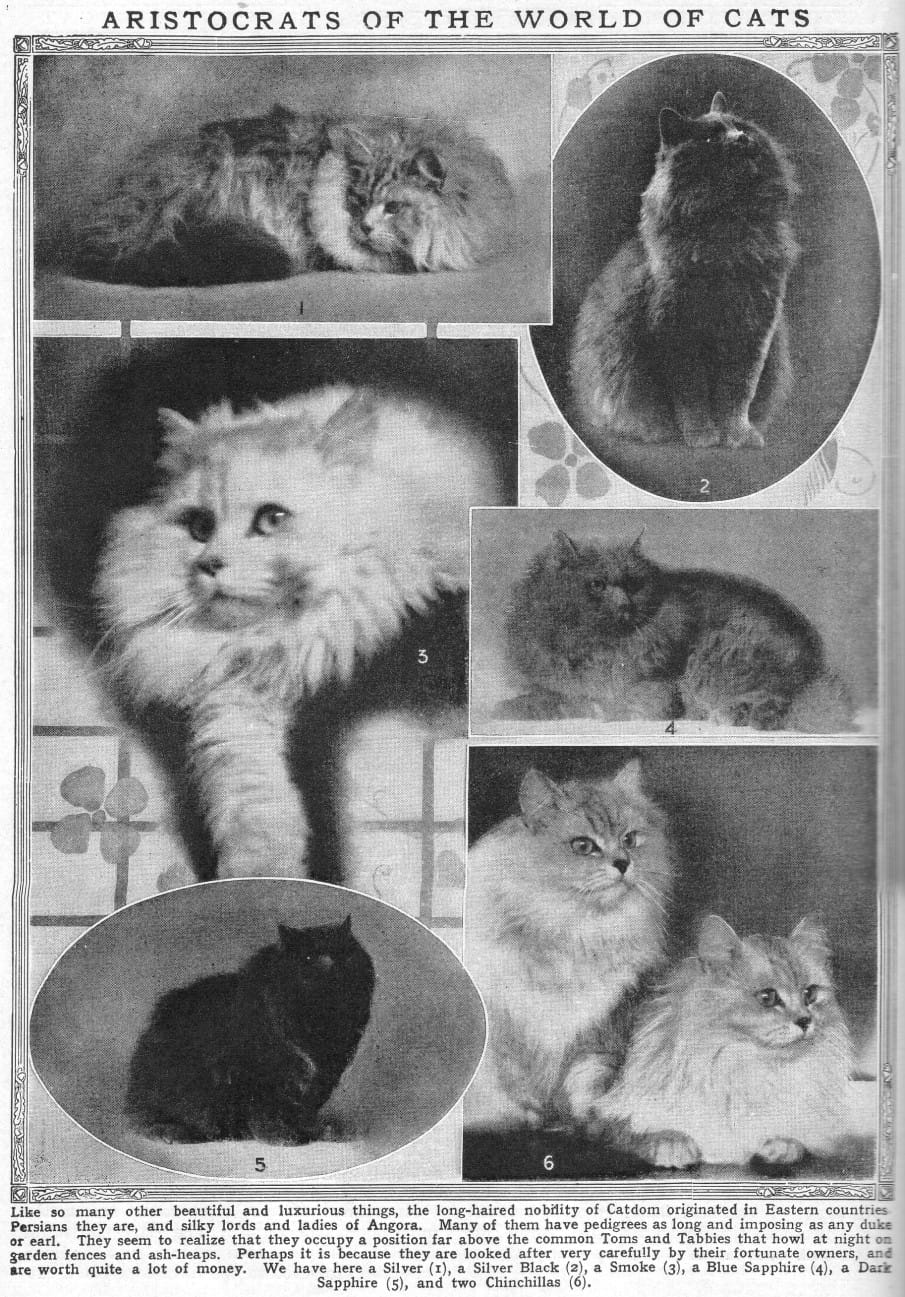
The allure of the Smoke Persian Cat, with its unique and captivating coloration, has a rich and complex history. While the exact origins remain somewhat elusive, tracing back to Great Britain in the late 1800s, dedicated breeders have meticulously shaped this distinct variety into the stunning felines we admire today. This deep dive explores the historical development, breeding challenges, and grooming intricacies that define the Smoke Persian.
A Glimpse into the Origins of Smoke Persians
The journey of the Smoke Persian likely began with the breeding of silver tabbies, eventually leading to the development of smoke coloring. Early smoke cats were noted for their green eyes, a characteristic that evolved over time. In the late 19th century, breeders began crossing smoke offspring back with black and blue Persians, a process that eventually introduced the desirable copper eye color.
An alternative theory, published in a 1963 issue of All Pets Magazine by Donald Martin, suggested that smoke coloring originated from a gene mutation in tabby cats. This mutation, instead of producing black markings on a silver-white coat, resulted in a solid black coat over a white undercoat.
Early Recognition and Shifting Tides
The black smoke was among the earliest documented colors. In the 1800s, blues were a new color, and it wasn’t until 1889 that they received their own show class. Silvers followed in 1893, the same year smokes were officially recognized as a distinct class. Prior to this, they were categorized as AOC (Any Other Color). Despite their early recognition, smokes historically lagged behind their solid-colored Persian counterparts in popularity and show presence.
Historical stud books from the early 1900s through the 1950s reveal that the type of smoke Persians did not see significant improvement for many years. Many breeders struggled to maintain the dense black topcoat, and some cats even reverted to showing barred legs and tabby facial markings. The early 20th century saw a decline in the number of smoke Persians, with only eighteen listed in the Governing Council of the Cat Fancy’s first stud book in 1912, down from thirty in the National Cat Club Stud Book and Register (1900-1905). By the end of World War II, smoke Persians were nearly non-existent.
Dedicated Breeders and a Slow Revival
Despite the challenges, a dedicated few breeders persevered. Figures like Alice and Judy Phillips of Inverness Cattery, Lydia O. Cypher of Akanta Cattery, and Carrie and Lucy Clingan of Kerry Lu Cattery were instrumental in maintaining the breed through the mid-20th century. In the 1960s, breeders such as Mr. & Mrs. Paul H. Raine (Fair Oaks Cattery), Mary Appleman and Eileen Gleeson (Miss Tiny’s Cattery), and Mrs. Rex Foster Jr. continued the effort.
A significant turning point occurred in 1961 when cameo colors, including the red smoke, were granted championship status in the Cat Fanciers’ Association (CFA). This opened new avenues for breeding and development. The blue smoke, though recognized for championship status later in 1962, also contributed to the growing interest. It wasn’t until 1965 that smokes were given their own dedicated show class, having previously been grouped with shaded varieties.
The late 1960s saw remarkable success for smokes from Araho Cattery, which dominated shows and produced multiple grand champion black smokes. Notable wins included Grand Champion Moonshine and Grand Champion Araho Cheyenne. The following decades witnessed a growing number of catteries focusing on smoke Persians, including Ja Bob Cattery, Peari’s Cattery, Palmetto, and many others, all contributing to the breed’s revival and improvement.
The Nuances of Smoke Persian Breeding and Grooming
Breeding smoke kittens requires specific knowledge. At least one parent must be a shaded or smoke cat to produce smoke offspring. It’s crucial to remember that blue smoke cats must have blue nose leather and paw pads, while black smokes will have black. Beyond color, smoke Persians share the same breed standards as other Persians, requiring attention to head structure, body type, and coat.
The development of smoke kittens is a fascinating process. Newborns often have gray/white markings around their eyes and muzzle. Over the next several weeks, the dense undercoat begins to emerge, leading to dramatic color changes. Some kittens may appear silver with a black spine line initially, gradually developing a black topcoat. Others might show a splotched appearance before settling into their adult coloration. Experienced breeders understand the patience required during these “waiting games.”
Grooming smoke Persians is a more intensive process than for many other Persian varieties. Their coats are delicate and require year-round care to maintain their show condition. Preventing mats is crucial, as pulling them out can remove the valuable white undercoat. Daily grooming, regular baths (at least weekly for adults, more frequently for kittens), and meticulous attention to cleanliness are essential. Using a high-power dryer and carefully fluffing the coat with fingers during drying helps maintain its volume and appearance.
The author’s personal experience highlights the dedication involved: “Breeding smokes is not for everyone. If you must be a winner first time out, stay away from smokes. If you are willing to work hard, face disappointment and keep on going until you do finally produce that winner, then “Welcome to the world of smokes!”” The satisfaction of nurturing these stunning cats and achieving recognition for the breed is a testament to the breeders’ passion and perseverance.
Notable Achievements and Recognition
Over the years, smoke Persians have achieved significant recognition in cat shows. The tortie smoke finally gained championship status in CFA on May 1, 1977, a celebrated moment for dedicated breeders. The blue-cream smoke followed on May 1, 1982. National premiership wins by tortie smokes further underscored their success.
The 1990s marked a period of continued revival, with new breeders joining the effort and further improving the breed’s type. In 1992, CFA accepted the cream smoke for championship status. The transfer of shaded cameo and shaded tortie into the Smoke Division in 1995 was a welcomed expansion, promising a larger and more competitive smoke class. Today’s smoke Persians stand proudly alongside their solid-colored counterparts, a testament to the dedicated breeding programs that have preserved and enhanced this magnificent variety.
