
There are moments in cinema that stay with you forever, etched into your memory with an almost painful clarity. For an entire generation of kids who grew up in the 80s, the Sinking Horse Neverending Story scene is arguably the most defining, a shared cinematic trauma that taught us about grief, despair, and the crushing weight of sadness far too early. It wasn’t just a scene in a movie; it was a profound lesson in loss, delivered through the heartbreaking demise of a loyal friend in a place aptly named the Swamp of Sadness. Understanding the depth of this moment is key to appreciating the film’s powerful message, a journey that has much in common with deciphering the horse in the neverending story and its role in the narrative.
The film, The Neverending Story, released in 1984, is a fantasy epic that follows a young boy named Bastian who reads a magical book about the mythical land of Fantasia. As Fantasia is consumed by a force called “The Nothing,” a young warrior named Atreyu is tasked with finding a cure. His only companion on this perilous quest is his beloved white horse, Artax. Their bond is the emotional core of the film’s first act, making what happens next all the more devastating.
The Swamp of Sadness: A Devastating Scene
Atreyu’s quest leads him and Artax to the Swamp of Sadness. They are warned that the swamp is a place where hope dies, and the sadness it contains can physically weigh you down and pull you under. Atreyu, protected by the magical Auryn medallion, is able to resist the swamp’s despairing influence. Artax, however, is not. As they wade through the murky waters, the horse begins to slow down, the immense sorrow of the swamp seeping into his spirit.
Atreyu, initially unaware, urges his companion forward. But then he turns and sees the terror in his horse’s eyes as Artax begins to sink into the thick, black mud. What follows is one of cinema’s most harrowing sequences. Atreyu screams, pleads, and pulls at Artax’s reins, begging his friend not to give up. “Fight the sadness, Artax! Please! You’re my friend! I love you!” he cries. But it’s no use. The weight of all the world’s despair is too much for the noble creature. Artax succumbs, slowly sinking beneath the mud until he is gone forever, leaving a distraught Atreyu utterly alone.
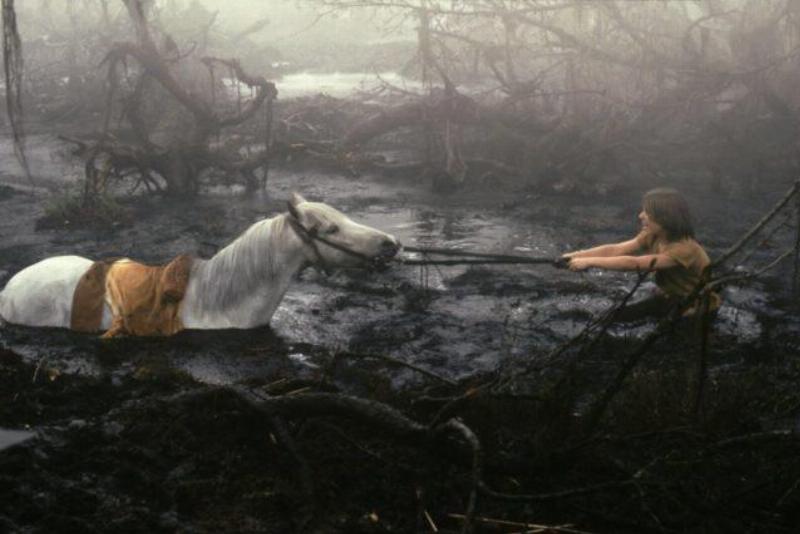 The iconic sinking horse neverending story scene showing Artax succumbing to the Swamp of Sadness.
Who Was Artax, Atreyu’s Loyal Companion?
Before he was the tragic figure of the sinking horse neverending story, Artax was Atreyu’s closest and only friend. He wasn’t just a mode of transport; he was a character in his own right, a symbol of innocence, loyalty, and strength. Their journey together through the grassy plains of Fantasia established a deep, unspoken connection. Artax was brave, steadfast, and completely devoted to Atreyu. This powerful bond is what makes his death so impactful. The audience doesn’t just see a horse die; they witness a child losing his best friend in the most brutal way imaginable. The question of what is the name of the horse in neverending story is one that stays with viewers precisely because of the emotional weight his loss carries.
In the original novel by Michael Ende, Artax can actually speak with Atreyu, making their connection even more explicit. While the film chose to make their bond silent, it was no less powerful, conveyed through their shared journey and Atreyu’s desperate cries.
The Symbolism Behind the Sinking Horse Scene
The death of Artax is far more than just a sad moment; it is a critical narrative and thematic turning point. The Swamp of Sadness and Artax’s fate are powerful metaphors for complex adult emotions that are rarely explored in children’s films.
Giving in to Despair
The swamp represents a tangible, physical manifestation of despair. It doesn’t kill with monsters or traps but with an overwhelming feeling of hopelessness. Dr. Sarah Miller, a child psychologist and media analyst, explains, “The Artax scene is so powerful because it externalizes an internal struggle. It shows children that sadness isn’t just a feeling; it can be an overwhelming force that feels impossible to escape. Artax doesn’t die from an attack; he gives up. He lets the sadness win. For a child, that’s a terrifyingly real and sophisticated concept.” Atreyu survives because the quest and the Auryn give him a purpose, a glimmer of hope to cling to. Artax, in his innocence, has no such protection.
A Metaphor for Depression and Loss of Hope
At its core, the sinking horse neverending story scene is a raw depiction of depression. It illustrates how depression can paralyze you, making it impossible to move forward, no matter how much your loved ones plead with you. Atreyu’s desperate attempts to save Artax mirror the painful experience of trying to help someone who is consumed by their own despair. It’s a somber lesson that sometimes love and encouragement are not enough to save someone from their inner demons. This scene forces the audience, and Atreyu, to confront the reality that some battles must be fought alone and that loss is an unavoidable part of life’s journey. It’s a heavy theme, similar in its emotional gravity to discussions around the neverending story horse sinking phenomenon.
The Unforgettable Legacy of the Scene
Decades after its release, the death of Artax remains a cultural touchstone. It is frequently cited as one of the most traumatizing scenes in children’s film history, a moment that introduced a generation to the concepts of profound grief and hopelessness. For many, it was their first on-screen experience with the death of a beloved animal character, and it was handled with brutal honesty, without looking away.
The scene’s power lies in its realism, despite its fantastical setting. There is no magical rescue. Atreyu’s pleas go unanswered. The hero fails. This raw depiction of failure and loss is what makes the scene so memorable and effective. It teaches a difficult but essential lesson: the world isn’t always fair, and fighting against “The Nothing” means facing and overcoming such heartbreaking moments of despair. Getting the neverending story horse name right is important to fans because that name, Artax, is synonymous with this powerful lesson.
Behind the Scenes: The Reality of Filming
The filming of the scene was notoriously difficult. The actor who played Atreyu, Noah Hathaway, was only 12 years old and formed a real bond with the horse. The scene was shot in a cold, muddy tank, and the horse was placed on a hydraulic lift that was slowly lowered into the water. While the animal was never in any real danger, the emotional toll on the young actor was immense. His desperate cries in the film were reportedly very real, stemming from his fear and concern for his equine co-star. This authentic emotion undoubtedly contributed to the scene’s gut-wrenching power. It adds another layer of poignancy when you consider the bond between the boy and the animal, which is central to why people search for the name of horse neverending story.
Frequently Asked Questions (FAQ)
Why did Artax have to die in The Neverending Story?
Artax’s death is a crucial plot device and a powerful metaphor. It represents the loss of innocence and hope, demonstrating the true danger of the Swamp of Sadness and the emotional stakes of Atreyu’s quest. It forces Atreyu to continue his journey alone, having faced and survived his first great personal tragedy.
What is the name of the horse in The Neverending Story?
The horse’s name is Artax. He is Atreyu’s loyal companion and a symbol of innocence and courage in the face of the encroaching despair represented by “The Nothing.”
What does the Swamp of Sadness represent?
The Swamp of Sadness is a physical manifestation of despair, depression, and hopelessness. It is a place where giving up leads to certain doom. It teaches that the greatest battles are often internal, against one’s own feelings of sadness and futility.
Is the sinking horse scene too scary for kids?
This is a subject of debate. The scene is emotionally intense and can be very upsetting for young viewers. However, it also serves as a profound, if harsh, introduction to themes of loss and resilience, which are important aspects of storytelling and life.
Did the horse actually die during filming?
No, the horse was not harmed. The scene was filmed using a special hydraulic platform that safely lowered the horse into a pool of muddy water. The horse was carefully monitored by professional trainers throughout the process.
A Legacy of Hope Born from Despair
The sinking horse neverending story scene is a masterpiece of emotional filmmaking. It is brutal, heartbreaking, and unforgettable. Yet, it is essential to the film’s ultimate message. By showing us the ultimate despair, the film makes Atreyu’s eventual triumph and the rebirth of Fantasia that much more powerful. The story teaches us that we can lose everything we hold dear, sink into the deepest mud of sadness, and still find the strength to keep going. Artax’s death is the moment Atreyu—and the audience—learns that hope is not the absence of sadness, but the courage to push forward in spite of it.
