
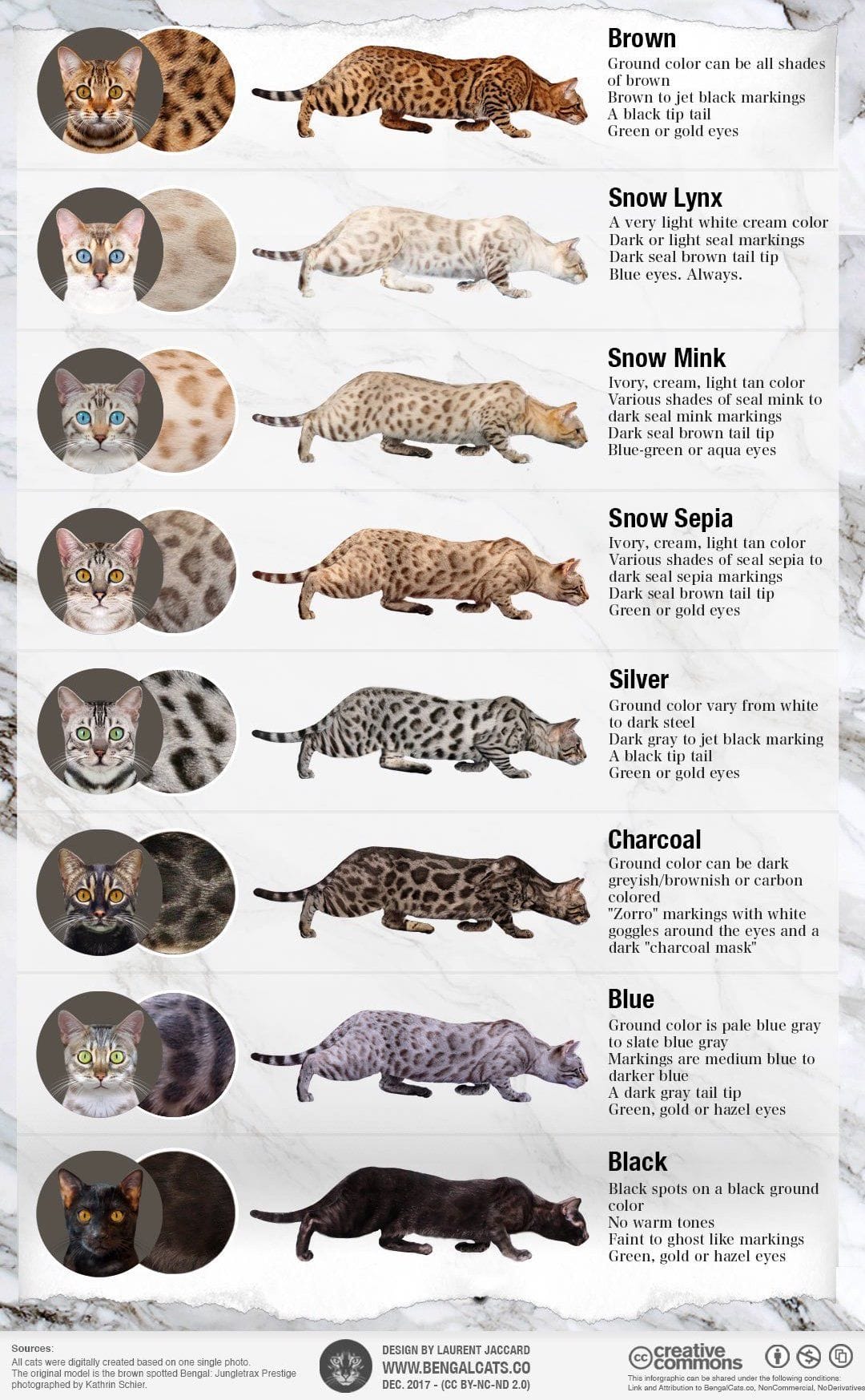
Bengal cats are renowned for their striking resemblance to wild leopards, captivating admirers with their distinctive spotted or marbled coats. Beyond their exotic appearance, the allure of the Bengal breed is significantly enhanced by the incredible diversity of their coat colors and patterns. Whether you are drawn to the rich warmth of brown, the ethereal beauty of snow, or the sleek mystery of silver, there is a Bengal cat color to suit every preference. This guide delves into the fascinating spectrum of Bengal cat colors, exploring the recognized shades and the unique characteristics that make each one special.
The Bengal cat breed boasts a variety of coat colors, officially categorized into standard and non-standard types by The International Cat Association (TICA). While there are six primary color categories, the true beauty lies in the nuanced shades and the high contrast patterns that define this breed.
Standard Bengal Cat Colors
The TICA recognizes three main color divisions for Bengal cats: Brown, Snow, and Silver. Each of these offers a unique palette of possibilities, ensuring that no two Bengals are exactly alike.
The Brown Bengal Cat
The Brown Bengal is the most popular and historically significant color within the breed. It was the first Bengal cat color recognized by TICA in 1983. These cats exhibit a range of earthy tones, from warm golden hues to rich tawny shades. The ground color can vary from a gray-tawny to a vivid orange-gold, providing a beautiful canvas for their markings.
The markings on a Brown Bengal can appear as spots, rosettes, or marbling, and their color can range from black to light or dark brown, sometimes with reddish undertones. While all shades of brown are accepted, an orange-brown ground color is often preferred. Key characteristics of a Brown Bengal include:
- Markings: Brown to jet black.
- Tail Tip: Black.
- Nose: Red.
- Eyes: Brown, copper, gold, green, or hazel.
- Belly: A white belly is considered a desirable trait.
The Snow Bengal Cat
For those enchanted by the elegance of a mini snow leopard, the Snow Bengal offers an equally captivating aesthetic. These Bengals possess coats in cream and ivory shades, a trait inherited from their Siamese and Burmese ancestry, which contributes to a form of albinism. Contrary to their name, Snow Bengals are not pure white but exhibit distinct patterns on a lighter background.
Snow Bengals are further divided into three genetically distinct color variations: Seal Lynx, Seal Mink, and Seal Sepia. Differentiating between these can be challenging without genetic testing, but eye color often provides a clue:
- Snow Seal Lynx Bengal: Characterized by a very light cream or white base coat with dark or light seal markings. They possess a dark seal brown tail tip and exclusively have blue eyes.
- Snow Seal Mink Bengal: These Bengals have an ivory, cream, or light tan base coat with varying shades of seal mink markings. Their tail tips are dark seal brown, and they typically have blue-green or aqua eyes.
- Snow Seal Sepia Bengal: Similar in base color to the Mink, the Snow Seal Sepia Bengal features seal sepia markings. Their tail tips are dark seal brown, and they usually have green or gold eyes.
The Silver Bengal Cat
The Silver Bengal, recognized by TICA in 2004, offers a striking visual contrast. This color variation is essentially a “lack of color” due to the inhibitor gene, which suppresses warm tones and results in an almost white or very pale gray base coat. This pale background is then adorned with sharp, dark markings, creating a breathtaking effect.
Silver Bengals can have backgrounds ranging from pure white to a deep steel gray. They can also be found in combination with other color genes, such as Silver Snow, Silver Charcoal, and Blue Silver. Key traits of the Silver Bengal include:
- Tarnish: Minimal yellow or rusty brown tones in the coat are preferred.
- Markings: Dark gray to jet black.
- Tail Tip: Black.
- Nose: Brick red.
- Eyes: Green or golden.
Non-Standard Bengal Cat Colors
While TICA recognizes Brown, Snow, and Silver as standard colors, other variations exist and are often bred for, even if they don’t currently hold championship status.
The Charcoal Bengal Cat
The Charcoal Bengal is a darker, more intense version of the traditional Bengal colors. The smoky charcoal hue was particularly prominent in early generations of the breed. This trait is inherited independently and can appear within brown, silver, snow, and even blue Bengal cats.
Charcoals typically display a dark grayish-brown or carbon-colored background with very subdued rufous (reddish-brown) tones. Their markings are exceptionally dark, often appearing as a deep spotted or marbled pattern. A distinctive feature of some Charcoals is a darkened facial “mask” and a thick dorsal stripe, sometimes described as a “Zorro cape and mask.” These masks can be so dark they blend seamlessly with the body markings. The tail is usually dark brown/black or grayish-black with stripes and a black tip. Charcoal browns and silvers might exhibit “ghost markings” – faint patterns on a black or very dark body, which can sometimes be mistaken for solid colors.
The Blue Bengal Cat
The Blue Bengal, resulting from the dilute gene (d,d), is a rare but sought-after color variation. These cats feature a powder blue or gray coat with subtle cream undertones. The spotted or marbled patterns appear in shades of dark blue or metallic gray. Because the blue gene is recessive, both parents must carry the gene for blue to produce a blue Bengal kitten.
Characteristics of the Blue Bengal include:
- Ground Color: Steely blue.
- Undertones: Peachy hues.
- Markings: Blue, which will not darken to black.
- Tail Tip: Dark gray.
- Eyes: Gold, green, or hazel.
The Black (Melanistic) Bengal Cat
The Black or Melanistic Bengal, arising from the agouti gene (a,a), presents a stunning solid black coat. These cats are often compared to the black panther, with black patterns superimposed on a black ground color. Their patterns are known as “ghost markings” or “ghost spots” because they are very subtle and often only visible in natural sunlight.
Melanistic Bengals are rare and less commonly bred for, partly because this color variation is not approved by major cat associations. The faint spots can range from dark brown to black. A smoke Bengal is the silver variation of a melanistic Bengal. For those seeking a “mini black panther,” this color variation is the closest representation.
Additional Coat Characteristics: Patina, Ticking, and Glitter
Beyond the base colors, Bengal cats can exhibit other unique coat traits that add to their visual appeal.
Patina and Ticking
Patina refers to the presence of black or dark-tipped hairs that can obscure or “blur” the underlying pattern of the cat’s coat, often appearing from the shoulders down the back. Ticking, on the other hand, affects the entire coat, making it appear blurred due to a lack of contrast. This is caused by multi-colored hair shafts, giving the fur a “faded” appearance, meaning the fur isn’t as bold.
Glitter
Perhaps one of the most enchanting features of the Bengal breed is its “glitter.” This unique characteristic, found in varying degrees, gives the cat’s coat a shimmering, sparkling effect, visible even in low light conditions. Glitter is not a dye or artificial application but a natural phenomenon. It’s caused by translucent, hollow hair shafts that catch and reflect light. This inherent sparkle adds an almost magical quality to the Bengal’s already exotic appearance. The presence of glitter is often highlighted in Snow Bengal cats, where it creates a dazzling contrast against their pale coats.
The diverse array of colors and patterns available in Bengal cats, combined with unique traits like glitter, makes them one of the most visually captivating domestic cat breeds. Each Bengal, regardless of its specific coloration, is a testament to the breed’s wild ancestry and the careful efforts of breeders to preserve its stunning aesthetic.
