
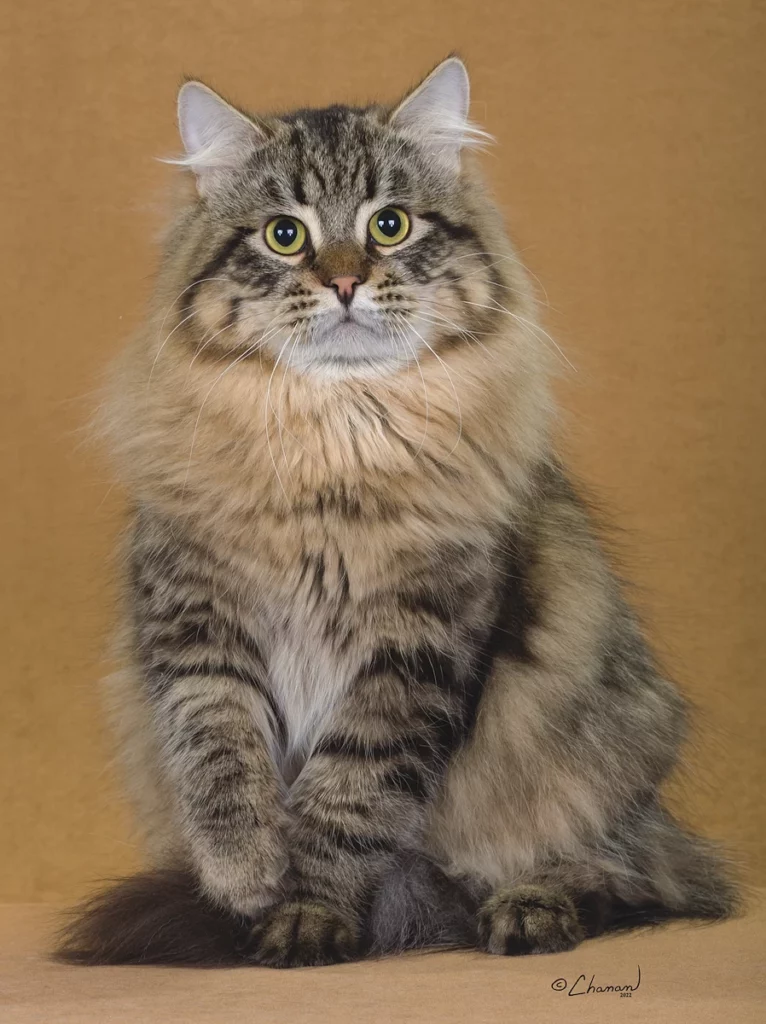
The Siberian cat, Russia’s native forest feline, boasts a rich history dating back to around 1000 AD. Hailing from the harsh climate of Siberia, this breed is a testament to nature’s design for survival, characterized by its robust build and triple coat. Siberians are known for their impressive presence, alertness, and a sweet facial expression. This breed matures slowly, with full development taking up to five years. Females are typically smaller than males, and the standard emphasizes type over size, with an overall impression of roundness and circular forms rather than sharp angles.
Head
The Siberian’s head is a modified wedge, medium to large in size, with rounded contours that are in proportion to its body. It is broader at the top of the skull, narrowing slightly to a full, rounded muzzle. Cheekbones are neither high-set nor prominent, and there’s a subtle doming between the ears with an almost flat forehead. Adult males often exhibit well-developed jowls, while females present a more moderate appearance.
The ears are medium to large, rounded, and wide at the base, tilting slightly forward. They are set as much on the sides of the head as on top. While the hair at the back of the ear is short and thin, furnishings lengthen from the middle of the ear, covering its base. Ear tipping is permissible.
Eyes are medium to large, almost round, and proportionate to the head. The outer corners are angled slightly towards the ear base. Eyes should be set more than one eye-width apart, appearing open, alert, and expressive. With the exception of colorpointed varieties, there is no specific relationship between eye color and coat pattern.
The chin is well-rounded but not protruding, aligning with the nose. The muzzle is moderately short, full, and rounded, featuring a slight curvature. The transition from the side of the head to the muzzle is gentle and inconspicuous.
In profile, the top of the head is nearly flat, with a gentle slope from the forehead to the nose, and a slight concave curve before the tip. The neck is rounded, sturdy, and well-muscled.
Body
The Siberian’s body is medium in length, well-muscled, with a slight arch to the back, higher than the shoulders. It possesses a barrel-shaped, firm belly that conveys a sense of solid weight. A moderate stomach pad or “famine pouch” on the lower abdomen is acceptable.
Legs are medium in length, featuring substantial bone structure. The hind legs are slightly longer than the front legs. Feet are large and rounded, with toe tufts being desirable.
The tail is medium in length, somewhat shorter than the body, wide at the base, and tapering slightly to a blunt tip. It should be evenly and thickly furnished, without thickening or kinks.
The breed’s boning is substantial, and its musculature is powerful.
Coat, Color, and Pattern
The Siberian is a moderately long to longhaired cat possessing a triple coat. The hair on the shoulder blades and lower chest is thick and slightly shorter. Adult cats should have an abundant, full collar ruff that frames the head. Allowances should be made for variations in coat density due to weather. The hair on the belly and britches may thicken into curls, but a wavy coat is not characteristic of the breed.
The coat’s texture can range from coarse to soft, depending on the color. A tight undercoat is present, especially in mature cats and during colder weather.
All colors and combinations are accepted, with or without white. White can appear in any amount and location. On tabbies, white is permissible on the chin, breast, and stomach. Buttons, spots, and lockets are allowed. Strong colors and clear patterns are desirable, and tarnishing on silvers is not penalized.
Eye Color
Eye color should be in shades of green, gold, green-gold, or copper. White cats and those with white may have blue or odd eyes.
Nose Leather and Paw Pads
These can be any color or combination of colors, not necessarily related to the coat color, except where noted. Cats with white feet may have pink, bi- or multi-colored paw pads.
Buttons, Spots, and Lockets
These are permissible on any color and pattern and do not incur a penalty.
White
Pure, glistening white is the standard. For white cats, pink nose leather and paw pads are desirable.
Black
A dense, coal-black color, sound from root to tip, is preferred. Black nose leather and paw pads are desirable.
Blue
A level tone from nose to tail, sound to the roots, is required. Blue nose leather and paw pads are desirable.
Red
A deep, rich, clear, brilliant red, without shading, markings, or ticking, is desired. Brick red nose leather and paw pads are desirable.
Cream
A level shade of buff cream, without markings and sound to the roots, is preferred, with lighter shades being favored. Pink nose leather and paw pads are desirable.
Chinchilla Silver
The undercoat is pure white, with the coat on the back, flanks, head, and tail sufficiently tipped with black to create a sparkling silver appearance. Legs may have slight shading. Chin, ear tufts, stomach, and chest are pure white. Rims of eyes, lips, and nose are outlined with black. Brick red nose leather and black paw pads are desirable.
Shaded Silver
The undercoat is white, with a mantle of black tipping that shades from dark on the ridge to white on the chin, chest, stomach, and under the tail. Legs match the face tone. The overall effect is darker than chinchilla silver. Eye rims, lips, and nose are outlined with black. Brick red nose leather and black paw pads are desirable.
Chinchilla Golden
The undercoat is a rich, warm cream. The coat on the back, flanks, head, and tail is tipped with black, creating a golden appearance. Legs may have slight shading. Chin, ear tufts, stomach, and chest are cream. Eye rims, lips, and nose are outlined with black. Deep rose nose leather and black paw pads are desirable.
Shaded Golden
The undercoat is a rich, warm cream with a mantle of black tipping shading from dark on the ridge to cream on the chin, chest, stomach, and under the tail. Legs match the face tone. The overall effect is darker than chinchilla golden. Eye rims, lips, and nose are outlined with black. Deep rose nose leather and black paw pads are desirable.
Shell Cameo (Red Chinchilla)
The undercoat is white, with the coat on the back, flanks, head, and tail tipped with red to produce a sparkling appearance. Face and legs may be slightly shaded. Chin, ear tufts, stomach, and chest are white. Rose nose leather and paw pads are desirable.
Shaded Cameo (Red Shaded)
The undercoat is white, with a mantle of red tipping that shades from dark on the ridge to white on the chin, chest, stomach, and under the tail. Legs match the face tone. The overall effect is redder than shell cameo. Rose nose leather and paw pads are desirable.
Shell Tortoiseshell
The undercoat is white. The coat on the back, flanks, head, and tail is delicately tipped with black, featuring well-defined patches of red and cream-tipped hairs in a tortoiseshell pattern. Face and legs may be slightly shaded. Chin, ear tufts, stomach, and chest are white to slightly tipped. A blaze of red or cream tipping on the face is desirable.
Shaded Tortoiseshell
The undercoat is white, with a mantle of black tipping and clearly defined patches of red and cream-tipped hairs in a tortoiseshell pattern. Shading occurs down the sides, face, and tail, from dark on the ridge to slightly tipped or white on the chin, chest, stomach, legs, and under the tail. The overall effect is darker than shell tortoiseshell. A blaze of red or cream tipping on the face is desirable.
Black Smoke
A white undercoat deeply tipped with black. The cat appears black when at rest but reveals the white undercoat when in motion. Face, legs, and tail are black with a narrow band of white at the hair base, visible only when parted. A light silver frill and ear tufts are present. Black nose leather and paw pads are desirable.
Blue Smoke
A white undercoat deeply tipped with blue. The cat appears blue at rest and shows the white undercoat when in motion. Face, legs, and tail are blue with a narrow band of white at the hair base. White frill and ear tufts are present. Blue nose leather and paw pads are desirable.
Cream Smoke
A white undercoat deeply tipped with cream. The cat appears cream at rest and shows the white undercoat when in motion. Face, legs, and tail are cream with a narrow band of white at the hair base. White frill and ear tufts are present. Pink nose leather and paw pads are desirable.
Cameo Smoke (Red Smoke)
A white undercoat deeply tipped with red. The cat appears red at rest and shows the white undercoat when in motion. Face, legs, and tail are red with a narrow band of white at the hair base. White frill and ear tufts are present. Rose nose leather, eye rims, and paw pads are desirable.
Smoke Tortoiseshell
A white undercoat deeply tipped with black, featuring clearly defined patches of red and cream-tipped hairs in a tortoiseshell pattern. The cat appears tortoiseshell at rest and shows the white undercoat when in motion. Face, legs, and tail display a tortoiseshell pattern with a narrow band of white at the hair base. White ruff and ear tufts are present. A blaze of red or cream tipping on the face is desirable.
Blue-Cream Smoke
A white undercoat deeply tipped with blue, with clearly defined patches of cream in a blue-cream pattern. The cat appears blue-cream at rest and shows the white undercoat when in motion. Face, legs, and tail exhibit a blue-cream pattern with a narrow band of white at the hair base. White ruff and ear tufts are present. A blaze of cream tipping on the face is desirable.
Classic Tabby Pattern
Markings are dense, clearly defined, and broad. Legs have even barring with bracelets extending to the body markings. The tail is evenly ringed. Several necklaces adorn the neck and upper chest, with a locket allowed. “M” frown marks on the forehead, with unbroken lines extending back from the outer eye corners. Swirls on the cheeks and vertical lines on the back of the head that extend to shoulder markings resembling a butterfly with outlined wings marked with dots. Back markings include a vertical line down the spine from the butterfly to the tail, paralleled by stripes of the ground color. Large solid blotches on each side are encircled by one or more unbroken rings. White buttons and/or lockets are allowed.
Mackerel Tabby Pattern
Markings are dense, clearly defined, and narrow. Legs are evenly barred with narrow bracelets. The tail is barred. Necklaces on the neck and chest are distinct; white lockets are allowed. The head is barred with an “M” on the forehead. Unbroken lines run back from the eyes. Lines run down the head to meet the shoulders. Spine lines merge to form a narrow saddle. Narrow pencillings encircle the body. White buttons and/or lockets are allowed.
Patched Tabby Pattern
A patched tabby (torbie) is an established silver, brown, blue, or blue-silver tabby with patches of red and/or cream. White buttons and/or lockets are allowed.
Spotted Tabby Pattern
Body markings are spotted, varying in size and shape, with preference for round, evenly distributed spots. Spots should not merge into a broken mackerel pattern. A dorsal stripe runs the length of the body to the tail tip, ideally composed of spots. Face and forehead markings follow typical tabby patterns. The underside has “vest buttons.” Legs and tail are barred. White buttons and/or lockets are allowed.
Ticked Tabby Pattern
Body hairs are ticked with various shades of marking color and ground color. The body should be free of noticeable spots, stripes, or blotches when viewed from above, except for darker dorsal shading. The lighter underside may show tabby markings. Face, legs, and tail must display distinct tabby striping. White buttons and/or lockets are allowed.
Brown Patched Tabby
The ground color is brilliant coppery brown with dense black classic or mackerel tabby markings. Patches of red and/or cream are clearly defined on both body and extremities. A blaze of red and/or cream on the face is desirable. Lips and chin match the rings around the eyes.
Blue Patched Tabby
The ground color, including lips and chin, is pale bluish ivory with deep blue classic or mackerel tabby markings providing good contrast. Patches of cream are clearly defined on both body and extremities. A blaze of cream on the face is desirable. Warm fawn overtones or patina may be present over the entire cat.
Silver Patched Tabby
The ground color, including lips and chin, is pale, clear silver. Markings are dense black. Patches of red and/or cream are clearly defined on both body and extremities. A blaze of red and/or cream on the face is desirable. Brick red nose leather and black paw pads are desirable.
Silver Tabby (Classic, Mackerel, Spotted, Ticked)
The ground color, including lips and chin, is pale, clear silver. Markings are dense black. Brick red nose leather and black paw pads are desirable.
Blue-Silver Tabby (Classic, Mackerel, Spotted, Ticked)
The ground color is pale, clear silver. Markings are a deep blue, providing good contrast with the ground color. White trim around the chin and lip is allowed. Old rose nose leather and rose paw pads are desirable.
Blue-Silver Patched Tabby
The ground color is pale, clear silver, with deep blue classic or mackerel tabby markings offering good contrast. Patches of cream are clearly defined on both body and extremities. A blaze of cream on the face is desirable. White trim around the chin and lip is allowed.
Red Tabby (Classic, Mackerel, Spotted, Ticked)
The ground color is red. Markings are deep, rich red. Lips and chin are red. Brick red nose leather and paw pads are desirable.
Brown Tabby (Classic, Mackerel, Spotted, Ticked)
The ground color is brilliant coppery brown. Markings are dense black. The back of the leg is black from paw to heel. Black or brown nose leather and paw pads are desirable.
Blue Tabby (Classic, Mackerel, Spotted, Ticked)
The ground color, including lips and chin, is pale bluish ivory. Markings are a deep blue, providing good contrast. Warm fawn overtones or patina may be present. Rose nose leather and paw pads are desirable.
Cream Tabby (Classic, Mackerel, Spotted, Ticked)
The ground color, including lips and chin, is very pale cream. Markings are buff or cream, sufficiently darker than the ground color for contrast, but remaining within the dilute color range. Pink nose leather and paw pads are desirable.
Cream Silver Tabby (Classic, Mackerel, Spotted, Ticked)
Markings are cream. The undercoat is white. Pink nose leather and paw pads are desirable.
Cameo Tabby (Classic, Mackerel, Spotted, Ticked)
Markings are red. The undercoat is white. Rose nose leather and paw pads are desirable.
Golden Tabby (Classic, Mackerel, Spotted, Ticked)
The ground color is rich golden, with an undercoat ranging from pale honey to bright apricot. Markings vary from rich brown to black, providing contrast, and can change intensity with age. Lighter shading may appear around the muzzle, on the chest and undersides, with toes appearing almost white. Rose nose leather (with or without darker outlining) and black paw pads are desirable.
Blue Golden Tabby (Classic, Mackerel, Spotted, Ticked)
The ground color is rich golden, with an undercoat ranging from pale honey to bright apricot. Markings are dense blue, providing contrast. Rose nose leather and blue or rose paw pads are desirable.
Tortoiseshell
Black with patches of red or softly intermingled areas of red on the body and extremities. Several shades of red are acceptable.
Calico
White with unbrindled patches of black and red. Preferred minimum includes white feet, legs, undersides, chest, and muzzle. An inverted “V” blaze on the face is desirable.
Dilute Calico
White with unbrindled patches of blue and cream. Preferred minimum includes white feet, legs, undersides, chest, and muzzle. An inverted “V” blaze on the face is desirable.
Blue-Cream
Blue with clearly defined, well-broken patches of solid cream on the body and extremities.
Bi-Color
Solid color and white, tabby and white, smoke and white, shaded and white, or colorpoint and white. White is allowed in any amount and location. On tabbies, white or off-white on the chin, breast, and stomach is permitted.
Van Bi-Color
Black and white, blue and white, red and white, or cream and white. White cat with color confined to extremities (head, tail, and legs). One or two small colored patches on the body are allowable.
Van Calico
White cat with unbrindled patches of black and red confined to the extremities (head, tail, and legs). One or two small colored patches on the body are allowable.
Van Dilute Calico
White cat with unbrindled patches of blue and cream confined to the extremities (head, tail, and legs). One or two small colored patches on the body are allowable.
Tabby and White
White with colored portions conforming to established tabby color standards.
Smoke/Shaded/Shell and White
White with colored portions conforming to the color standard.
Tortoiseshell and White
White with colored portions conforming to the tortoiseshell standard.
Blue-Cream and White
White with colored portions conforming to the blue-cream standard.
Any Other Siberian Colors
Any other color or pattern, excluding those showing hybridization resulting in chocolate, lilac, or combinations thereof with white.
Colorpoint Colors
Siberian (Point) Pattern
Body color should be clear, with subtle shading allowed. Older cats may have darker color, but a definite contrast between body and point color is necessary. Points (ears, legs, feet, tail, mask) display the cat’s basic color. The ideal mask extends from above the eyes down to the chin and from side to side across the eyes.
Seal Point
Even pale fawn to cream body, warm in tone, shading to lighter color on stomach and chest. Points are deep seal brown. Seal brown nose leather and paw pads. Blue eyes.
Blue Point
Bluish-white body, cold in tone. Points are blue. Slate blue nose leather and paw pads. Blue eyes.
Flame (Red) Point
Creamy white body. Points are deep orange flame to deep red. Flesh to coral pink nose leather and paw pads. Blue eyes.
Cream Point
Creamy white body. Points are buff cream. Flesh to coral pink nose leather and paw pads. Blue eyes.
Tortie Point
Creamy white or pale fawn body. Points are seal with unbrindled patches of red and/or cream. Seal brown and/or coral pink nose leather and paw pads. Blue eyes.
Blue-Cream Point
Bluish-white or creamy white body. Points are blue with patches of cream. Slate blue and/or pink nose leather and paw pads. Blue eyes.
Siberian Lynx (Point) Pattern
Masks must be clearly lined with dark stripes, forming a vertical “M” on the forehead and horizontal stripes on the cheeks. The mask includes light rings around the eyes and dark spots on light whisker pads, outlined in dark color. Inner ears are light with ticking on the outer ear. Markings are dense, clearly defined, and broad. Legs are evenly barred with bracelets. The tail is barred with a lighter underside. Body shading may appear as ghost striping.
Seal Lynx Point
Points are beige-brown ticked with darker brown tabby markings. Body color is pale cream to fawn, warm in tone. Seal brown or brick red nose leather. Seal brown paw pads. Blue eyes.
Blue Lynx Point
Points are light, silvery blue, ticked with darker blue tabby markings. Body color is bluish-white, cold in tone. Blue or old rose nose leather. Blue paw pads. Blue eyes.
Flame (Red) Lynx Point
Points are deep orange flame ticked with deep red tabby markings. Body color is creamy white. Flesh to coral pink nose leather and paw pads. Blue eyes.
Cream Lynx Point
Points are pale cream ticked with dark cream tabby markings. Body color is creamy white, significantly lighter than the points. Flesh to coral pink nose leather and paw pads. Blue eyes.
Tortie Lynx Point
Points are beige-brown with dark brown tabby markings and patches of red. Body color is creamy white or pale fawn. Seal brown, brick red, and/or coral pink nose leather and paw pads. Blue eyes.
Blue-Cream Lynx Point
Points are blue with darker blue tabby markings and patches of cream. Body color is bluish-white, cold in tone. Blue, old rose, and/or pink nose leather and paw pads. Blue eyes.
Seal Silver Lynx Point
Points are silvery, with the ground color ticked with brown to brownish-black barring. Seal coloring is colder and duller than in non-silver seal tabby points. Body color is ivory to pale fawn beige with a white undercoat. The underside of the tail base is silver white. Nose leather ranges from pink to seal to brick red, with or without black lining. Brownish-black paw pads with rosy undertones are allowed. Blue eyes.
Blue Silver Lynx Point
Points are bluish silver ticked with darker blue-gray tabby markings. Body color is bluish-white to silver gray, cold in tone, without any trace of brown. The underside of the tail base is silver white. Blue or old rose nose leather lined in blue. Dark blue to slate gray paw pads. Blue eyes.
Bimetallic Colors
This unique expression of the agouti gene creates an appearance of silver and gold combined with darker tipping (shaded) or tabby markings in all recognized patterns. Bimetallic cats have a white to off-white undercoat and appear primarily silver with distinct areas of pale gold. Tipping or tabby markings range from black in the silver areas to rich brown in the golden areas. Lighter shading may appear around the muzzle, on the chest and undersides, with toes appearing almost white. Body markings may become less prominent with age, and mature tabbies may appear shaded; head and facial markings are the deciding factor. Pink to rose nose leather with no outlining. Black paw pads are desirable.
Siberian Color Class Numbers
Note: The following information is for reference only and not an official part of the CFA Show Standard.
Siberian Allowable Outcross Breeds: None.
| Category | Class Number |
|---|---|
| Bi-Color and Parti-Color | 3730, 3731 |
| All Other Siberian Colors (Includes all tabbies, pointed and lynx-pointed cats, solid colors, smokes, shadeds, and any other allowable color, without white.) | 3700, 3701 |
| AOV | None |
Temperament and Allowances
The Siberian temperament must be unchallenging. Due to the breed’s slow maturation, coat and physical structure should be considered when judging kittens and young adults. Buttons, spots, and lockets are allowed.
Penalties and Disqualifications
Penalize: Straight profile, narrow or fox-like muzzle, long tail, delicate boning, non-muscularity, long body, almond-shaped eyes, very long or very short legs, an adult cat with a long body or lacking good body weight.
Disqualify: Kinked tail, incorrect number of toes, crossed eyes, evidence of illness, poor health, or emaciation.
