
When it comes to fitting saddles for horses with short backs, the common belief is that a shorter saddle is the solution. However, this can be a misleading simplification. For over two decades, extensive research across various horse breeds has revealed that the efficiency of weight distribution is a far more critical factor than saddle length alone. This article explores why focusing on balanced weight distribution and proper saddle fit is crucial for the comfort, performance, and long-term health of horses with short backs.
The Myth of Saddle Length
Many horse owners are led to believe that short-backed horses necessitate short saddles. This misconception often leads to saddles that are too small, inadvertently causing concentrated pressure and restricting the horse’s natural movement. Horses are biomechanically designed to carry weight efficiently when the load is distributed over a larger surface area along their spine, rather than compacted in the center of their back or placed too far forward.
When riders are confined to overly small saddle seats with short bars (the weight-bearing structure of the saddle tree), they can inadvertently create damaging pressure points on the horse’s shoulders and central back. This discomfort can lead to a cascade of negative effects: horses may hold their shoulders forward to escape pressure, carry their heads high, develop sagging backs, and put excessive weight on their forehands. This can result in choppy strides, a “strung out” hindquarters, an inability to engage their hindquarters effectively, and, ultimately, pain and potential lameness.
Test Ride for True Fit
The idea that a longer saddle might be better for a short-backed horse can sound counter-intuitive. However, the experience of many riders tells a different story. Equine biomechanics and saddle fit experts invite horse owners to test ride saddles that prioritize balanced weight distribution. By comparing a well-fitting, properly balanced saddle with their current equipment, riders can often feel the difference immediately and understand the significant benefits for their horse. When true fit and balance are achieved, saddle length becomes a secondary consideration.
Expert Validation: Dr. Roberta Ferro De Godoy
The hypothesis that weight distribution is more critical than saddle length has been reinforced by interactions with equine science professionals. Dr. Roberta Ferro De Godoy, Senior Lecturer in Veterinary Physiotherapy and Equine Science at Writtle University in the UK, and her team have conducted research that supports this view. Having observed numerous saddle brands and horse breeds, and analyzed data on comfort levels, Dr. Ferro De Godoy explained:
“The load of the rider is the same, so if the saddle is short the contact area is small, so the pressures are more concentrated. A larger panel distributes better this pressure. Think about high heels, if you step in somebody with high heels you can hurt much more than normal shoes as the forces and pressures are concentrated in a very small area. We know from research that increasing the homogeneity of pressure distribution under the saddle seems to improve the back movement (flexion/extension) under the seat of the rider. Additionally, increase of pressure on one part of the equine back reduces the mobility of this region.”
This analogy highlights how concentrated pressure from a short saddle can be detrimental, akin to the damaging effect of high heels on a person. Conversely, a larger saddle panel that distributes pressure evenly promotes better back movement and overall comfort for the horse.
Case Study: Skipper’s Transformation
A compelling example of this principle in action is the story of Kate Charboneau and her short-backed Welsh cross gelding, Skipper. After Skipper went through several saddles in just four months, exhibiting signs of muscle atrophy and struggling with cantering, Kate discovered a solution with a Natural Performer Western Saddle.
Kate initially harbored skepticism about claims of horses “telling” riders when a saddle was a good fit. However, after just two rides with the Natural Performer saddle, Skipper’s movement transformed. Within ten minutes of a ride, he transitioned into a light and lofty canter, a stark contrast to his previous struggles and reluctance. This sudden improvement in his gait led Kate to realize the profound impact the saddle was having on her horse’s comfort and performance.
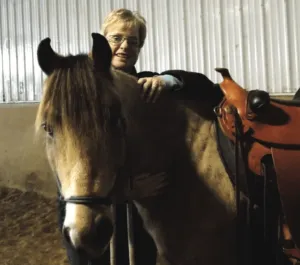 Kate Charboneau and Skipper with their Natural Performer Western Saddle
Enhancing Saddle Fit for Short-Backed Horses with Shims
For horses with short backs, saddle pads with shim pockets can be invaluable tools for fine-tuning saddle fit. Shims should ideally be contained within a saddle pad’s shim pocket, which should lack vertical seams that can cause shims to shift. If a pad with a pocket isn’t available, shims can be experimented with by tucking them underneath the saddle.
When positioning shims, consider the following:
- Shoulder Relief: Utilize at least one set of tapered foam shims placed with their “lifting power” at the point of the horse’s scapula maximum backswing. This critical placement prevents pressure on the horse’s working shoulders, promoting optimal biomechanics throughout the body. For horses with hollow backs or other topline deterioration issues, specialized shimming strategies might be necessary, often detailed in resources like contour-saddlery.com.
- Balance Adjustment: If the saddle’s balance point is not ideal for the rider’s position, an additional shim can be used to lift either the front or rear of the saddle, correcting any tilt. Helpful diagrams or a professional saddle fit evaluation can assist in determining the correct shim placement.
The Horse’s Approval is Key
Ultimately, the quality of any saddle setup is best judged by the horse’s response. A saddle that allows for freedom of movement, even weight distribution, and overall comfort will enable the horse to perform at its best and maintain its long-term health. For personalized assistance with short-backed horses and saddle fit, seeking expert advice and completing a Free Saddle Fit Evaluation form online is highly recommended.
