
Have you ever felt a sudden chill on a quiet country road at dusk? Or heard a faint, rhythmic hoofbeat in the dead of night with no horse in sight? For centuries, horses have been our loyal companions, symbols of strength and freedom. But in the shadows of folklore and legend, a different kind of equine exists—one that haunts the misty moors and terrorizes misty lanes. These are not your gentle pasture pals; these are the subjects of the most terrifying Scary Horse Stories ever told.
The connection between horses and the supernatural is as old as storytelling itself. They are powerful creatures, capable of immense speed and strength, making them perfect vessels for our deepest fears. Whether they are phantom steeds carrying headless riders or demonic water spirits luring unsuspecting travelers to their doom, these tales tap into a primal fear of the familiar turned monstrous. While many tales paint a gentle picture, like the ones you might find in collections of disney 5 minute horse stories, the world of folklore also whispers much darker legends. Get ready to saddle up for a journey into the dark side of equestrian lore.
Phantom Riders and Their Ghostly Steeds
Perhaps the most iconic image in the realm of scary horse stories is that of the ghostly rider. These spectral figures are often tied to a tragic past, forever bound to their powerful, phantom mounts. Their tales are whispered in taverns and around campfires, serving as a chilling warning to those who dare to travel alone after dark.
The Headless Horseman’s Demonic Mount
You can’t discuss ghostly equines without mentioning the most famous one of all: the steed of the Headless Horseman. Made legendary by Washington Irving’s “The Legend of Sleepy Hollow,” this terrifying apparition is the ghost of a Hessian trooper decapitated by a cannonball during the American Revolutionary War. He endlessly searches for his lost head, mounted on a powerful black horse described as being as headless as its rider.
According to the legend, the horse is a demonic creature from the underworld, its gallop sounding like thunder and its phantom form capable of breathing fire. This isn’t just a ghost; it’s a force of pure terror, a key element that makes the Horseman’s chase so frightening. The story of Ichabod Crane’s frantic race against this ghastly duo has become the gold standard for American folklore.
The horse is not merely a vehicle for the rider; it’s a co-conspirator in the horror. It shares the Horseman’s relentless nature, an unstoppable phantom that represents death itself galloping through the night. It is the raw, untamable power of the horse that makes the legend so enduring.
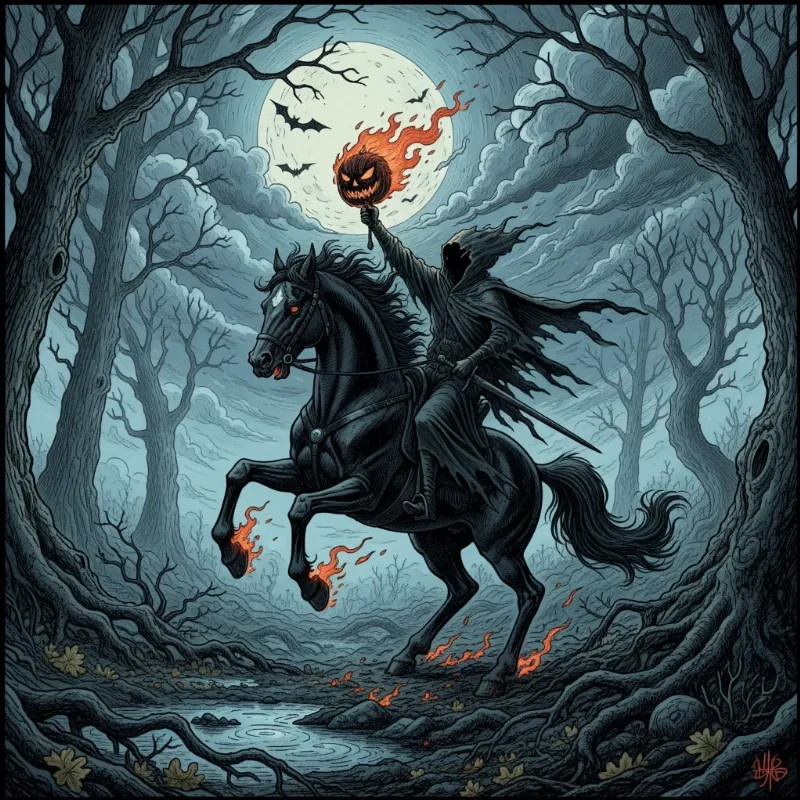 An illustration of the legendary Headless Horseman riding a powerful black steed, one of the most famous scary horse stories.
The Wild Hunt
Across Northern Europe, tales are told of the Wild Hunt, a ghostly procession of hunters and hounds tearing across the sky. Leading this terrifying chase is a spectral figure like Odin or Gwyn ap Nudd, and they are always mounted on ghostly horses. To witness the Wild Hunt is considered a terrible omen, often foretelling war, plague, or the death of the witness.
The horses of the Wild Hunt are described as skeletal or having glowing red eyes. Their hooves never touch the ground as they gallop through the clouds on stormy nights. The sound of their approach—a cacophony of horns, baying hounds, and thundering hooves—is enough to chill the blood of anyone unfortunate enough to be outdoors.
When Horses Are the Monsters: Mythical Beasts
In some legends, the horse isn’t just the ride for a ghost; it is the monster. These creatures often use a beautiful equine form to hide a much more sinister nature, preying on the human instinct to trust these magnificent animals. These mythical beasts are some of the most chilling subjects of scary horse stories.
The Kelpie: Scotland’s Vicious Water Horse
Along the misty lochs and rivers of Scotland lurks a truly terrifying creature: the Kelpie. This supernatural shape-shifter most often appears as a stunningly beautiful horse, typically white or black, standing peacefully by the water’s edge. Its coat is sleek, and its mane might be dripping with water, seeming lost and tame.
But this is a deadly trap. Anyone who tries to mount the Kelpie finds themselves stuck fast to its magical, adhesive hide. Once its victim is captured, the Kelpie reveals its true nature. It gallops into the deepest part of the loch, dragging its screaming rider down to a watery grave. The creature then devours the human, leaving only the heart or liver to float to the surface. According to Dr. Alistair Reid, a folklorist, “The Kelpie represents the deceptive beauty and hidden dangers of nature. It’s a powerful cautionary tale about trusting something that seems too good to be true.”
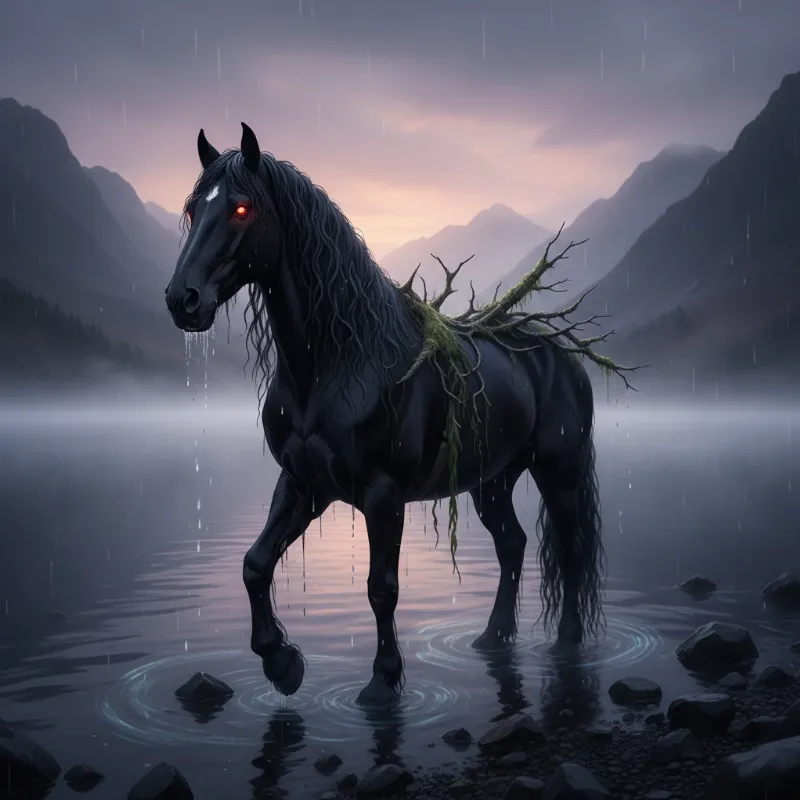 A depiction of a Scottish Kelpie, a mythical water horse from scary horse stories, looking deceptively calm by a loch.
The Each-Uisge: More Dangerous Than the Kelpie
If you think the Kelpie is horrifying, its saltwater cousin, the Each-Uisge (pronounced ech-oosh-kya), is even worse. Inhabiting the seas and sea-lochs of Scotland and Ireland, the Each-Uisge is considered the most dangerous water horse in the British Isles. Like the Kelpie, it appears as a handsome horse to lure victims. However, while the Kelpie only drowns and eats its prey, the Each-Uisge has a more gruesome method.
After dragging its victims into the water, it tears them apart and devours them entirely, except for the liver, which it leaves to float away. Its skin is also sticky, but a person’s flesh will even stick to it if they just touch it. The only way to handle an Each-Uisge is near freshwater, as it is weaker there. These tales served as stark warnings to people to be wary of lone animals near the coast.
What are the main types of scary horse stories?
These tales generally fall into a few categories:
- Phantom Steeds: Ghostly horses, often with spectral riders, tied to a specific location or legend.
- Mythical Monsters: Shape-shifting creatures like the Kelpie or Each-Uisge that use a horse’s form to deceive and harm humans.
- Omens of Doom: Horses that appear as harbingers of death or disaster, such as those in the Wild Hunt.
- Haunted Locations: Stories centered around specific stables, roads, or battlefields where ghostly hoofbeats are still heard.
Real-Life Chills: Unexplained Equestrian Encounters
While folklore and myths are filled with terrifying horses, some of the most unsettling tales are those that claim to be real. Countless stories exist about haunted stables, ghostly apparitions on old battlefields, and eerie hoofbeats heard on empty roads. For example, the battlefields of Gettysburg are said to be haunted by the sounds of spectral cavalry charges at night.
Riders have also reported their own horses acting strangely in certain areas, refusing to pass a specific spot on a trail, their ears pricked and eyes wide with a fear of something unseen. Are they simply sensing a natural predator, or are they reacting to something beyond our perception? These small, unexplained moments can often be more frightening than any ancient legend because they feel immediate and real. They remind us that our trusted companions might see a world—or a spirit world—that we cannot.
Ultimately, whether they are ancient myths or modern-day ghost stories, these scary horse stories continue to captivate us. They transform a symbol of beauty and nobility into a creature of the night, reminding us that even the most familiar things can hold a dark and terrifying secret.
Frequently Asked Questions (FAQ)
1. What is the most famous scary horse story?
The Legend of Sleepy Hollow, featuring the Headless Horseman and his demonic steed, is arguably the most famous scary horse story in Western culture, defining the phantom rider trope.
2. What is a Kelpie?
A Kelpie is a mythological water spirit from Scottish folklore. It typically appears as a beautiful horse to lure people onto its back, then its skin becomes adhesive, and it drags them into a river or loch to drown and eat them.
3. Are there ghost stories about real horses?
Yes, many ghost stories are centered on specific, real horses. For example, some say the ghost of Napoleon’s famous white stallion, Marengo, can still be seen, or that phantom horses from famous battles haunt the old fields.
4. Why are horses so common in ghost stories?
Horses have been close to humans in life, work, and war for millennia. Their power, speed, and intelligence, combined with their strong presence in historical events (like battles), make them potent symbols in stories about ghosts, death, and the supernatural.
5. What is the Wild Hunt?
The Wild Hunt is a European folk myth about a ghostly group of hunters and hounds on horseback who ride across the night sky. Witnessing it is considered an omen of terrible events like war or plague.
