
The Ruby-throated hummingbird (Archilochus colubris) is a common sight for many in the eastern United States and parts of Canada during the warmer months. These tiny, energetic birds, measuring only 3 to 4 inches long and weighing between 2 to 6 grams, undertake a remarkable migration from Central America and Mexico each spring to breed. For observers in Maine, they typically arrive around May. Understanding their unique characteristics and habitat needs is crucial for appreciating and supporting these fascinating creatures. This guide delves into their appearance, feeding habits, life cycle, and the importance of conservation efforts.
Appearance and Identification
Distinguishing the Ruby-throated hummingbird is relatively straightforward due to its small size and distinctive flight patterns. Both males and females share a metallic green head and back, a white breast, and a long, needle-like bill. The male, however, possesses a striking iridescent red throat patch that can appear black depending on the angle of the light. Females lack this vibrant throat coloration, and their outer tail feathers are tipped with white. Juvenile hummingbirds closely resemble the adult female.
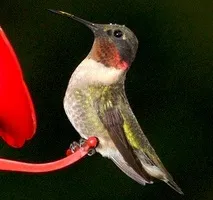 Ruby-throated hummingbird at feeder
Feeding Habits and Metabolism
The Ruby-throated hummingbird operates with an incredibly rapid metabolic rate, necessitating frequent feeding. Their hearts can beat over 600 times per minute, and their wings achieve impressive speeds of up to 70 beats per second during normal flight, even faster during courtship displays, producing their signature buzzing sound. This exceptional flight agility allows them to hover precisely while feeding on nectar and to catch small insects mid-air. To sustain their high energy demands, they feed approximately 5 to 6 times every hour. Their preferred food source is nectar from tubular flowers, particularly those that are red or orange. When nectar is scarce, they may supplement their diet with tree sap.
Life Cycle and Territorial Behavior
Ruby-throated hummingbirds are solitary creatures, embarking on their migrations alone. Males generally arrive in their breeding grounds before the females. These birds are highly territorial, with males vigorously defending prime nectar sources against any perceived intruders, including insects and other hummingbirds. This can lead to captivating aerial displays as they vie for dominance over feeding areas.
Females are responsible for building nests and raising their young independently. They construct their nests on tree branches or within shrubs, using a combination of materials bound together with spider silk. Typically, two to three eggs are laid, and after about two weeks of incubation, they hatch. The young remain in the nest for an additional three weeks before fledging. A female may raise up to two broods in a single breeding season. As autumn approaches, hummingbirds increase their feeding significantly to build up fat reserves essential for their long journey back to Mexico or Central America. They continue to feed frequently along their migratory route. While the average lifespan of a Ruby-throated hummingbird is around 5 years, some individuals have been documented to live as long as 12 years.
Habitat and Conservation
The phenomenon of hummingbirds migrating north each spring and south in the fall is a key indicator of seasonal changes. The “Signs of the Seasons” program encourages observers to contribute phenological data, which helps monitor potential shifts in the annual life cycle events of hummingbirds. These observations are vital for understanding how changing climates might affect their migration patterns and breeding success. Providing appropriate habitat, including feeders with nectar solutions and native flowering plants, can support these small but resilient birds.
Sources and Additional Information:
USA Phenology Network – Observing Plants and Animals, http://www.usanpn.org/Archilochus_colubris
UMaine Cooperative Extension Bulletin # 7152, Understanding Ruby-Throated Hummingbirds and Enhancing Their Habitat in Maine
USDA Natural Resources Conservation Service and Wildlife Habitat Council, Fish and Wildlife Habitat Management Leaflet Number 14, December 1999, http://plants.usda.gov/pollinators/Ruby-throated_hummingbird.pdf
US Forest Service, Celebrating Wildflowers: Ruby-Throated Hummingbird, http://www.fs.fed.us/wildflowers/pollinators/pollinator-of-the-month/ruby-throated_hummingbird.shtml
US Fish and Wildlife Service National Digital Library, http://digitalmedia.fws.gov/index.php
