
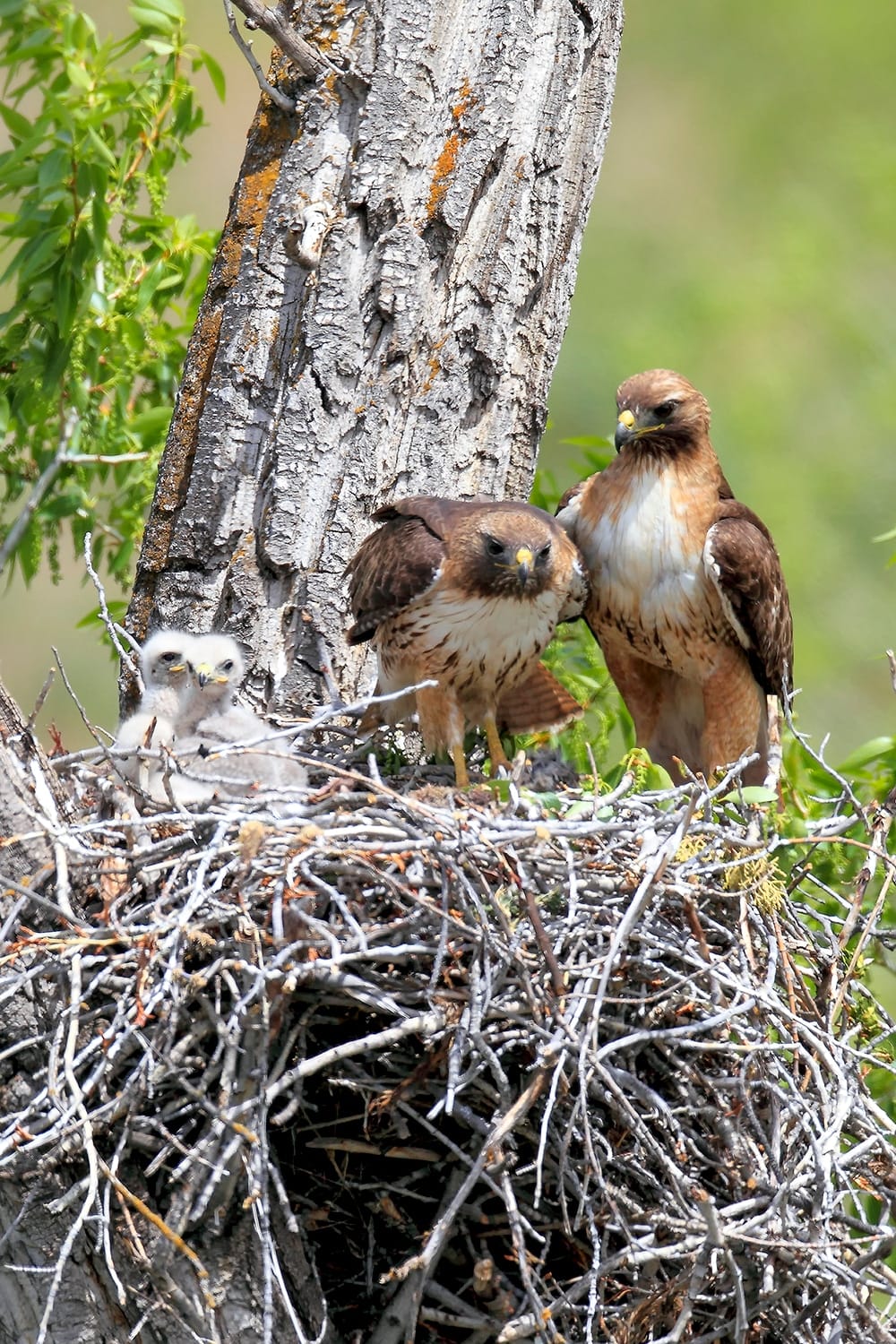
The Red-tailed Hawk (Buteo jamaicensis), a ubiquitous bird of prey across North America, showcases remarkable adaptability, thriving in diverse habitats from the boreal forests of Alaska to the tropical regions of Venezuela and the Caribbean. While its broad distribution and common observation make it a familiar sight, the taxonomic status of certain populations remains a subject of ongoing study. This species exhibits significant variation across its range, with up to 16 subspecies identified, often differentiated by ventral coloration, tail markings, or size, though clear geographical patterns are not always evident. The existence of polychromatic (polymorphic) populations, displaying a spectrum of ventral coloration from nearly white to black, further complicates straightforward subspecies distinctions and highlights extensive intergradation. Red-tails undertake diurnal migrations, with the distance and annual extent influenced by weather patterns, particularly snow cover. Typically, migratory movements are less than 1500 km, and water crossings are seldom more than 25 km. While most individuals from the northernmost populations migrate southward, those in the southern U.S. and northern Mexico tend to be year-round residents.
These hawks are generally monogamous, initiating courtship and sustaining pair bonds through intricate aerial displays performed by both partners. Territories are actively defended, especially during the breeding season, and can be maintained year-round by sedentary birds or in areas with high overwintering densities. Territory size is variable, influenced by habitat and food availability, but commonly ranges from approximately 1.25 km² to over 2.5 km², with the closest reported inter-nest distance being 0.32 km. In interior North America, the breeding season commences with the first eggs laid in mid-to-late March, though egg-laying has been recorded as early as December in tropical regions. A typical clutch consists of 2-3 eggs, with incubation lasting around 28 days. Fledglings emerge from the nest approximately 42-46 days after hatching and may remain associated with their parents for up to six months thereafter.
The preferred habitat of the Red-tailed Hawk is characterized by open areas interspersed with tree stands or similar structural features. However, the species also demonstrates a capacity to nest at high densities within closed-canopy rain and cloud forests in tropical environments. Primarily a sit-and-wait predator, the Red-tail typically utilizes elevated perches for hunting. In dense tropical forests, it adapts by diving on prey from above the canopy or by capturing bats and other airborne prey directly from the air. On occasion, Red-tailed Hawks have been observed to hunt insects and other small prey on foot. Their diet is varied, encompassing a wide array of small to medium-sized mammals, birds, reptiles, amphibians, arthropods, and carrion.
As a common species, the global population of Red-tailed Hawks, estimated at 2,000,000 or more, is considered stable or slightly increasing, despite a potential minor decline in the mixed-woodland plains of eastern Canada. Throughout the mid-to-late 20th century, populations in much of North America experienced growth, seemingly linked to the proliferation of open, wooded parkland resulting from the conversion of grasslands or dense forests. This species exhibits a notable tolerance for exurban and agricultural development, provided that adequate food sources, open hunting spaces, and suitable nesting structures like tall trees are available. Some individuals have even successfully adapted to breeding in large urban settings.
Much of the existing knowledge regarding the life history and ecology of the Red-tailed Hawk stems from studies focused on breeding populations in interior North America and wintering populations. However, significant contributions from Puerto Rico have broadened our understanding of how this adaptable species thrives in varied habitats. Research into its life history and ecology in tropical regions outside of Puerto Rico remains less documented. The Red-tailed Hawk serves as an exemplary model of a highly adaptable, generalist predator, and ongoing research across its extensive range promises to yield crucial insights into the factors that enable certain species to exploit diverse environments and persist amidst rapid ecological changes.
