
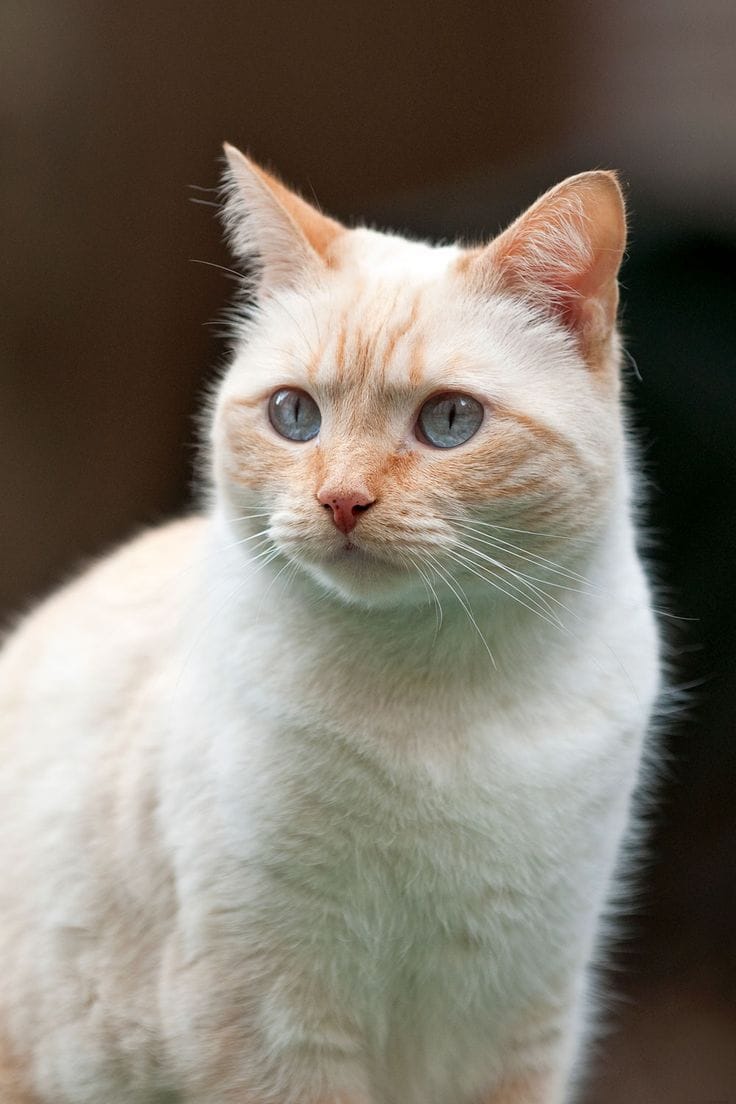
The Siamese cat, often affectionately nicknamed the “meezer,” has captivated hearts for centuries with its sleek physique, striking blue eyes, and famously talkative and affectionate personality. While the classic seal point is widely recognized, a rarer and equally exquisite variation exists: the red point Siamese, also known as the flame point Siamese. These distinctive cats boast beautiful points in warm, reddish-orange hues against a creamy white body, making them truly stand out. Their high intelligence, playful nature, and deep loyalty mirror their traditional Siamese counterparts, creating an irresistible companion for many. This article delves into seven fascinating facts about the enchanting red point Siamese, exploring their origins, breed recognition, unique characteristics, and surprising preferences.
The Genesis of the Red Point Siamese
The emergence of the red point Siamese traces back to the mid-20th century. In the 1930s and 1940s, dedicated breeders in the United Kingdom sought to introduce new color variations into the Siamese breed. Through careful crossbreeding with British Shorthair cats carrying the orange gene—specifically those with red tabby or tortoiseshell coats—they were able to develop the red point Siamese. This experimental process, involving numerous trials, eventually led to the creation of this vibrant new hybrid. It wasn’t until the 1960s that the UK’s Governing Council of the Cat Fancy (GCCF) officially acknowledged the red point Siamese as a distinct breed color. Since then, other color variations like cinnamon point, fawn point, and caramel point have also been developed within the Siamese lineage, further expanding the breed’s colorful spectrum.
A Question of True Siamese Recognition
Despite their Siamese lineage and characteristic traits, the official recognition of the red point Siamese can be a point of contention among different feline associations. The Cat Fanciers’ Association (CFA) in the United States, for instance, does not classify the red point Siamese as a true Siamese. Due to their cross-bred origins and the introduction of the orange gene, the CFA categorizes them, along with other newer colors like tortie point and cinnamon point, as Colorpoint Shorthairs. However, this classification is not universally adopted. In the United Kingdom, where the red point Siamese first appeared, the GCCF recognizes them as Siamese. Similarly, other registries, such as The International Cat Association (TICA), also acknowledge the red point Siamese, highlighting the ongoing discussion about breed standards and variations within this beloved feline family.
Belonging to a Special Color Group
Red point Siamese cats are part of a special group that includes similar variations such as apricot point, cream point, and tortie point. These cats share a common characteristic of creamy white bodies, with the primary difference lying in the specific shades and intensity of the orange-red points. Distinguishing between these shades can be challenging, but guidelines exist. According to GCCF standards, a true red point Siamese will display bright reddish-gold points on their ears, mask, and tail. Apricot points are characterized by a hot cream mask, ears, and tail with a softer, metallic sheen. Cream points exhibit a cooler cream color with a powdery appearance on the mask, ears, and tail. All these variations typically show a paler version of their point color on their legs and feet. The tortie point, the fourth color in this category, presents a more complex pattern. Like traditional tortoiseshell cats, tortie points carry both black and orange genes, resulting in a multicolored coat that can manifest in various combinations, including seal and red, blue and cream, or chocolate and red, among others. These cats are almost exclusively female due to the genetic linkage of coat color to the XX chromosomes.
Rarity and Investment: The Red Point Siamese
The red point color variation is notably rare within the Siamese breed, and producing these kittens can be a challenging endeavor for breeders. Compounding this rarity is the genetic predisposition for orange coloration to be more prevalent in male cats. It’s estimated that approximately 80 percent of all orange cats are male, making female red point Siamese even more uncommon, accounting for only about 25 percent of the population. This scarcity directly impacts their cost. Prospective owners in the United States should anticipate spending upwards of $2,000 for a red point Siamese kitten from a reputable breeder. Furthermore, it’s important to note that the distinct red points on younger kittens may not be fully developed or clearly visible until they reach sexual maturity.
A Long and Healthy Lifespan
One of the remarkable aspects of the Siamese breed, including the red point variety, is their impressive longevity. With proper care, nutrition, and a loving environment, Siamese cats can typically live for 15 to 20 years, and often even longer. This significantly surpasses the average lifespan of domestic cats, which is generally between 12 and 15 years. A well-cared-for red point Siamese has a strong likelihood of reaching 15 years, which is equivalent to approximately 76 human years. Cats that surpass their late teens and enter their early twenties are considered super seniors, a testament to their robust health and the quality of care they receive.
Potential for Mistaken Identity
The distinctive orange coloration of the red point Siamese can sometimes lead to them being mistaken for other breeds or colorations, particularly orange tabbies. The inherent striping that often accompanies orange coats can create a visual similarity, leading some observers to believe they are simply an unusually marked orange tabby cat. While the red point Siamese might exhibit some tabby-like markings, their overall conformation, the characteristic Siamese body type, and the striking blue eyes set them apart from typical orange tabbies. The unique blend of Siamese features with the warm reddish-orange points creates a distinct feline appearance that, while sometimes confused, is ultimately quite unique.
An Unusual Affinity for Water
In stark contrast to the common feline aversion to water, the Siamese breed, including the red point Siamese, is often noted for its unusual enjoyment of water. While this doesn’t mean they necessarily relish bath time, many Siamese cats display a strong curiosity and fascination with water. Their playful and inquisitive nature likely contributes to this trait. They are often observed watching water as it moves, listening to its flow, and even playing with drips from a faucet or ripples in a bowl. This intrigue with water can make them particularly drawn to interactive water features. For owners of a red point Siamese who exhibit this tendency, investing in a cat water fountain can be an excellent way to provide mental stimulation and encourage hydration while satisfying their unique aquatic interest.
