
Welcome to the world of dog ownership! If you’re reading this, you’ve likely discovered that while puppies are bundles of joy, they’re also little accident-making machines. You’re looking for a solution, and you’ve heard whispers about the magic of a Potty Training Dog Crate. Let’s be clear: when used correctly, a crate isn’t a cage. It’s a powerful tool, a safe haven for your dog, and your absolute best friend in the journey to a clean, accident-free home. This method taps into your dog’s natural instincts to create a positive and efficient training experience.
Using a crate is about more than just preventing puddles on your new rug; it’s about setting a foundation of routine and security for your pup. It provides them with a space of their own, a “den” where they can feel safe and relaxed. Understanding how to properly introduce and utilize a crate can transform your potty training process from a frustrating chore into a successful bonding experience. For a deeper dive into the initial steps, understanding how to crate train a dog for potty training is a great starting point.
Why a Crate is Your Secret Weapon
So, what makes a simple crate so effective? It all boils down to a dog’s natural instinct. Wild canines are den animals. They instinctively seek out small, enclosed spaces to rest and raise their young. A crucial part of this denning instinct is cleanliness; a dog will do everything in its power to avoid soiling its own resting space. A crate effectively becomes your dog’s personal den within your home.
When you use a potty training dog crate, you’re not punishing your dog; you’re communicating with them in a language they already understand.
- Accident Prevention: The crate prevents your puppy from wandering off and having an accident in a hidden corner when you can’t supervise them directly. This management is key to building good habits.
- Schedule Reinforcement: It helps you establish a predictable potty schedule. Since the dog will hold it while in the crate, you can anticipate when they need to go out, leading to more successful potty breaks.
- Safety and Security: Beyond potty training, the crate becomes a safe space for your dog during stressful times, like when you have guests over or during thunderstorms. It’s their personal retreat.
As renowned canine behaviorist Dr. Sarah Miller often states, “A crate is not a prison. It’s a bedroom. It’s a space where a dog can feel secure and understand the boundaries of its home. This sense of security is the bedrock of successful house training.”
Choosing the Perfect Potty Training Dog Crate
The effectiveness of this method hinges on selecting the right crate. A common mistake is buying a crate that’s too large, thinking the dog will “grow into it.” An oversized crate gives your puppy enough room to use one end as a bathroom and the other as a bedroom, completely defeating the purpose.
Size is Everything
The golden rule for sizing a dog potty training crate is simple: it should be just large enough for your dog to stand up, turn around, and lie down comfortably. Many wire crates come with a divider panel, which is an excellent feature. You can buy a crate that will fit your dog’s adult size and use the divider to adjust the internal space as they grow. This is both economical and practical.
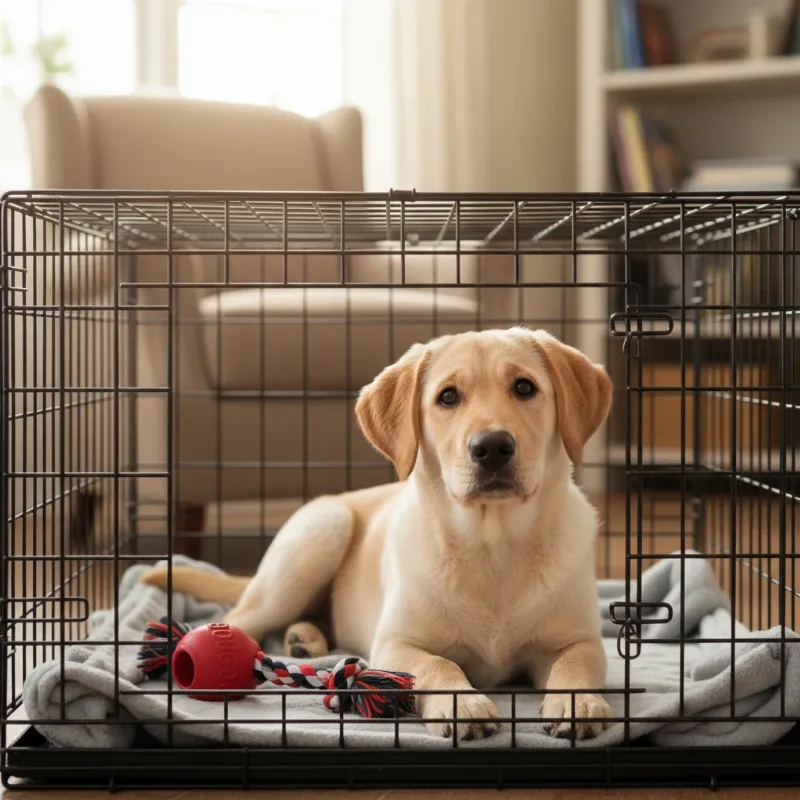 A happy Labrador puppy sitting comfortably inside a wire potty training dog crate with a divider, looking out with a calm expression.
Types of Crates
You’ll generally encounter three main types of crates, each with its pros and cons:
- Wire Crates: These are the most popular choice for potty training. They offer excellent ventilation, are easy to clean, and often fold down for travel. The inclusion of a divider panel is a major advantage.
- Plastic Crates: Also known as travel carriers, these crates offer a more enclosed, den-like feel, which some dogs prefer. They are durable and great for travel, but can be harder to clean thoroughly and offer less visibility.
- Soft-Sided Crates: Made of fabric, these are lightweight and highly portable. However, they are not recommended for potty training, especially for puppies who might chew or claw through the material. They are best for dogs who are already crate trained.
A Step-by-Step Guide to Crate Training
Introducing the crate should be a positive, gradual process. The goal is to make your dog love their “den.” Never force them inside or use the crate for punishment.
Step 1: Make the Crate a Palace
Start by placing the crate in a common area of the house, like the living room. Leave the door open. Make it inviting by putting a comfy blanket and some special, high-value toys inside. Randomly toss treats near the crate, then just inside the door, and eventually all the way to the back. Let your dog explore it at their own pace without any pressure.
Step 2: Feed Meals in the Crate
Begin feeding your dog their meals inside the crate. At first, place the bowl just inside the door. As they become more comfortable, move it further toward the back. This builds a powerful positive association between the crate and something they love—food!
Step 3: Introduce a Verbal Cue
Once your dog is entering the crate willingly, start using a verbal cue like “Crate” or “Go to your den.” When they go in, reward them with a special treat that they only get when they’re in the crate.
Step 4: Close the Door
After your dog is comfortable eating in the crate, you can try closing the door for a few seconds while they eat. Gradually increase the duration. Start with a few minutes and slowly work your way up. Always stay in the room initially.
Step 5: Establish a Strict Potty Schedule
This is where the training really comes together. A puppy can typically hold its bladder for one hour for every month of its age, plus one (e.g., a 3-month-old can hold it for about 4 hours).
A typical schedule looks like this:
- First thing in the morning: Immediately take the puppy from the crate outside to their potty spot.
- After every meal: Puppies usually need to go within 15-30 minutes of eating.
- After every nap: Waking up often stimulates the need to potty.
- During playtime: Take them out every 30-45 minutes during active play.
- Last thing before bed: A final potty trip is essential.
When you can’t actively supervise your puppy, it’s crate time. This prevents them from having accidents. This structured approach is also crucial if you’re dealing with an older dog that needs a refresher, a process often called re potty training dog.
Common Mistakes to Avoid
Crate training is highly effective, but a few common mistakes can derail your progress.
- Using the Crate as Punishment: This is the cardinal sin of crate training. The crate must always be a positive, safe space. Sending your dog there when they’ve been bad will create fear and anxiety, leading to resistance.
- Leaving Your Dog in Too Long: A crate is a short-term management tool, not a long-term confinement solution. Leaving a puppy in a crate for longer than they can physically hold their bladder is unfair and will force them to have an accident in their den, which can be detrimental to the training process.
- Making a Fuss During Departures and Arrivals: When you leave or come home, act calm and neutral. Over-the-top goodbyes or greetings can create anxiety around you leaving and the dog being in the crate.
Frequently Asked Questions (FAQ)
What if my dog whines in the crate?
First, ensure all their needs have been met (they’ve had a potty break, have water, and have had exercise). If they are still whining, try to ignore it. If you let them out every time they whine, you teach them that whining gets them what they want. You can also give them a special puzzle toy to keep them occupied.
What should I do if my dog has an accident in the crate?
If this happens, it’s usually a sign of one of two things: the crate is too big, or you left them in for too long. Re-evaluate the crate size and your schedule. Clean the crate thoroughly with an enzymatic cleaner designed to eliminate pet odors, otherwise, the lingering smell will encourage them to go in the same spot again.
How long does it take to potty train using a crate?
Every dog is different. Consistency is key. For most puppies, it can take anywhere from a few weeks to a few months to be fully reliable. Be patient and celebrate the small victories.
Should I put potty pads in the potty training dog crate?
No. This sends a mixed message. It teaches the dog that it’s sometimes okay to soil their den, which contradicts the entire principle of crate training. The goal is to teach them to hold it until they are outside.
When can I stop using the crate?
Once your dog has been accident-free in the house for at least a month and has demonstrated they understand the potty rules, you can start giving them more freedom. Do it gradually. Start by leaving them out of the crate for short periods when you’re away and slowly increase the time. Many dogs continue to love their crate as their personal space long after training is complete.
Your Partner in Raising a Great Dog
Using a potty training dog crate is one of the kindest and most effective ways to house-train your new companion. It fosters a sense of security, establishes a predictable routine, and protects your home from inevitable accidents. By understanding your dog’s natural instincts and following a consistent, positive approach, you can build a foundation for a lifetime of good behavior. Remember that patience and consistency are your most valuable assets on this journey. You’re not just training a dog; you’re building an unbreakable bond.
